Market Notes
43% of Builders Cut Prices. Buyers Still Can't Buy, 2026

The Take
Builder confidence hit 29 in October 2026, the lowest reading since June 2012, and 43% of builders cut prices trying to fix it. That's the biggest share of price cutting in the whole 2020 to 2026 stretch, and buyer traffic still fell. The discount isn't the problem; the mortgage rate attached to it is. At 7.40% on a 30-year loan, a buyer needs around $99,000 of income to carry the payment on a median-priced home, and the median household makes $87,460. Builders can keep cutting into that gap and most buyers still won't clear it.
What the Data Shows
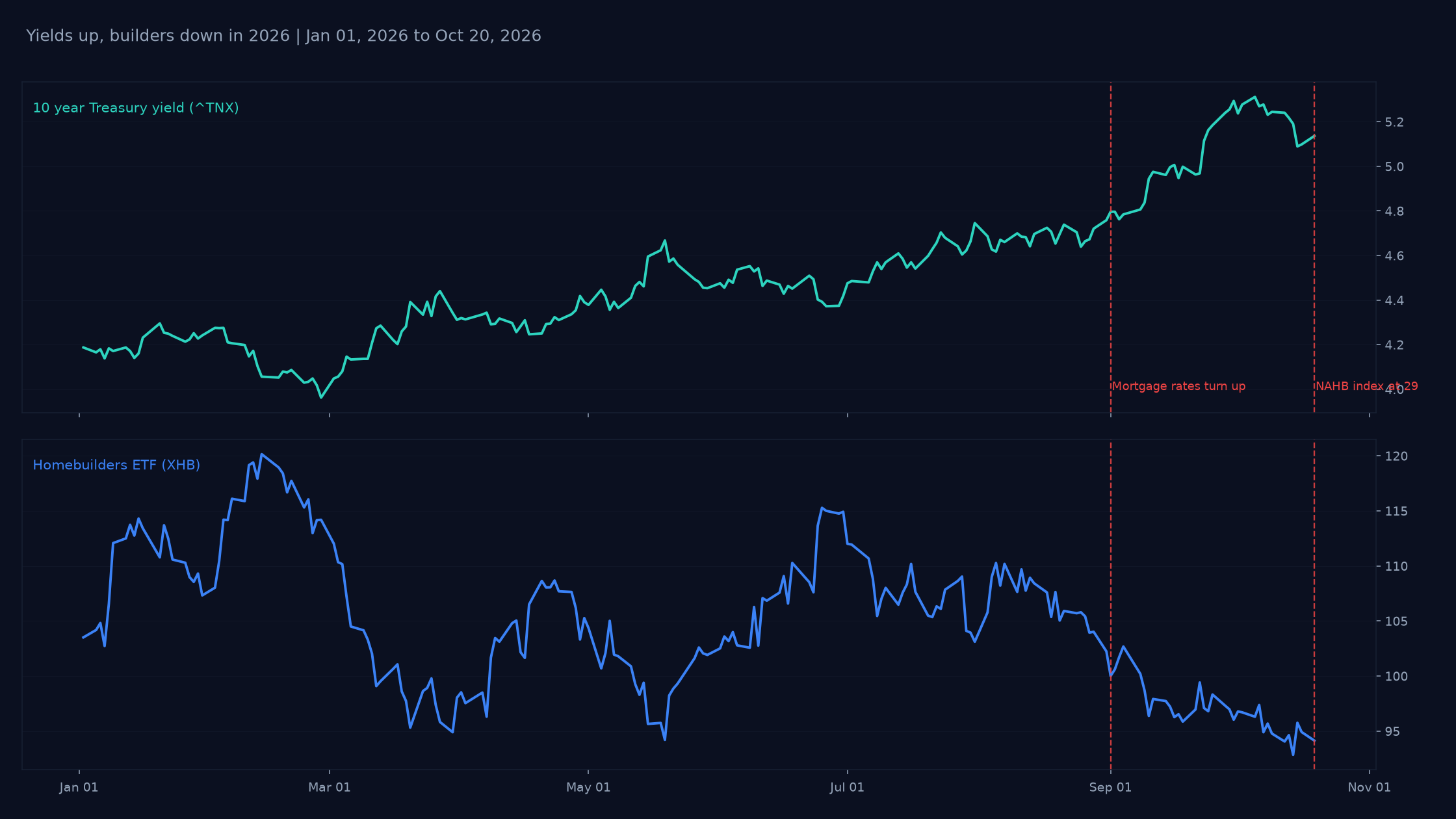
The NAHB/Wells Fargo Housing Market Index fell 3 points to 29 in the October 19, 2026 release. Anything under 50 means more builders call conditions poor than good, so 29 isn't a soft patch, it's the worst print in 14 years. The internals are worse than the headline. Prospective buyer traffic dropped 5 points to 18, current sales conditions fell 2 points to 33, and sales expectations for the next 6 months fell 5 points to 32.
Builders are already doing everything they can on price. NAHB says 43% of them cut prices in October 2026, the highest share in the 2020 to 2026 period, with the average cut holding at 6% for the 7th month in a row. 65% used sales incentives, the 19th straight month at 60% or higher. So this isn't one month of panic discounting; builders have been buying down the payment for a year and a half and traffic kept falling anyway.
The prices themselves already moved. Census and HUD put the median new home at $393,700 in August 2026, down from $414,300 in May 2026, while NAR put the median existing home at $417,500 in September 2026. New homes normally sell at a premium to resale, so builders are now undercutting the used market by $23,800 and still sitting on 483,000 homes for sale.
Run the payment and you can see why that's not enough. Freddie Mac had the 30-year fixed at 7.40% for the week of October 15, 2026. On the $417,500 resale median with 20% down, that's $83,500 in cash up front and about $2,313 a month in principal and interest, which the old 28% rule turns into roughly $99,000 of required income before you add property taxes and insurance. Census put median household income at $87,460 for 2025. A 6% price cut moves that required income by about $6,000, so the gap is still there.
Why It Matters for Your Portfolio
Housing is where the rate story stops being theory. Builders are the most rate-sensitive, most leveraged end of the real economy, and they're the ones eating a 6% average price cut plus incentives just to move units. If you hold anything tied to construction, building products, mortgage origination, or regional bank loan books, the squeeze shows up in margins first and volumes second. None of this resolves while the 10-year Treasury sits at 5.09%, because the long end is what sets the mortgage rate. I'm watching it, not calling a bottom in builders.
What I'm Watching
Census and HUD release September new residential sales on October 27, 2026. I want to see whether the median new home price breaks below $390,000 and whether inventory moves off the 483,000 it's been stuck at since July 2026. The November NAHB print lands mid month, and if the price-cutting share goes above 43% while traffic stays at 18 or lower, builders are buying volume with margin and the next thing to give is starts. The cleanest tell is the weekly Freddie Mac rate. If the 30-year gets back under 7%, I'd expect buyer traffic to turn before sentiment does, and I could be wrong on how fast that feeds through.
Related Reading: The 30-Year Hit 5.31% and Treasury Stepped In, August 2026 and Japan Pays 4% at Home Now. US Yields Won't Fall in 2026
Howard is a full-time trader based in New Jersey with 13 years of experience across Forex, crypto, equities, and futures. He started Position Note to document his trades and analysis in public. All positions are disclosed. Nothing here is personalized investment advice.