Market Notes
The Fed's $233 Billion Hole Is Shrinking, Not Growing, 2026

The story going around is that the Fed just posted a record loss. That's not what the numbers say. The Fed's cumulative shortfall, the line it calls a deferred asset, was 232.8 billion dollars on September 16, 2026, and it's been getting smaller all year instead of bigger. What the September 16 rate hike actually did was slow that paydown, because the Fed pays interest on 3 trillion dollars of bank reserves and just agreed to pay 25 basis points more on every one of them.
What the Data Shows
The deferred asset peaked at 245.9 billion dollars on January 28, 2026 and has come down every month since, to 232.8 billion on September 16, per the Fed's weekly balance sheet data on FRED. That's 13 billion dollars of the hole filled in 8 months. A year ago the same line read 241.7 billion on September 17, 2025, so the Fed is about 9 billion dollars better off than it was then. Nobody covering this as a record loss is looking at the direction.
Now the hike cuts the other way. The Fed raised the interest it pays on reserve balances from 3.65 percent to 3.90 percent effective September 17, 2026, and banks held 3.014 trillion dollars of reserves as of September 16. A quarter point on 3.014 trillion is roughly 7.5 billion dollars a year in extra interest expense, which is more than half of what the Fed has clawed back since January. The asset side does catch up as old bonds mature and get replaced with higher coupons, but that takes years and the bigger reserve bill is already running.
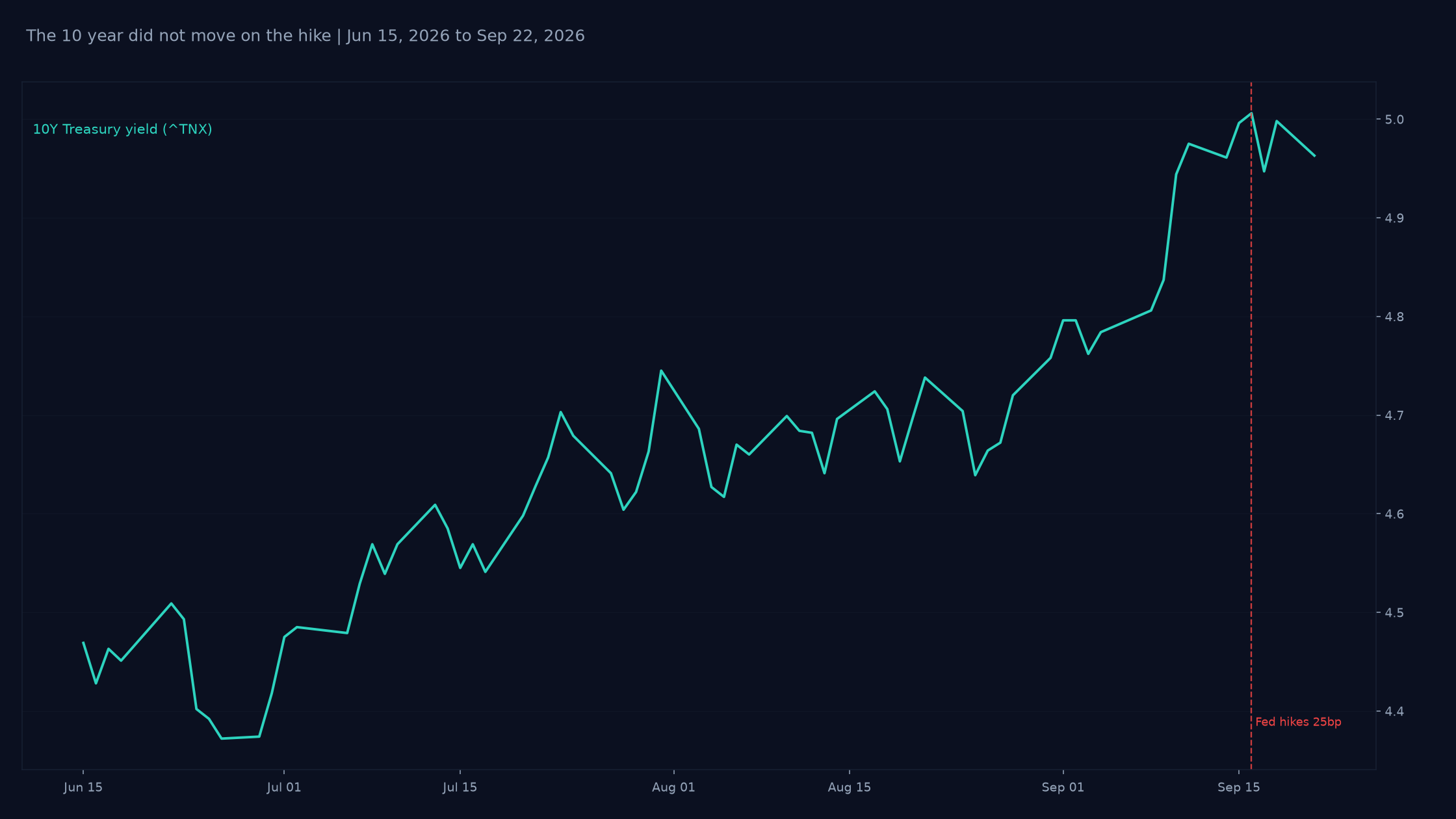
None of this moved the long end. The 10 year Treasury yield closed at 5.01 percent on hike day and 4.96 percent on September 21, and FRED's 10 year constant maturity read 5.01 percent on September 18. In the same September 16 projections the Fed took its longer run rate median up to 3.2 percent from 3.1 percent in June, the highest that number has been since March 2016. A rate hike, a unanimous 12 to 0 vote, a higher terminal dot, and the 10 year went nowhere.
Why It Matters for Your Portfolio
The part that touches your portfolio is the Treasury side, not the Fed's accounting. The Fed remitted 107.4 billion dollars to the Treasury in 2021 and has remitted nothing since the week of September 7, 2022, and it keeps remitting nothing until that 232.8 billion is paid off in full. Federal debt was 39.1 trillion dollars at the end of the first quarter of 2026, and the money the Fed used to hand over for free now has to be raised by selling more paper instead. That's a supply story, not a Fed-is-broke story, and supply is why the 10 year sits near 5 percent no matter what the front end does.
What I'm Watching
The deferred asset prints every Thursday in the Fed's H.4.1 release, and I want to see whether it stops falling in October and November now that the reserve bill went up. If it flattens out around 233 billion, the paydown is over and the carry is negative again.
The other thing is the December 9 meeting, because the September dots carry one more hike in 2026 and each additional 25 basis points costs the Fed another 7.5 billion a year at current reserve levels. If we get that second hike and the 10 year is still above 4.9 percent, the long end is pricing supply and inflation rather than policy. I'd keep expecting long term yields to stay high.
Related Reading: The Fed's First Warsh Meeting Is a Liquidity Test and The Market Is Not Buying the Fed Pivot Yet. Here's Why
Howard is a full-time trader based in New Jersey with 13 years of experience across Forex, crypto, equities, and futures. He started Position Note to document his trades and analysis in public. All positions are disclosed. Nothing here is personalized investment advice.