Market Notes
Gold's Long Game Is Getting Louder. I'm Still Watching

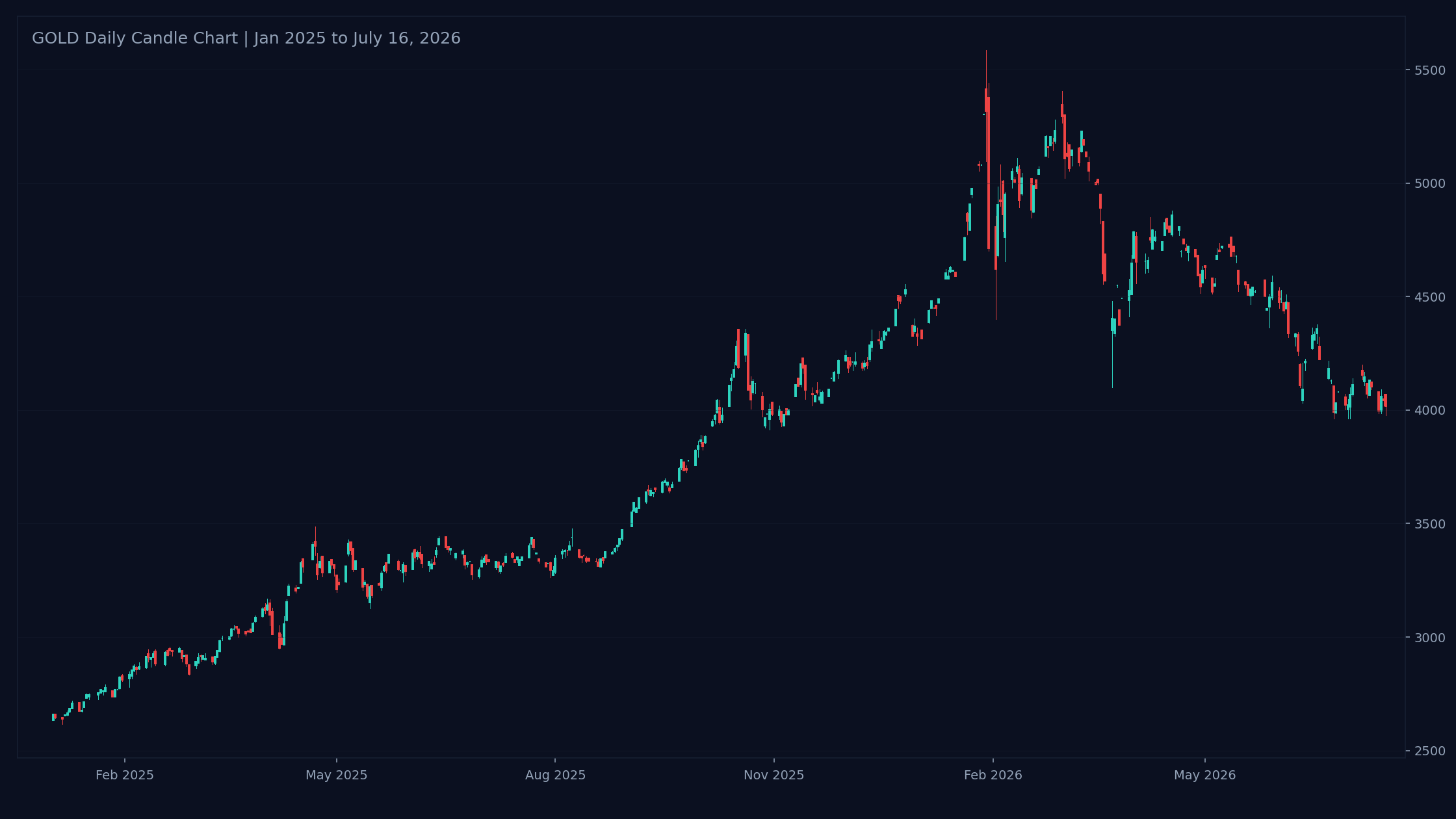
Gold is the closest thing I can point to right now to a generational hold, and I still don't own a single ounce. The structural case is getting louder every month: central banks and China are accumulating gold as fast as they can, and they're doing it while the price falls. That's a statement about direction, though, not about timing. Gold is down nearly 30% from its January high of $5,589 and trades around $4,000 today, and I'm not in the business of chasing a 28% drawdown on a thesis that plays out over a decade. So I'm watching, not buying, and the gap between those two words is the whole point of this note.
What the Data Shows
The tell isn't the price, it's who's buying into the weakness. The People's Bank of China added 14.93 tonnes of gold in June, its biggest single-month purchase since 2023 and the 20th month in a row it has bought. That streak started back in November 2024 and is the longest since at least 2015, and most of it happened during gold's worst quarterly decline in more than a decade. A buyer who keeps loading up while the price craters is not trying to trade it, they're trying to own it.
Chinese households are doing the same thing. As of early July, the largest exchange-traded fund in all of China is the Huaan Yifu Gold ETF at roughly $13 billion, which just passed the CSI 300 stock-index ETF at around $12 billion. That's the first time a gold fund has ever topped the country's ETF rankings, and China's gold ETFs pulled in a record $8.5 billion in the first quarter alone, per the World Gold Council. In the second-largest economy on earth, the biggest single pool of retail money now sits in gold rather than stocks.
This isn't only a China story. Central banks worldwide bought more than 1,000 tonnes of gold in each of 2022, 2023, and 2024, and added another 863 tonnes in 2025. Set that against the 2010 to 2021 average of roughly 470 tonnes a year and the shift is obvious: the official sector is buying at nearly double its old pace and shows no sign of stopping.
Why It Matters for Your Portfolio
For a trader, the useful distinction here is between a trade and a strategic hold. None of the buying above tells you where gold trades next month, and anyone who says the China story means "buy today" is selling you the direction as if it were the timing. Those are two different bets, and conflating them is how people end up underwater on an asset they were right about.
The reason gold matters for a long-term sleeve is what sits underneath all this accumulation, and it's the part most people never think about: the slow, quiet drift toward gold as a neutral asset to settle global trade. That's a multi-year process, not a catalyst, which is exactly why I treat gold as a position to build patiently rather than a level to lunge at. The Deep Note below walks through why so many serious people keep circling back to the same idea.
What I'm Watching
I want to see a real base before I do anything, meaning gold stops making lower lows and holds a level for long enough to trust it. A new all-time high doesn't pull me in, a durable floor does. I'm also watching whether the central-bank pace holds through the back half of the year in the next World Gold Council data, because a genuine slowdown there would weaken the structural case that makes this worth owning at all. Until the chart gives me a floor and the official-sector buying keeps up, I stay exactly where I am: convinced on the direction, and in no rush on the price.
The Deep Note: Why the World Keeps Circling Back to Gold
A note before you read: what follows is the long-arc argument behind the buying, plus a widely shared bit of math. I'm laying it out because it's the "why" that makes gold a hold rather than a headline. The price figures at the end are thought experiments, not forecasts, and I'll flag them clearly.
The same idea, proposed over and over for 80 years
The notion that the world needs a neutral reserve asset, something no single country controls, is not new and not fringe. It keeps getting proposed by the people running the system, and it keeps getting shelved by whoever benefits from the status quo at the time.
John Maynard Keynes brought it to the 1944 Bretton Woods negotiations as the "Bancor," an international unit backed by a basket of about 30 commodities, designed so that no country could run permanent surpluses or deficits without the system correcting it. The United States, running the giant surplus of that era, had no interest in a mechanism that punished surpluses, and the idea died in favor of the dollar system we still live under.
It resurfaced in March 2009, when People's Bank of China governor Zhou Xiaochuan published "Reform the International Monetary System." He argued for "an international reserve currency that is disconnected from individual nations," revived Keynes's Bancor by name, and made the case that the world's savings should not be parked in any one country's currency. A year later, in a 2010 Financial Times piece, World Bank president Robert Zoellick suggested the system should "consider employing gold as an international reference point." In 2016, former IMF chief economist Kenneth Rogoff told emerging markets to raise gold toward 10% of their reserves, noting China then held barely 2%.
The system's own architects are now saying it
Here's the part that turns a fringe argument into something worth positioning around. The people making it are no longer outsiders.
At Davos in January 2026, US Trade Representative Jamieson Greer invoked Keynes and Bretton Woods directly, arguing the economics profession needs to "take a cue from Keynes" and reckon with trade imbalances the old system was built to ignore. Then in June, Treasury Secretary Scott Bessent published a Wall Street Journal op-ed, "Hamilton Inspires Trump's Economic Statecraft," laying out five principles centered on rebuilding American industrial capacity, reciprocal trade, and maintaining dollar leadership. Analysts like Luke Gromen of FFTT have made the point that those goals collide: you can't rebuild factories, protect wages, and keep an overvalued dollar all at once, and the piece most likely to give is the dollar. A managed way to let the dollar down without breaking the system is to let a neutral asset absorb the adjustment, and gold is the only asset with a few thousand years of doing that job.
The math everyone quotes, and what it actually means
This is where the eye-popping numbers come from, so let me show the mechanism and then tell you what to do with it. The exercise is simple: take a country's trade surplus and divide it by the gold it imports, and you get the gold price at which that trade would balance if it were settled in gold instead of dollars.
Run it on China's 2024 numbers, as Gromen does: a roughly $990 billion surplus against 1,384 tonnes of imported gold implies a gold price near $22,000 an ounce to flatten the balance. Use a bigger surplus and fewer tonnes and the same arithmetic climbs toward the $30,000 to $40,000 range that floats around online. The number is not the point, and I'd treat any specific figure as an order-of-magnitude illustration rather than a target. What the math is really saying is that the problem may not be a cheap yuan, it may be a dollar that is wildly overvalued against real money.
That's the case for owning gold eventually, and it's a strong one. It is also, notably, an argument about a process that unfolds over years, with major corrections along the way, including in gold itself. Being right that this happens and being right about when to buy are still two different things. I intend to be right about both, which is why I'm still watching.
This is not investment advice. I hold no position in gold. See disclaimer.
Related Reading: China Isn't Banning Gold. It's Challenging the Paper Price and The Dollar Trade Nobody's Talking About in 2026
Howard is a full-time trader based in New Jersey with 13 years of experience across Forex, crypto, equities, and futures. He started Position Note to document his trades and analysis in public. All positions are disclosed. Nothing here is personalized investment advice.