Market Notes
Japan Pays 4% at Home Now. US Yields Won't Fall in 2026

Japan's 30-year government bond paid 3.989% on August 12. That's the number I keep coming back to for US Treasuries this year, because a Japanese pension fund or insurance company can now hit its return target at home, in yen, with nothing to hedge. The US 10-year still pays more, 4.68% on the same day, but that premium has to cover exchange rate risk a JGB doesn't carry. And you could watch it play out this week: July CPI came in cooler on August 12 and the US 10-year closed at exactly the same yield it closed at the day before. I think the long end has a buyer problem, and Japan is a big part of it.
What the Data Shows
Japan's Ministry of Finance publishes its own JGB rate table every trading day, so this is not somebody's estimate. On August 12, 2026 the 30-year closed at 3.989% and the 10-year at 2.856%. The 30-year was at 3.919% on August 6, so it has been grinding higher through the month rather than settling down.
The July CPI report landed the same day. Per the BLS series, the unadjusted CPI-U index was 333.918 in July 2026 against 323.048 in July 2025, which works out to a 3.4% annual rate, down from 3.5% in June. That's a cooler inflation print, the kind of number that normally hands the long end a reason to rally.
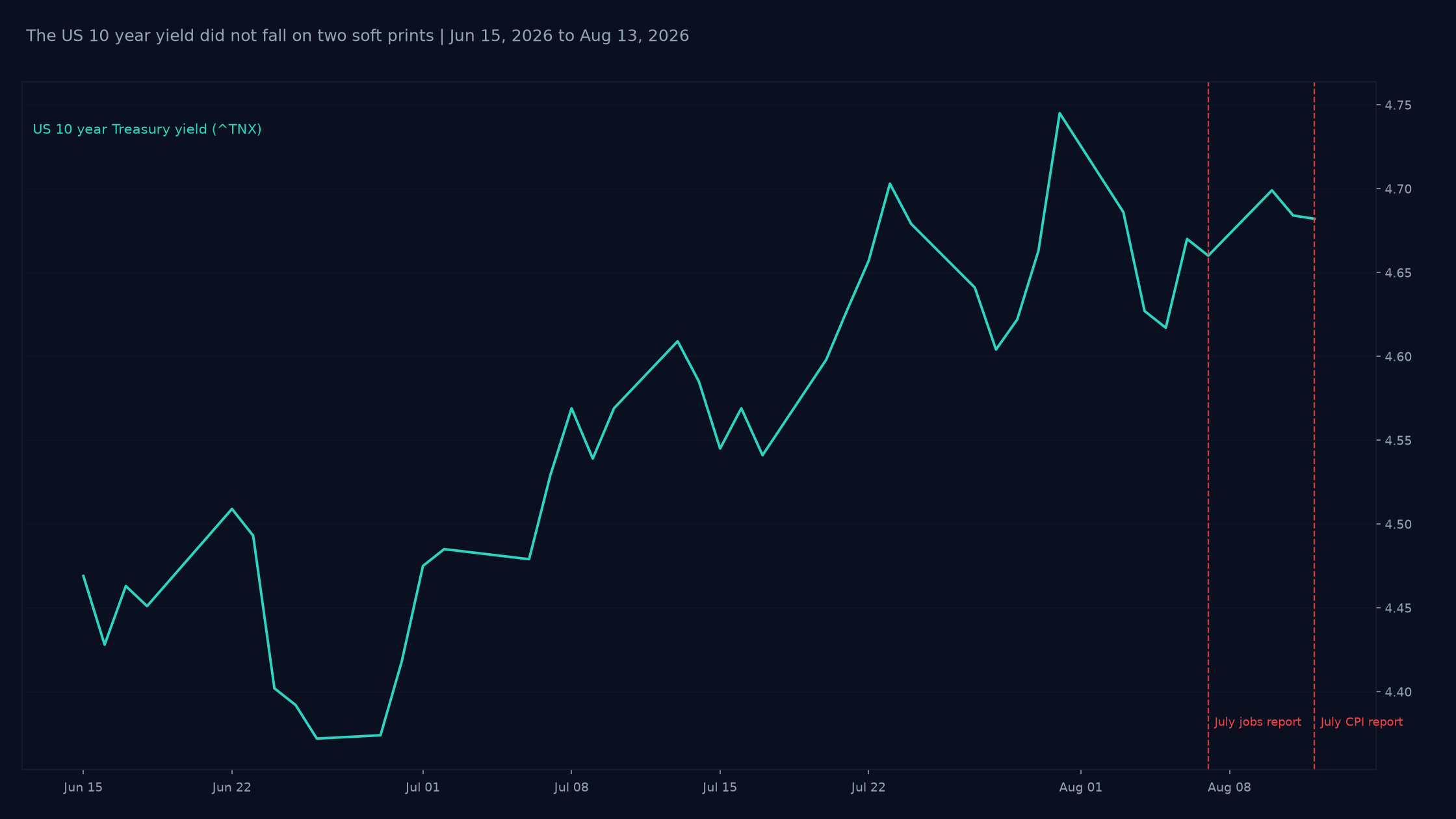
It didn't move. The 10-year Treasury yield closed at 4.68% on August 11 and 4.68% on August 12, the day the report came out. The 2-year sat at 4.22% on August 11 per FRED, and the 10-year minus 2-year spread was 0.48% on August 12, so what steepening there is keeps coming from the long end.
Gold went the other way again. Gold futures closed at 4,434.50 on August 13, up 1.67% over 5 sessions, which is where the money went instead of into duration.
Why It Matters for Your Portfolio
Japanese pension funds and insurers went abroad for yield because there wasn't any at home. There is now. If you own long Treasuries or a total bond fund on the theory that softer inflation drags yields down, the buyer on the other side matters as much as the data does, and a 3.989% JGB in your own currency changes who that buyer is. This doesn't mean a wave of selling, it means the automatic bid is thinner, and the long end has to clear at a price domestic buyers will actually take.
What I'm Watching
The Bank of Japan's next policy meeting is September 17 and 18, 2026. If the 30-year JGB holds above 4% into that meeting and the US 10-year stays at or above 4.68% through another soft inflation print, this read is working and duration keeps disappointing people who buy it for the wrong reason. If the JGB 30-year rolls back under 3.75% and the US 10-year breaks 4.50%, I'm wrong and this was a plain rate-cycle story. Let's be honest about the limits here: I can't see the cross-border flows in real time, and the monthly Treasury holdings data that would confirm any of it runs about 2 months behind, so I'm watching yields, not calling a stampede.
Related Reading: The US Just Bought Yen. Gold Read It First in 2026 and The Market Is Not Buying the Fed Pivot Yet. Here's Why
Howard is a full-time trader based in New Jersey with 13 years of experience across Forex, crypto, equities, and futures. He started Position Note to document his trades and analysis in public. All positions are disclosed. Nothing here is personalized investment advice.