Market Notes
Washington Is Writing Rules on Who Buys the Debt, 2026

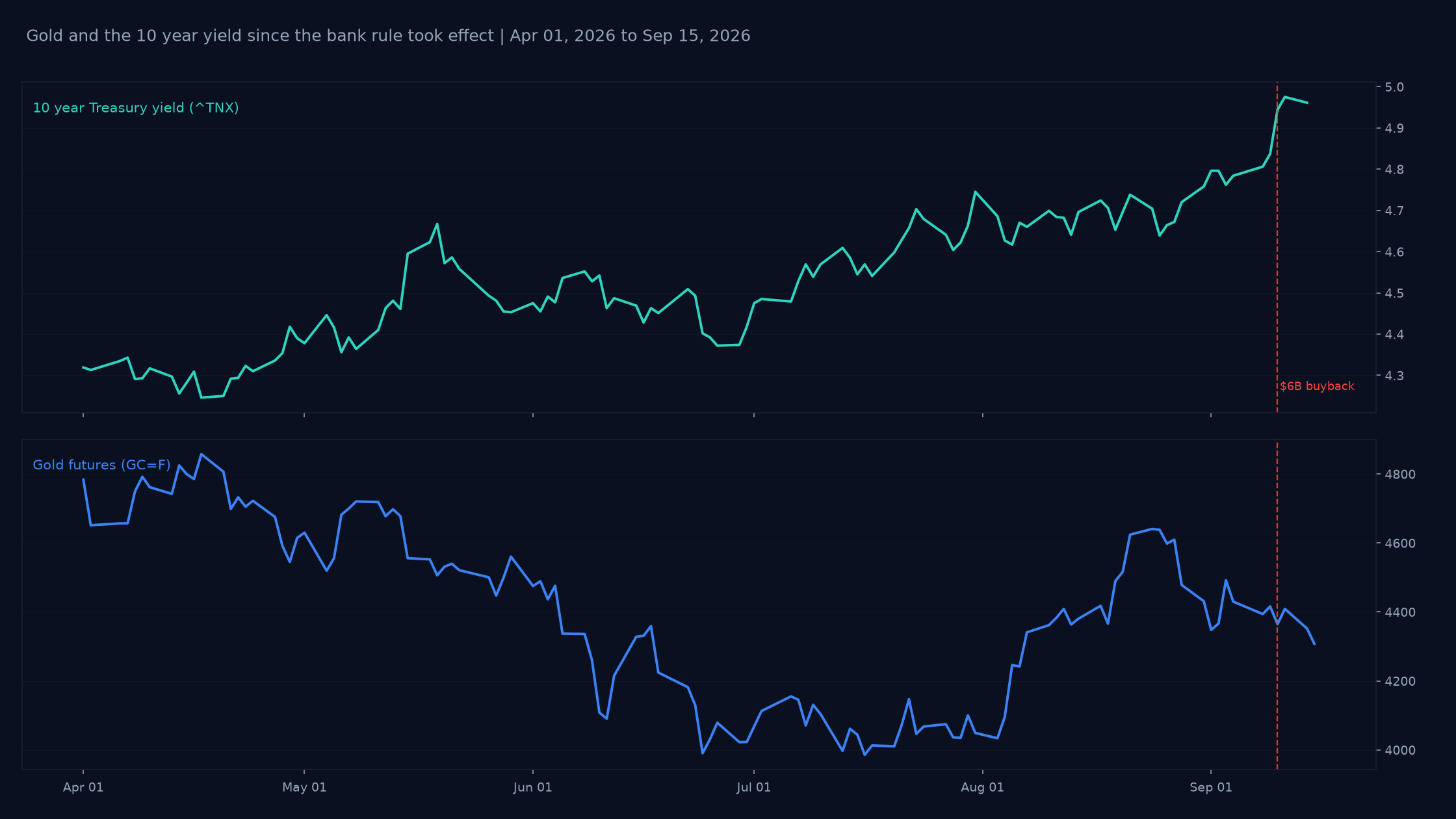
Everybody is watching who stopped lending to the US. The better question is who Washington has already told to buy. 2 rules are on the books right now: the GENIUS Act makes stablecoin issuers hold short-term Treasuries, and a bank capital change that took effect April 1, 2026 cut the penalty banks pay for holding them. Neither one is a proposal, and one of them is already showing up in the bank data.
The scarier version going around, that pensions and money market funds get mandated next, I couldn't verify. There's no filed rule, so I'm leaving it out. What's on paper is enough.
What the Data Shows
Start with the rule that moved money. The Fed, the OCC, and the FDIC finalized changes to the enhanced supplementary leverage ratio on November 25, 2025, effective April 1, 2026. Depository subsidiaries of the biggest banks went from a flat 6% leverage requirement to 3% plus the lesser of 1% or half the parent's GSIB surcharge, so no more than 4%.
The OCC bulletin says the old level "may discourage a bank from engaging in low-risk activities, such as Treasury market intermediation." They wrote the rule to get banks holding more government paper, and they said so.
It worked. Commercial banks held $4.808 trillion of Treasury and agency securities in August 2026, up from $4.736 trillion in April when the rule took effect, per the Fed's H.8 series on FRED. That's $71 billion in 4 months and $152 billion since December 2025. The GENIUS Act, Public Law 119-27, signed July 18, 2025, does the same job on the crypto side: a stablecoin issuer has to back its coins 1 to 1 with cash or Treasuries maturing in 93 days or less.
Now the side that's leaving, which is narrower than the headline version. Foreign official institutions sold a net $9.8 billion of Treasury notes and bonds in June 2026 and $34.9 billion over the 12 months through June, per Treasury's TIC release on August 17. Over those same 12 months they bought $106.3 billion of long-term US securities on net. They're selling Treasuries and buying American stocks and corporate bonds instead, which is a rotation inside the dollar, not an exit from it.
Gold tells a mixed story too. Central banks bought 289 tonnes in Q2 2026 per the World Gold Council's July 30 report, a record second quarter, but the first half total of 345 tonnes was the lowest since 2022. The dollar's share of allocated reserves actually went up, to 57.13% in Q1 2026 from 56.42% in Q4 2025, per the IMF's COFER release on July 1.
None of it is holding the long end down. Treasury's $6 billion buyback ran on September 10 and the 10-year yield went from 4.83% on September 9 to 4.95% that day and 4.96% on September 11, per FRED. The 30-year did the same thing, 5.28% to 5.37% to 5.35%.
Why It Matters for Your Portfolio
Every mandated buyer Washington has created so far buys the front of the curve. Stablecoin reserves are capped at 93 days by statute, and bank Treasury books don't set the price of 30-year paper. The 30-year closed at 5.35% on September 11, and that yield is what sits behind mortgages, long dated corporate borrowing, and every data center financed at a spread over Treasuries. If you own duration and you're waiting on a policy rescue, it's being aimed at a different part of the curve.
What I'm Watching
2 things land on September 16. Treasury publishes July TIC data that morning, and the line I want is foreign official net Treasury notes and bonds; another negative month makes that 12-month figure worse than $34.9 billion. The FOMC decision comes the same day.
After that it's a level. If the 30-year still can't print under 5.20% with banks adding paper and bills funding the buybacks, then the rules Washington already wrote are doing their job and it's still not enough. That's when harder mandates stop being a theory.
Related Reading: Treasury's Buyback Restarts at $6 Billion, September 2026 and Japan Pays 4% at Home Now. US Yields Won't Fall in 2026
Howard is a full-time trader based in New Jersey with 13 years of experience across Forex, crypto, equities, and futures. He started Position Note to document his trades and analysis in public. All positions are disclosed. Nothing here is personalized investment advice.