Market Notes
Oil Peaked September 15. The 10-Year Kept Going, 2026

The Iran deal stalling is the reason everybody is giving for both moves this month, oil up and yields up. The data only half agrees. Brent topped at $130.80 on September 15 and was back to $114.89 by September 22, down 12%, while the 10-year Treasury yield went from 5.00% on September 15 to 5.24% on September 28. Oil stopped pricing the war 2 weeks ago and the bond market didn't, and that gap is what I'm actually watching.
What the Data Shows
Brent closed at $71.32 on February 27, the last session before the US and Israel hit Iran, per FRED's daily EIA series. It ran to $130.80 on September 15 after Saudi Arabia shut its East-West pipeline on September 11 following a drone attack launched from Iraq, a line that had been moving 4 to 5 million barrels a day per Al Jazeera on September 12. Then it dropped to $114.89 by September 22, even though Al Jazeera reported on September 17 that the pipeline still had no confirmed restart. Oil came off 12% with the physical supply still missing, so what it gave back was deal odds, not barrels.
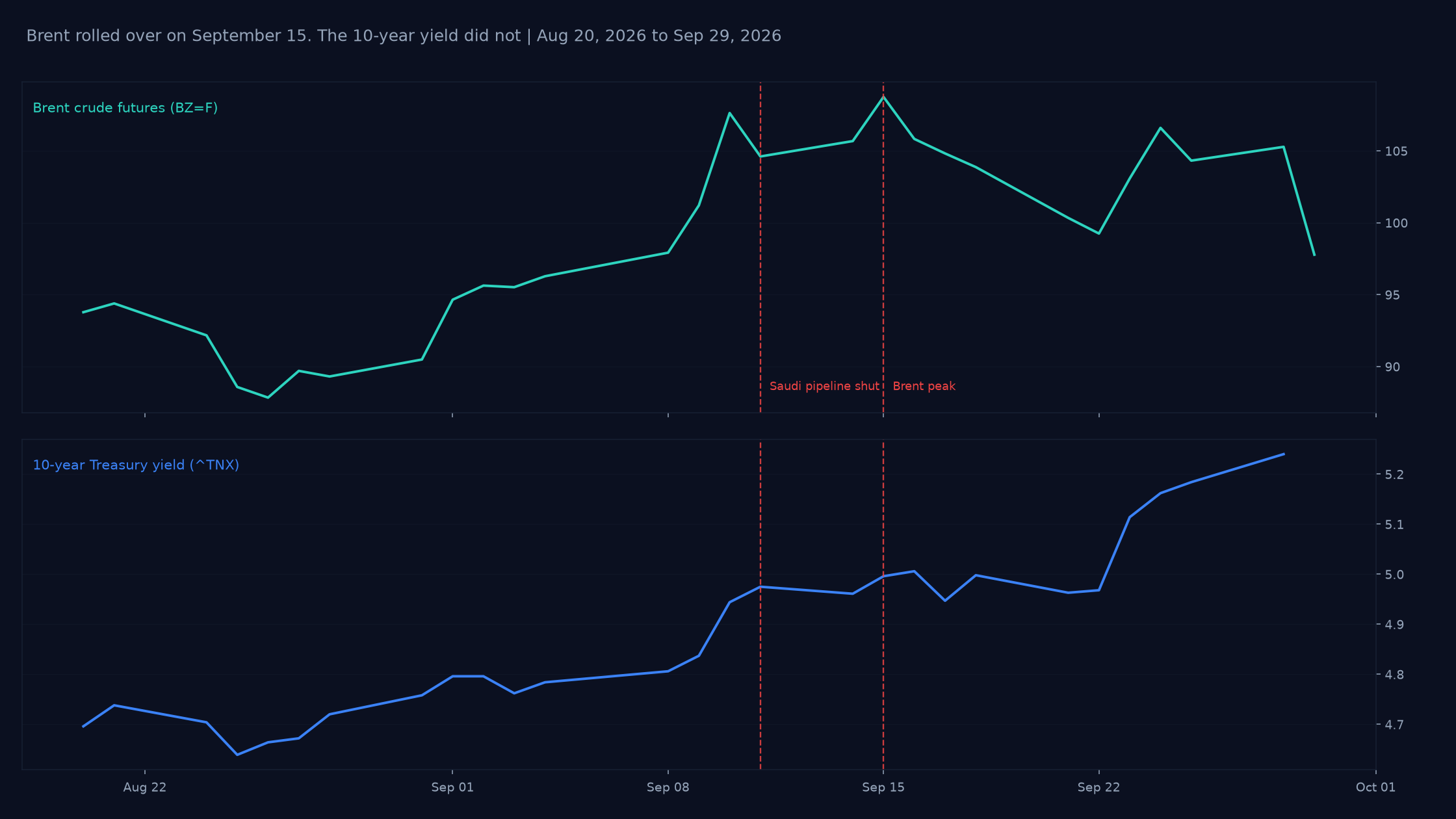
The 10-year didn't give anything back. FRED has it at 4.69% on August 20 and 5.17% on September 25, and the CBOE 10-year yield index closed at 5.24% on September 28, up 5.48% in 5 sessions. The 2-year moved further over that same window, 4.19% to 4.81%, which narrowed the 10-year minus 2-year spread from 0.50% to 0.32%. When the front end leads like that, you're looking at Fed and inflation pricing, not an oil premium.
Diesel is where the oil move actually landed. EIA's weekly survey puts retail on-highway diesel at $6.529 a gallon for the week of September 21, up from $6.285 the week before and $2.78 above a year ago. EIA's own April 7 forecast had 2026 diesel averaging $4.80 a gallon, and its September 9 outlook still had Brent averaging around $90 in the second half of this year. Both were wrong inside of weeks, which is a fair measure of how little baseline anyone has here.
Why It Matters for Your Portfolio
If a deal is your base case, the obvious trade is long duration and long whatever rates have hit hardest. The front end is the problem with that. Oil already handed back 12% and the 2-year still rose 62 basis points from August 20 to September 25, so a deal that unwinds the oil move doesn't automatically unwind the yield move. Anything you own that's priced off a 10-year near 5.24% is carrying rate risk that has nothing to do with Hormuz.
What I'm Watching
2 things, both with numbers on them. First, the restart rate on the East-West pipeline, because Rystad told Al Jazeera on September 17 it expected 40% to 60% capacity, or 2.5 to 3 million barrels a day, against the 4 to 5 million the line had been carrying. A restart at the low end keeps Brent bid no matter what the deal headlines say. Second, the 10-year minus 2-year spread at 0.32% on September 28: if it keeps flattening while oil falls, the bond market is telling you it cares more about the Fed than about Iran, and I'd want to see it back above 0.50% before I called the yield move a war story.
Related Reading: The Yields-Up, Dollar-Down Signal Nobody Priced in 2026 and Japan Pays 4% at Home Now. US Yields Won't Fall in 2026
Howard is a full-time trader based in New Jersey with 13 years of experience across Forex, crypto, equities, and futures. He started Position Note to document his trades and analysis in public. All positions are disclosed. Nothing here is personalized investment advice.