Market Notes
Treasury's Buyback Bought 2 Days of Lower Yields in 2026

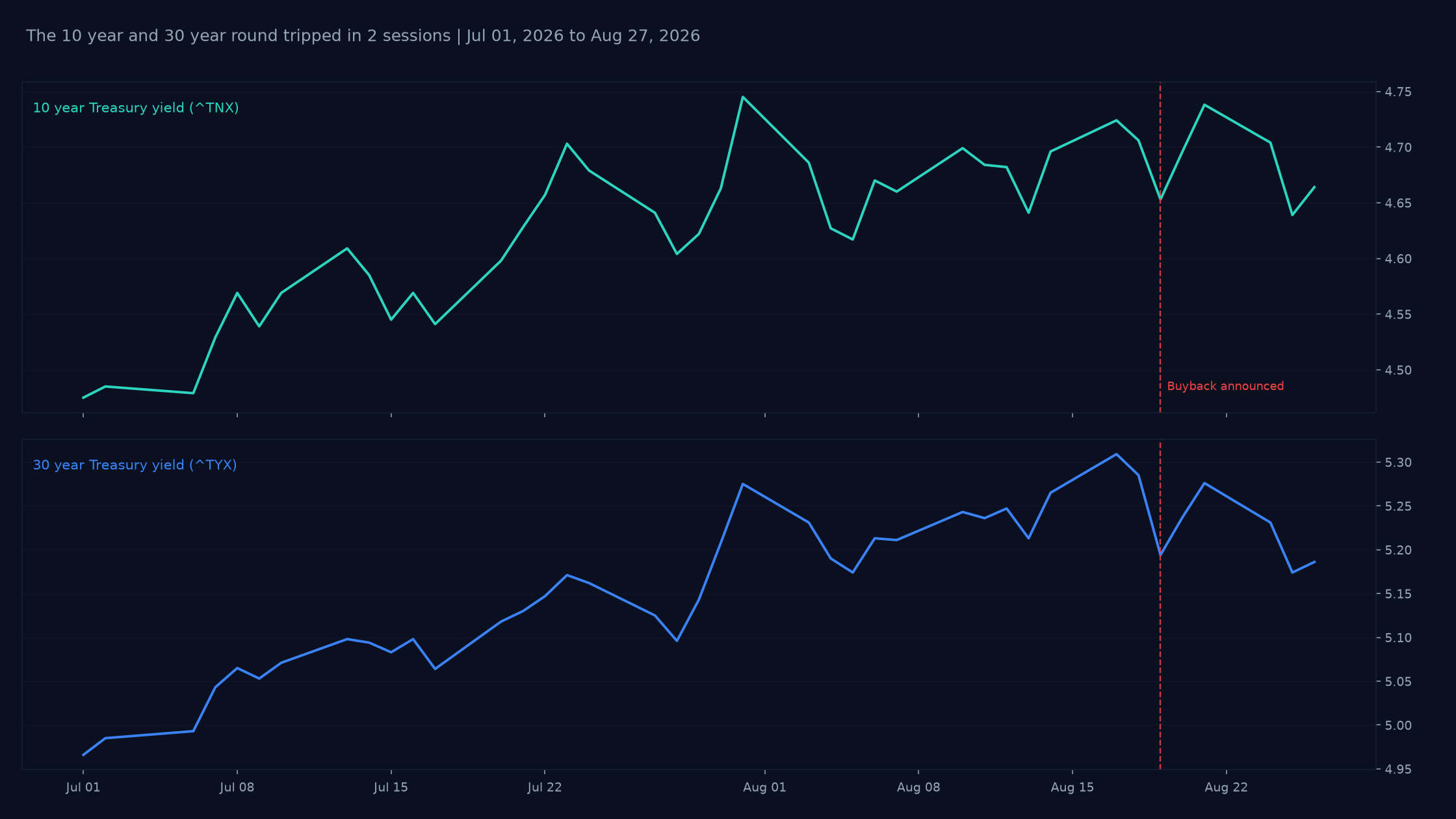
Treasury announced bigger long-end buybacks on August 19, 2026, and the bond market gave the whole move back in 2 sessions. The 10-year constant maturity yield closed at 4.65% on announcement day and 4.74% 2 sessions later, per the Fed's H.15 release. The 30-year went from 5.19% to 5.27% over the same 2 days and hasn't closed under 5% once since. I don't think this failed because the operation was too small. I think it failed because announcing it told everyone the borrower is worried, and the first enlarged operation doesn't even run until September 9.
What the Data Shows
The Fed's H.15 release on August 26, 2026 has the round trip in one table. The 10-year constant maturity yield went 4.65% on August 19, up to 4.74% on August 21, then back to 4.64% on August 25. The 30-year did the same thing one level higher, 5.19% to 5.27% to 5.17%, and the 2-year barely moved at all, 4.19% to 4.17%. The front end is pinned because the Fed has held the target range at 3.50% to 3.75% since December 11, 2025, so all of this is happening at the long end where Treasury has the least control.
The buyback itself is smaller than the headline makes it sound. Treasury's August 19 announcement raises the maximum size of each long-end liquidity support operation from $2 billion to at least $4 billion, covering the 10-to-20 year and 20-to-30 year sectors, effective September 9 and running through November 4, 2026. Total public debt outstanding was $40.09 trillion on August 25, 2026 per Treasury's own daily figures. So the market repriced twice on an operation that adds $2 billion of capacity per session and hasn't happened yet.
Here's the part that cuts against the story everyone's telling. The usual line is that foreign central banks are walking away from Treasuries, but Treasury's TIC data for June 2026 shows foreign official institutions were net buyers of $37.3 billion of long-term US securities that month. That's not a buyers' strike. The long end is repricing on what buyers want to get paid, not on whether buyers exist, and that's a much harder problem to fix from a buyback desk.
Why It Matters for Your Portfolio
The 30-year sets the price on mortgages, long dated corporate debt, and every data center that gets financed at a spread over Treasuries. If you're holding duration and waiting for someone to come rescue the long end, that was the rescue, and it lasted 2 days. I'd rather sit in the part of the curve where the Fed actually sets the rate than the part where the auction sets it.
What I'm Watching
September 9 is the first enlarged operation, and I want to see whether the 30-year holds under 5.20% through it. The FOMC meets September 15 and 16, and the Fed hasn't moved since December 2025, so a hold plus a 30-year back over 5.30% would tell me the buyback bought nothing at all. If the 30-year closes under 5% and stays there into October, then this really was plumbing and I'm wrong about the credibility part. I could be wrong on the timing either way, but a 2-day round trip on a program that hasn't started isn't a market that believes you.
Related Reading: The 30-Year Hit 5.31% and Treasury Stepped In, August 2026 and Japan Pays 4% at Home Now. US Yields Won't Fall in 2026
Howard is a full-time trader based in New Jersey with 13 years of experience across Forex, crypto, equities, and futures. He started Position Note to document his trades and analysis in public. All positions are disclosed. Nothing here is personalized investment advice.