Market Notes
The 30-Year Hit 5.31% and Treasury Stepped In, August 2026

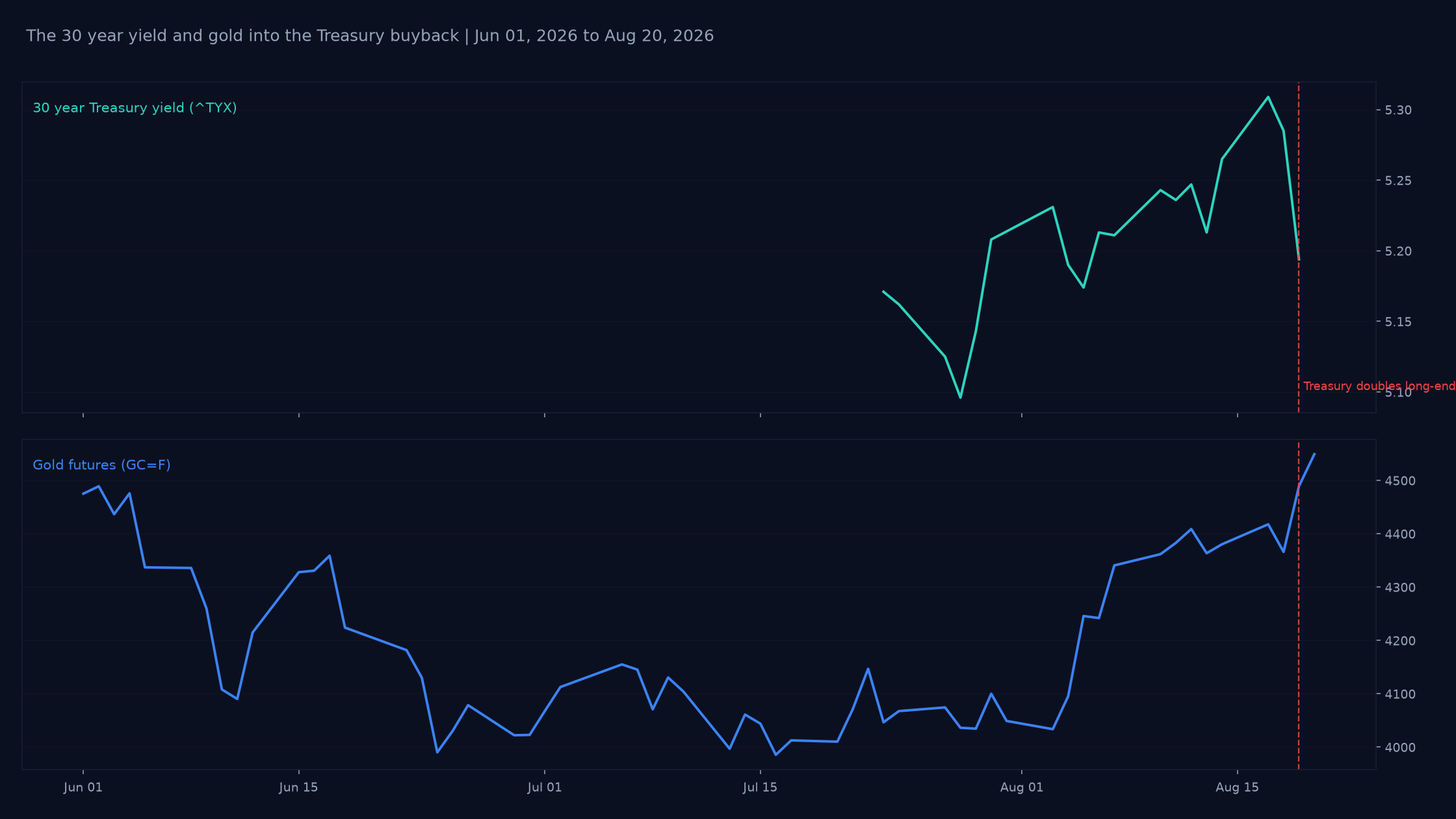
The 30-year Treasury closed at 5.31% on August 17, 2026, and 2 days later the Treasury Department said it would at least double the size of its long-end buyback operations. That's the borrower stepping in to support the market for its own debt, and it happened before the Fed said a word. Gold futures ran 2.87% in 3 sessions, the dollar index broke under 99, and Nasdaq 100 futures dropped 2.07% over the same stretch. I don't read the buyback as a policy shift, it's plumbing, but the way gold and the dollar traded it tells you what the market thinks the plumbing is for.
What the Data Shows
The long end is where all of this is happening. The Federal Reserve's H.15 release on August 19, 2026 puts the 30-year constant maturity yield at 5.24% on August 12, 5.31% on August 17, and 5.28% on August 18. The 10-year was 4.71% and the 2-year was 4.19% on August 18, so the front end barely moved while the long bond kept climbing. FRED had the 10-year minus 2-year spread at 0.46% on August 19, and a curve that steepens because long yields are rising is the market pricing inflation and supply risk, not growth.
Then Treasury acted. On August 19, 2026 it announced it's increasing the maximum size of its liquidity support buyback operations for longer dated nominal coupon securities from $2 billion per operation to at least $4 billion, covering the 10-to-20 year and 20-to-30 year sectors, effective September 9 and running through November 4, 2026. Treasury's own reason is greater liquidity support in the longer dated sectors, where it routinely receives a significant volume of high quality offers, and that's what a buyback is, so I'll take the description at face value. It's still the first real action anyone has taken on the long end, and the Fed's target range is 3.50% to 3.75%, unchanged since December 2025.
The reaction is the part I keep coming back to. Gold futures closed at 4,417.80 on August 17 and 4,544.70 on August 20, up 2.87%, while the dollar index went from 99.64 to 98.70 over the same 3 sessions. The 10-year yield on the CBOE index came down from 4.72% on August 17 to 4.65% on August 19. Nasdaq 100 futures fell 2.07% in that window against 0.66% for S&P 500 futures, so the bid went to gold while the dollar and the AI-heavy index both leaked.
Why It Matters for Your Portfolio
The 30-year prices mortgages, long dated corporate debt, and every data center financed at a spread over Treasuries. If you're holding long bonds waiting for the Fed to bail you out, this week's relief came from the Treasury's buyback desk instead, and gold caught a bid while the dollar lost one. That's a different setup than a plain rate scare, and it's worth knowing which one you're actually positioned for.
What I'm Watching
Warsh gives his first Jackson Hole address as Fed chair at the Kansas City Fed symposium running August 27 to 29, 2026, and the market has spent weeks treating him as a chair who won't do anything. The first enlarged buyback operation is September 9 and the FOMC meets September 15 and 16. I'm watching the 2-year for the hawkish tell, because it sat at 4.19% on August 18, and if it climbs back toward 4.35% while the 30-year holds above 5.30%, the bond market is saying the Fed is behind. If the 30-year drops under 5.10% and gold gives back this week's move, the buyback did its job, this was a plumbing story, and I'm wrong about it meaning anything bigger.
Related Reading: The Fed's First Warsh Meeting Is a Liquidity Test and The Yields-Up, Dollar-Down Signal Nobody Priced in 2026
Howard is a full-time trader based in New Jersey with 13 years of experience across Forex, crypto, equities, and futures. He started Position Note to document his trades and analysis in public. All positions are disclosed. Nothing here is personalized investment advice.