Position Trades
Why I Still Own $ORCL After the AI Cloud Pullback

$ORCL is still one of the stranger AI trades in my portfolio.
The company is not an early-stage AI story. It is an old enterprise software company that suddenly became one of the market's key AI infrastructure names. That is why the stock ran hard, why it got crowded, and why the pullback matters.
I already trimmed part of the position into strength, but I still own $ORCL because the business has not broken.
The core setup is simple: Oracle Cloud Infrastructure is growing fast, the backlog exploded, and the market is now trying to decide whether the AI data-center buildout is a durable earnings story or just a capital-intensive spending cycle.
My public valuation range is $250-$350.
That is a wide range because $ORCL now trades on two things at once: the stability of the legacy software and database business, and the market's willingness to capitalize Oracle's AI cloud backlog. If the backlog converts into profitable revenue, the stock can work. If the capex and financing burden becomes the story, the multiple can stay capped.
The Chart
$ORCL has already had the full momentum-stock experience.
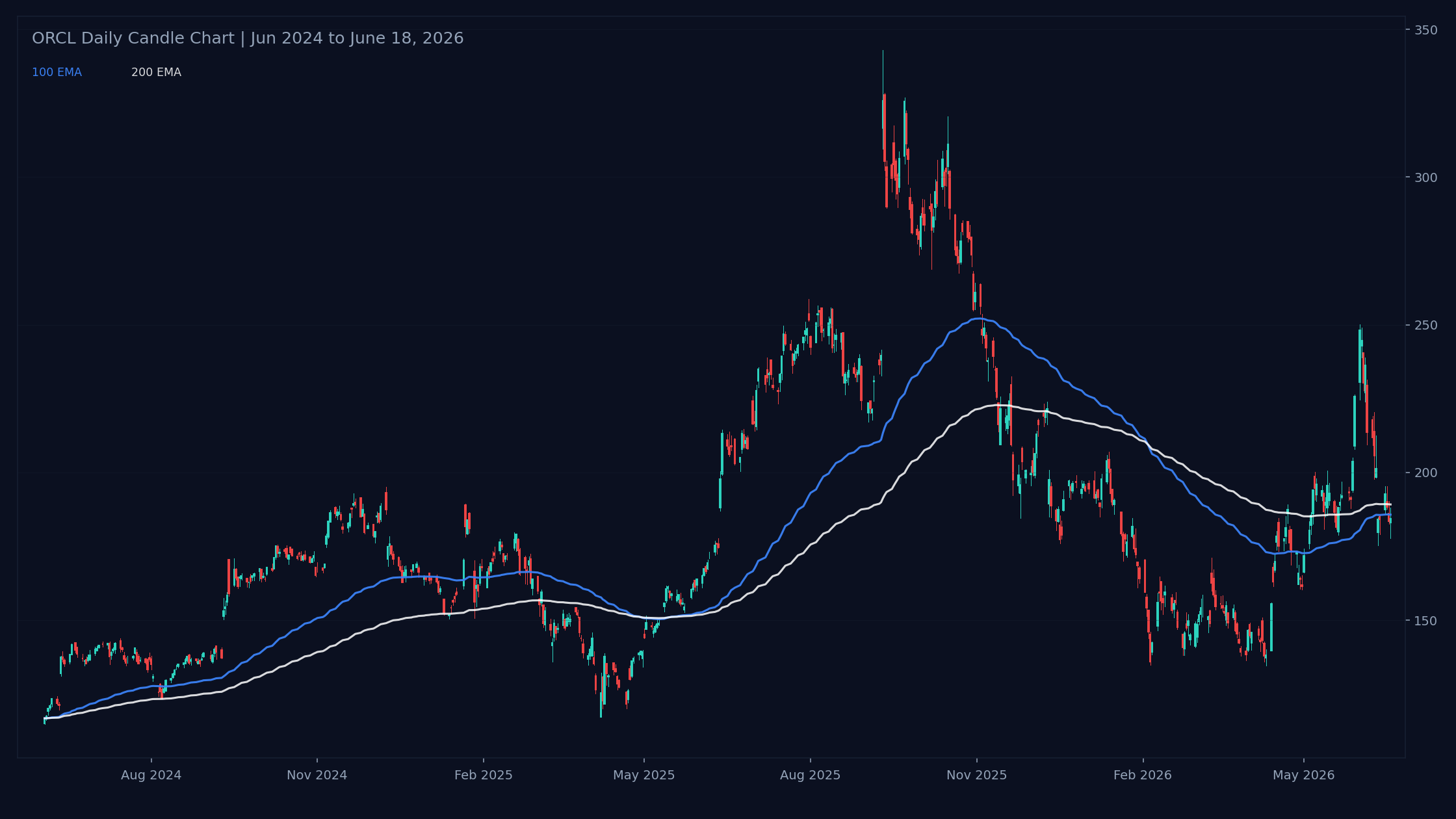
The recent close was about $184.29. That puts the stock just below the 100-day moving average near $185.73 and the 200-day moving average near $189.18.
So the chart is not broken in the same way as a stock making fresh lows, but it also is not clean.
$ORCL is still well below its September 2025 spike, when the stock traded above $340 intraday and closed near $326. From the closing high to the recent close, the stock is down roughly 43%. From the intraday high, the reset is closer to 46%.
That is the opportunity and the warning.
The opportunity is that the market has already taken a lot of the AI-cloud euphoria out of the stock. The warning is that the stock has not fully reclaimed the moving averages yet, and a name this capital-intensive needs the market to keep believing the growth story.
For me, this is a hold-and-manage position. I'm not treating $ORCL like a cheap slow-growth software stock anymore. I'm treating it like a cloud infrastructure rerating trade that has to prove the backlog can turn into revenue, cash flow, and earnings.
Why the Business Is Still Working
Oracle's latest quarter was strong on the numbers that matter most for the thesis.
In fiscal Q4 2026, total revenue was $19.2 billion, up 21% year over year. Total cloud revenue was $9.9 billion, up 47%. Cloud infrastructure revenue was the standout, growing 93% to $5.8 billion.
That is why I still care about the stock.
The legacy Oracle story was database, applications, maintenance, and enterprise switching costs. The new story is Oracle Cloud Infrastructure becoming a real AI capacity provider at a time when large customers need more compute.
The backlog is the headline. Remaining performance obligations ended the quarter at $638 billion, up 363% year over year and up $85 billion sequentially from Q3.
That is not a normal enterprise software backlog.
It shows that customers are signing very large commitments for future cloud and AI infrastructure capacity. It also gives Oracle a much bigger forward revenue bridge than the market was used to assigning the company.
The full-year numbers also support the setup. Fiscal 2026 revenue was $67.4 billion, up 17%. Total cloud revenue was $34.0 billion, up 39%. Cloud infrastructure revenue for the year was $18.1 billion, up 77%.
That is real acceleration.
The stock can still be wrong from here, but the business is not showing a demand problem. If anything, the demand signal is the reason the stock became controversial.
The Capex Problem
The risk is that Oracle's AI cloud opportunity is expensive.
Fiscal 2026 operating cash flow was $32.0 billion, up 54%, but capital expenditures were $55.7 billion. That pushed trailing four-quarter free cash flow to negative $23.7 billion.
That is the part I cannot ignore.
Oracle is not getting this AI infrastructure opportunity for free. It is building data centers, funding capacity, taking on obligations, and using the capital markets to support the growth plan.
The balance sheet shows the trade-off. Oracle ended fiscal 2026 with $31.3 billion of cash and equivalents, but current and non-current notes payable and other borrowings totaled about $129.5 billion.
Management also said Oracle raised $43 billion in debt financing and $5 billion in equity financing during fiscal 2026. For fiscal 2027, the company expects to raise about $40 billion through a mix of debt and equity financing, including the previously announced at-the-market equity program.
That is why $ORCL is not just a cloud growth story.
It is a funding story too.
The bull case is that Oracle can use customer commitments, prepayments, customer-supplied hardware, and financing to build capacity against demand that's already contracted. The bear case is that the company has to spend so heavily that free cash flow stays pressured and investors stop valuing the backlog at a premium.
Both sides are real.
My Valuation Range
I'm valuing $ORCL with a forward earnings framework, with a capex discount.
Oracle is not a clean high-growth software compounder right now because free cash flow is being pulled down by the AI infrastructure buildout. But I also don't want to value it like a no-growth legacy software company when cloud infrastructure revenue is growing close to triple digits.
Using recent market data, $ORCL trades around 17x forward earnings, with forward EPS around $10.90. That puts the current price near the market's base-case view that Oracle can grow, but that the capex burden deserves a discount.
My public range is $250-$350.
The lower end assumes Oracle earns roughly $10-$11 per share and the market pays about 23x-24x for a business with accelerating cloud revenue and a massive AI backlog.
The upper end assumes the market starts underwriting something closer to $11-$12 of earnings power with a high-20s multiple because OCI growth, RPO conversion, and AI demand are proving more durable than investors feared.
I'm not saying $ORCL deserves the upper end today.
I'm saying that if Oracle keeps converting backlog into cloud revenue, confirms fiscal 2027 revenue near the $90 billion guide, and shows investors that financing the buildout is manageable, the stock can recover back into that broader $250-$350 zone.
That is enough upside for me to keep managing the position in stages.
Where I Am Wrong
I'm wrong if the backlog doesn't convert into profitable revenue.
RPO is a powerful signal, but it's not the same thing as margin, cash flow, or return on invested capital. If Oracle builds too much capacity, if customers delay usage, or if AI infrastructure pricing gets more competitive, the market may decide the backlog is less valuable than it looks.
I'm also wrong if financing becomes the story.
Debt, equity issuance, capex, lease obligations, and negative free cash flow all matter. If the market starts focusing more on balance-sheet expansion than on cloud growth, $ORCL can stay under pressure even while reported revenue grows.
The final risk is technical.
The stock is still sitting around the 100-day and 200-day moving averages. If it cannot reclaim those levels and hold them, the market is telling me the post-pullback recovery is not ready yet.
What I Am Watching Next
The next few quarters are about conversion.
I want to see cloud infrastructure revenue keep growing at a high rate, RPO remain strong, and fiscal 2027 revenue guidance stay credible. I also want to see signs that operating cash flow can keep growing even while Oracle funds the AI buildout.
The number that matters most is not only revenue.
It is whether Oracle can turn this AI cloud demand into earnings power without making the balance sheet the center of the story.
For now, I still own $ORCL because the demand signal is too strong to ignore, the stock has already reset hard from the AI spike, and the company has a path back into my public $250-$350 range if OCI growth keeps converting into revenue and earnings.
But I'm not treating this like a no-risk compounder. This is a position trade around a major AI cloud buildout, and I want to manage it in stages instead of pretending the capex risk doesn't exist.
Related Reading
- Why I Still Own $MSTR After the Bitcoin Treasury Reset
- Why I Own $META After the AI Capex Reset
Disclosure: I own shares of Oracle.
Disclaimer: This isn't personalized investment advice. I'm sharing my own research process and portfolio thinking. Do your own work before making any investment decision.
Members Only: How I Am Managing the Position
- The $ORCL trim I already made
- The exact staged sell orders I still have working
- Why I'm using a ladder after the AI cloud spike
- What would make me keep, adjust, or cancel the plan
- The balance-sheet risk I'm watching before adding more exposure