Position Trades
Why I Own $PLTR After the 2026 AI Software Pullback

$PLTR is one of the few AI software names where the revenue is already showing up.
I own the stock because Palantir is converting the AI story into actual government and commercial growth, not just demos, pilots, and investor-day language. The problem is valuation. At the current price, the market is already paying for a lot of the future.
My public valuation range is $160-$200.
That range only works if Palantir keeps compounding revenue at an unusually high rate, keeps margins strong, and proves that AIP can remain a durable operating system for real enterprises. If growth slows faster than expected, this stock can stay expensive and still go nowhere.
The Chart
$PLTR has already had the AI software boom and the first real reset.
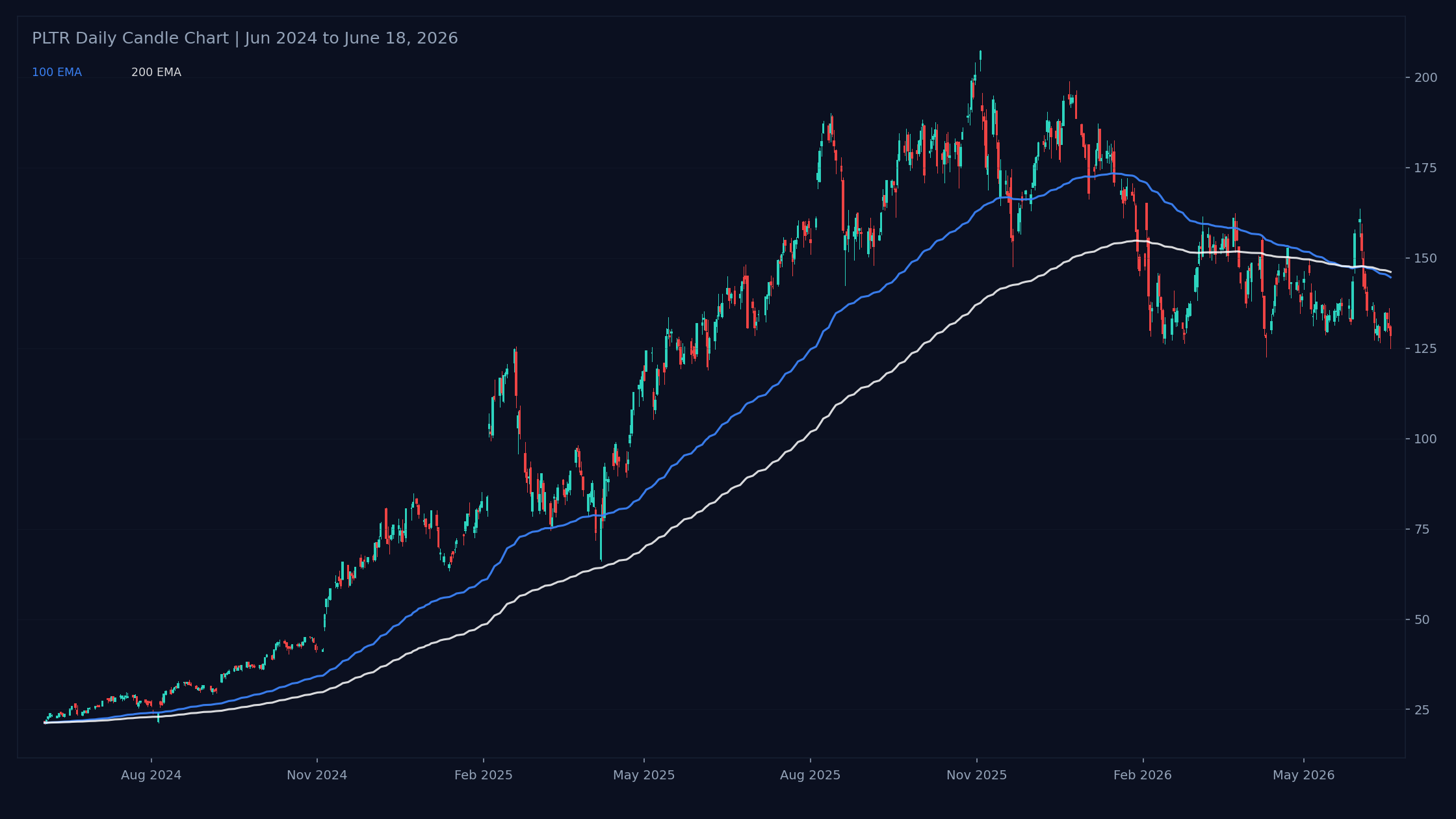
The recent close was about $128.47. That puts the stock below the 100-day moving average near $144.61 and the 200-day moving average near $146.13.
So this is not a clean momentum chart right now.
$PLTR hit an intraday high near $207.52 in November 2025 and a closing high near $207.18 on the same day. From that closing high to the recent close, the stock is down roughly 38%.
The reset matters because $PLTR was priced like the market's purest AI software winner.
I don't view the pullback as proof that the thesis is broken. I view it as the market finally forcing discipline back into a stock that had become too easy to love.
For me, this is a hold-and-prove position. I want exposure because the business is executing, but I don't want to pretend valuation no longer matters just because the AI story is real.
Why the Business Is Still Working
Palantir's latest quarter was one of the strongest software quarters in the market.
In Q1 2026, revenue was $1.63 billion, up 85% year over year and 16% sequentially. U.S. revenue grew 104% year over year to $1.28 billion. U.S. commercial revenue grew 133% to $595 million, while U.S. government revenue grew 84% to $687 million.
That mix is the key.
Palantir used to be viewed mostly as a government software company. The government business still matters, but the commercial acceleration is what changed the equity story. AIP made Palantir easier for enterprises to understand, adopt, and expand.
The company also showed unusual efficiency for a software business growing this quickly.
Adjusted operating income was $984 million, with a 60% adjusted operating margin. Adjusted free cash flow was $925 million, with a 57% margin. GAAP diluted EPS was $0.34, and adjusted diluted EPS was $0.33.
Those numbers are why I still own $PLTR.
This is not a company burning cash to manufacture growth. It's growing fast, producing cash, and expanding across both government and commercial customers.
The deal activity supports the same view. In Q1, Palantir closed 206 deals of at least $1 million, 72 deals of at least $5 million, and 47 deals of at least $10 million. Overall total contract value grew 61% year over year to $2.41 billion.
The business is not broken.
The stock just stopped getting a free pass on valuation.
The Real Thesis
The $PLTR thesis is that AI moves from chat interfaces into operations.
That's where Palantir wants to live.
The company's Ontology is the part of the story I care about most. It connects data, logic, workflows, permissions, and actions so AI can work inside a real organization instead of floating above it as a separate tool.
That matters because most companies don't need another AI demo. They need software that can touch messy data, respect security rules, route decisions, and create auditable workflows.
Palantir's pitch is that AIP plus Ontology can become the operating layer for that.
If that's right, $PLTR deserves a premium multiple because the company is not just selling AI wrappers. It's selling embedded decision infrastructure.
The reason I still have to be careful is that the market already understands this.
At a recent market cap around $308 billion, $PLTR is not priced like an undiscovered AI software company. It's priced like a category winner that still has to keep proving the category is large enough to support the multiple.
That's the trade.
The business is elite. The stock is demanding.
My Valuation Range
I'm valuing $PLTR with a high-growth software revenue framework, cross-checked against free cash flow.
For full-year 2026, Palantir guided for revenue of about $7.65 billion to $7.66 billion. The company also guided for adjusted operating income of about $4.4 billion to $4.5 billion and adjusted free cash flow of about $4.2 billion to $4.4 billion.
At the recent price near $128, the market cap is roughly $308 billion.
That means the stock is trading around 40x expected 2026 revenue and roughly 70x expected 2026 adjusted free cash flow.
There is no way to call that cheap.
My public range is $160-$200 because I'm looking one year forward and assuming Palantir can grow into part of the multiple.
If 2027 revenue lands around $10 billion to $11 billion and the market continues to value Palantir like a scarce AI software platform, a 38x to 44x revenue multiple supports a market cap of roughly $380 billion to $480 billion. Using roughly 2.4 billion shares, that points to about $160-$200 per share.
The free cash flow cross-check gets me to a similar zone only if margins remain exceptional.
If 2027 adjusted free cash flow can move toward $5.5 billion to $6.0 billion, a 65x to 75x free cash flow multiple gives a market cap range of about $360 billion to $450 billion. That supports roughly $150-$190 per share.
So I don't see $160-$200 as a conservative target.
I see it as a premium target for a premium company.
If Palantir keeps delivering 70% plus revenue growth, U.S. commercial acceleration, and very high free cash flow margins, the range can work. If growth slows into a more normal software curve, the range is too high.
Where I'm Wrong
I'm wrong if the AI software curve normalizes faster than the market expects.
The biggest risk is not that Palantir suddenly becomes a bad company. The biggest risk is that it remains a great company but the market decides the valuation was too far ahead of the fundamentals.
I'm also wrong if the commercial boom proves less durable than it looks.
U.S. commercial revenue grew 133% in Q1, but that kind of growth is hard to sustain as the base gets bigger. If AIP adoption slows, if pilot-to-production conversion weakens, or if enterprises start treating AI software spend more cautiously, the multiple should compress.
The government side carries its own risk.
Palantir has deep government relationships, but public-sector budgets, contract timing, scrutiny, and political pressure can all create volatility. The company's own filings also remind investors that many contracts can include termination-for-convenience provisions.
The final risk is dilution and governance.
Palantir's share count is large, stock-based compensation still matters, and the multi-class structure gives the founders meaningful voting control. I can live with that if execution stays exceptional. I can't ignore it if growth starts slowing.
What I'm Watching Next
The next few quarters are about whether Palantir can keep turning AIP demand into scaled revenue.
I want to see U.S. commercial revenue keep growing fast, total contract value stay strong, free cash flow remain high, and the company keep raising guidance without needing to explain away margin pressure.
The stock also needs to improve technically.
I don't need $PLTR to reclaim the old high immediately. But I do want to see it rebuild above the 100-day and 200-day moving averages. Until then, the chart is still telling me the market is working through the excess from the prior AI run.
For now, I still own $PLTR because the company is one of the clearest examples of AI turning into actual enterprise revenue. The public range is $160-$200, but this is a premium setup with a premium risk attached.
I'm willing to hold it, but I'm not willing to forget what I paid or pretend the multiple doesn't matter.
Related Reading
- Why I Still Own $ORCL After the AI Cloud Pullback
- Why I Still Own $SOFI After the 2026 Fintech Pullback
Disclosure: I own shares of Palantir.
Disclaimer: This isn't personalized investment advice. I'm sharing my own research process and portfolio thinking. Do your own work before making any investment decision.
Members Only: How I Am Managing the Position
- The exact $PLTR share count and average cost I have recorded
- Whether I'm adding, holding, or trimming after the pullback
- The technical levels I'm watching before making a change
- Why I don't want to chase a premium-multiple stock without confirmation