Position Trades
Why I Still Own $SOFI After the 2026 Fintech Pullback

$SOFI is still one of the cleaner fintech recovery trades in my portfolio.
I own it because the company is no longer just a member-growth story. It's now a profitable digital bank with real scale, a growing deposit base, and operating leverage starting to show up in the numbers.
The stock has pulled back hard from the 2025 high, but the business has not broken.
My public valuation range is $24-$32.
That range depends on SoFi continuing to grow adjusted net revenue, protect credit quality, and turn its member base into earnings power. If credit losses rise or growth slows, this stops being a rerating trade and becomes a normal consumer-finance stock.
The Chart
$SOFI had the full fintech momentum run, and now it's back in the prove-it zone.
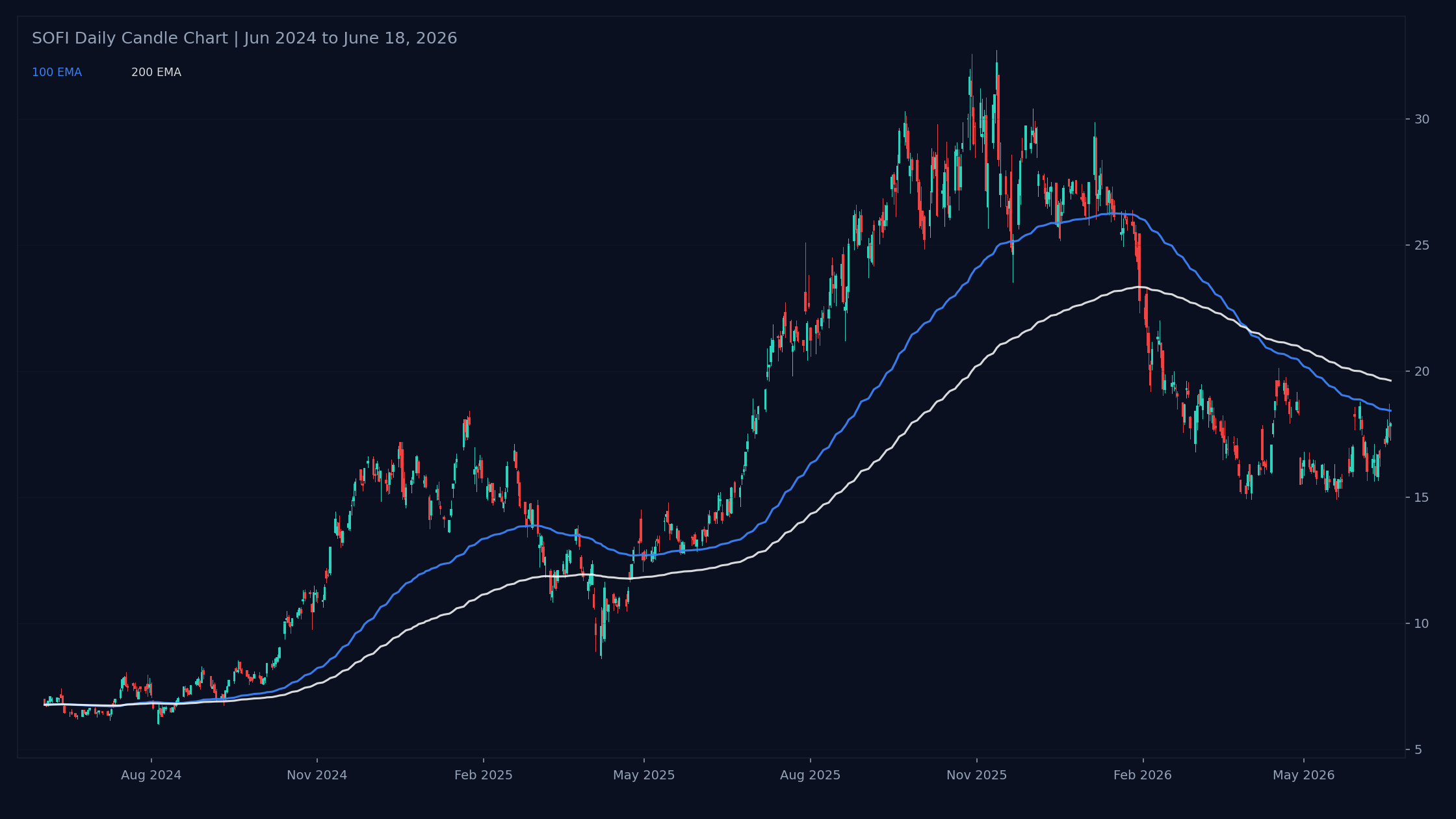
The recent close was about $17.91. That puts the stock slightly below the 100-day moving average near $18.43 and below the 200-day moving average near $19.62.
So the chart is not broken, but it's not clean either.
$SOFI reached an intraday high near $32.73 in November 2025 and a closing high near $32.21. From that closing high to the recent close, the stock is down roughly 44%.
That's the setup.
The stock has already given back a big part of the enthusiasm, while the business is still growing revenue, members, products, deposits, and earnings.
For me, this is a hold-and-manage position. I don't need $SOFI to go straight back to the old high, but I do need the company to keep proving that the bank model can scale without credit quality becoming the problem.
Why the Business Is Still Working
SoFi's latest quarter showed the model is getting stronger.
In Q1 2026, adjusted net revenue was $1.087 billion, up 41% year over year. GAAP net income was $166.7 million, and diluted EPS was $0.12. Adjusted EBITDA was $339.9 million, with a 31% margin.
That's the important shift.
SoFi is not just growing users while losing money anymore. It has now reported ten straight quarters of GAAP profitability, and the earnings contribution is becoming more visible.
The member data is still strong too.
SoFi added a record 1.055 million members in Q1, bringing total members to 14.7 million, up 35% year over year. Total products reached nearly 22.2 million, up 39%.
That matters because the long-term thesis depends on cross-sell.
The more products SoFi can attach to each member, the more the company starts to look like an operating system for consumer finance instead of a single-product lender.
The lending engine also remains large.
Total loan originations were $12.2 billion in Q1, with records across personal loans, student loans, and home loans. Personal loan originations were $8.3 billion, student loan originations were $2.6 billion, and home loan originations were $1.2 billion.
That scale is why the deposit base matters.
Deposits reached $40.2 billion, and the company said average total deposits made up more than 90% of average total liabilities. The lower-cost deposit funding is one reason SoFi can keep improving profitability as the balance sheet grows.
The Real Thesis
The $SOFI thesis is not just that fintech rebounds.
The thesis is that SoFi is becoming a profitable digital bank with a younger, engaged customer base and more products to sell into that base over time.
That's different from the 2021-style fintech story.
Back then, the market mostly cared about growth and total addressable market. Now I care more about deposits, credit, earnings, and whether each new member is becoming more valuable over time.
The bank charter changed the story because SoFi is not only relying on warehouse funding or referral economics. It can gather deposits, fund loans, earn net interest income, and cross-sell financial services through one app.
The best version of this company is a digital financial supermarket.
Checking, savings, lending, investing, credit card, insurance, small business tools, and eventually new products like SoFiUSD can all sit inside the same member relationship.
That's the upside.
The risk is that SoFi is still exposed to consumer credit and interest-rate cycles. This is not a pure software multiple business. It's a fintech-bank hybrid, and the market will punish it if loan performance deteriorates.
My Valuation Range
I'm valuing $SOFI with a fintech earnings framework, cross-checked against adjusted net revenue and EBITDA.
For full-year 2026, management guided for adjusted net revenue of about $4.655 billion, adjusted EBITDA of about $1.6 billion, and adjusted EPS of about $0.60.
At the recent price near $18, the market cap is about $23 billion.
That puts $SOFI around 5x expected 2026 adjusted net revenue, about 14x expected 2026 adjusted EBITDA, and roughly 30x expected adjusted EPS.
That's not expensive if the company keeps growing at this pace.
My public valuation range is $24-$32.
The lower end assumes SoFi can earn around $0.85 to $0.90 per share in 2027 and the market pays roughly 28x earnings for a profitable fintech still growing revenue around 25% to 30%.
The upper end assumes earnings power moves closer to $1.00 per share and the market pays a low-30s multiple because SoFi keeps adding members, expanding deposits, and proving the bank model has real operating leverage.
The revenue cross-check supports the same zone.
If 2027 adjusted net revenue can move toward $5.7 billion to $6.0 billion and the market values the company at roughly 5.5x to 6.5x revenue, that implies a market cap around $31 billion to $39 billion. With roughly 1.28 billion shares, that points to about $24-$31 per share.
So I view $24-$32 as a realistic recovery range, not a fantasy target.
It gets the stock back toward the prior high only if the company keeps executing and credit remains controlled.
Where I'm Wrong
I'm wrong if credit quality turns.
SoFi can grow members and deposits, but the lending business still matters. If charge-offs rise, if unemployment weakens the borrower base, or if the company has to pull back originations to protect the balance sheet, the market will stop treating this like a clean growth story.
I'm also wrong if the cross-sell story slows.
The member count is strong, but the value of the model comes from more products per member and more frequent engagement. If SoFi keeps adding users but they don't deepen their relationship with the platform, the long-term earnings power is lower.
The other risk is regulation and product complexity.
SoFi is expanding across banking, lending, investing, crypto, and stablecoin-related products. The company's filings call out risks around SoFiUSD, regulation, compliance, liquidity, operational controls, and reputation. That doesn't mean the product is a problem, but it does mean the business is becoming more complex.
Finally, the chart still needs work.
$SOFI is below the 100-day and 200-day moving averages. Until it reclaims that area, the stock is still digesting the prior run.
What I'm Watching Next
The next few quarters are about credit and operating leverage.
I want to see adjusted net revenue keep growing near the guided pace, EBITDA margins stay strong, deposits continue expanding, and member growth remain healthy. I also want to see loan performance stay controlled because that's what lets the market reward the bank model.
The stock doesn't need perfection.
But it does need evidence that SoFi can keep scaling without turning into a credit-risk story.
For now, I still own $SOFI because the company is profitable, the member base keeps expanding, deposits are meaningful, and the valuation still leaves room for a recovery back into my $24-$32 range.
This is not a no-risk fintech. It's a profitable digital-bank position trade, and I want the next leg to be supported by earnings quality, not just another momentum burst.
Related Reading
- Why I Own $PLTR After the 2026 AI Software Pullback
- Why I Still Own $ORCL After the AI Cloud Pullback
Disclosure: I own shares of SoFi.
Disclaimer: This isn't personalized investment advice. I'm sharing my own research process and portfolio thinking. Do your own work before making any investment decision.
Members Only: How I Am Managing the Position
- The exact $SOFI share count and average cost I have recorded
- Whether I'm adding, holding, or trimming after the pullback
- The technical area I want reclaimed before getting more aggressive
- The credit and deposit signals I'm watching before changing the plan