Market Notes
Your Index Fund Is About to Buy SpaceX Whether You Want It To

SpaceX is expected to price its IPO on June 11 and begin trading June 12 under the ticker SPCX. If it gets added to the Nasdaq-100 under Nasdaq's new fast-entry rules, anyone holding QQQ or a Nasdaq-100 tracker could own it shortly after the debut. You don't get a vote on that. The index decides, and the fund follows.
What the Data Shows
Nasdaq's rule change went into effect May 1. Under the new methodology, a newly public company can be evaluated after its seventh trading day and become eligible for Nasdaq-100 inclusion after 15 trading days, with five days of notice. Before that change, mega-cap IPOs could wait months, and sometimes close to a year, before entering the index.
The low-float rule changed too. Nasdaq removed the old 10% minimum float requirement and replaced it with a cap based on three times eligible float market value. That matters because SpaceX's expected $75 billion IPO raise against a roughly $1.75 trillion valuation implies a float a little above 4%. Under the old rule, that would have been a problem. Under the new one, it isn't an automatic blocker.
Reuters reported that SpaceX set an expected $135 IPO price and is aiming to raise $75 billion at a $1.75 trillion valuation. Morningstar values the company at $780 billion. That's not a small disagreement. It's roughly 55% below the IPO target.
The financials make the valuation gap hard to ignore. Morningstar says SpaceX reported $18.7 billion of 2025 revenue and a $4.9 billion net loss. At a $1.75 trillion valuation, the IPO is being marketed at about 94 times 2025 revenue.
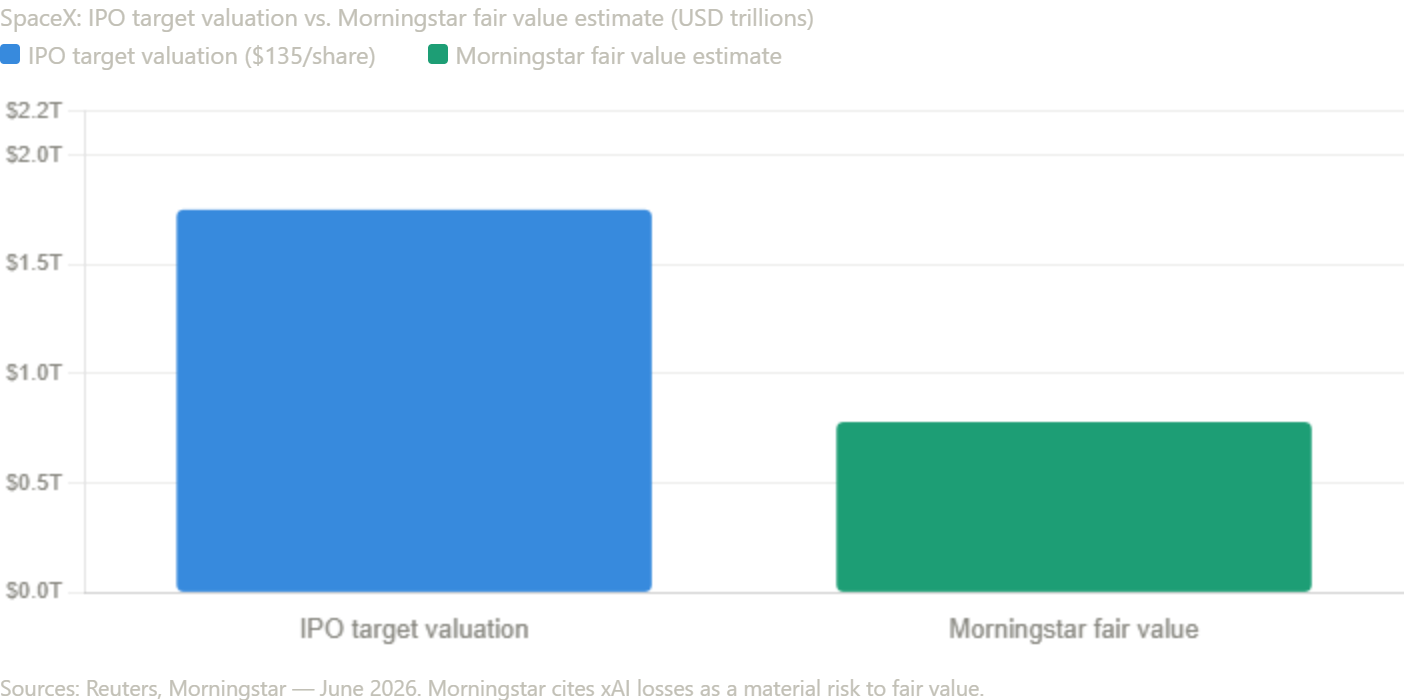
Alt text: Bar chart comparing SpaceX's expected IPO valuation of $1.75 trillion with Morningstar's $780 billion fair value estimate. Morningstar's estimate is roughly 55% below the IPO target. Sources: Reuters and Morningstar, June 2026.
Why It Matters for Portfolios
I hold MSFT, AMZN, and META. I'm not selling them. But the honest thing to say about this moment is that a bubble doesn't need to pop tomorrow to change how you deploy new capital.
The question is not whether SpaceX is real. Starlink alone is a serious business, and the company may become one of the most important public companies in the market. The question is always the same one: what price are you paying to own it?
Nasdaq's official explanation is that the 3x float cap is meant to make low-float index inclusion more manageable, not less. Critics read it differently. George Noble, CIO of Noble Capital Advisors, called the fast-entry proposal "the most shameless structural manipulation of a major index" he had seen and argued that passive retirement accounts become exit liquidity for early investors.
I think the mechanics matter more than the rhetoric. If SpaceX is added quickly, passive funds tracking the Nasdaq-100 have to buy according to the index rules. They are not buying because Morningstar likes the valuation. They are not buying because the company cleared a year of public price discovery. They are buying because the index changed.
That's a different risk profile than the broad market exposure I already carry. Technology winning and investors winning are two different things.
For more on the macro backdrop behind these moves, see The Dollar Trade Nobody's Talking About in 2026
What I'm Watching
The first signal is June 12: where SPCX opens relative to the $135 IPO price and whether it holds after the initial demand wave. A violent first-day rally followed by a slow drift lower would fit the pattern of mechanical demand getting ahead of fundamental buyers.
The second signal is the Nasdaq-100 inclusion calendar. Accounting for market holidays, the earliest realistic window looks like early July, not late June. If SpaceX holds its valuation into that window, the next test is OpenAI. Reuters says OpenAI has confidentially filed and could target a valuation up to $1 trillion in an IPO as early as September. Anthropic has also filed, and Reuters reported its latest post-money valuation near $965 billion.
Three companies. Potentially trillions of dollars in public-market value. All arriving in the same passive-investing machine.
I'm not sitting in cash waiting for a crash that may not come. I'm being more selective about where new money goes from here.
Long MSFT, AMZN, and META at time of writing.
Howard is a full-time trader based in New Jersey with experience across Forex, crypto, equities, and futures. He started Position Note to document his trades and analysis in public. All positions are disclosed. Nothing here is personalized investment advice.