13F Coverage
$GOOGL 13F Consensus: The Smart Money Split in Q2 2026

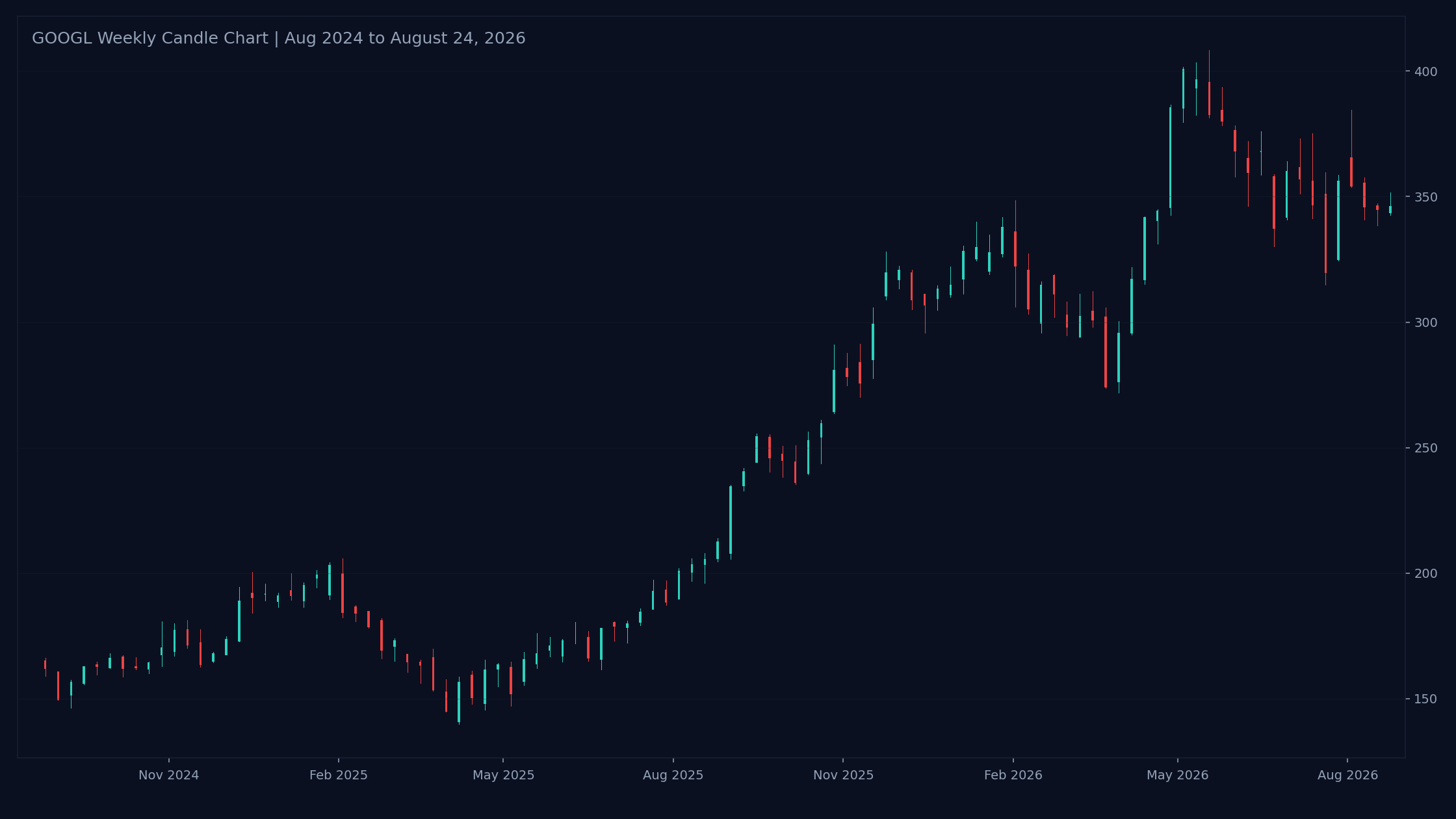
Berkshire Hathaway bought 48.1 million more shares of $GOOGL in Q2, roughly $17 billion worth, making Alphabet about 12.6% of its stock portfolio across both share classes. The same quarter, Tiger Global sold 45% of its stake, Fundsmith sold 40%, and David Abrams trimmed 27%. Eleven of the 24 funds I track still hold it, more than any other stock on my board. The stock trades at $346.92 as of August 25, down 13.8% from its May high. When the smart money disagrees this hard on one name, the disagreement itself is the signal, so let's look at both sides.
Quick rules for reading this: 13F filings show holdings as of June 30 and got filed August 14. They don't show entry prices, so nobody knows what these funds paid. And I sort my 24 funds into three tiers by holding period: patient long-duration money, opportunistic and activist funds, and fast-moving growth funds. Cross-tier agreement is the strongest signal these filings produce.
The Buyers
The buy side of this split is the patient money, and the sizes are not maintenance adds.
Berkshire's add is the headline for a reason. A 48.1 million share increase took its Class A stake up 45% in one quarter, and combined with the Class C shares, Alphabet is now Berkshire's number 4 position at 12.6% of the book, behind only $AAPL, American Express, and Coca-Cola. For a portfolio that famously does nothing most quarters, a $17 billion single-name add is about as loud as Omaha gets.
The rest of the buyer list backs it up:
- Third Point took its stake from 175,000 shares to over 1 million, a 486% increase to 7.8% of its book
- Harris Associates, the Oakmark value shop, added 118%
- Li Lu's Himalaya Capital kept roughly 48% of its entire portfolio in the two Alphabet share classes, the single most concentrated bet on my whole board
- Duquesne and others added too; across all institutions filing, 11 bought for every 6 that sold
What I find most interesting is what Dan Loeb sold to fund his add. Third Point exited $NVDA, Broadcom, and Meta entirely the same quarter it multiplied its Alphabet stake. That reads like a deliberate trade: get paid by the company using the chips instead of the companies selling them.
The Sellers
The sell side is real money too, and it's concentrated in the growth tier. Tiger Global cut from 10.6 million shares to 5.8 million, about $1.7 billion of selling that dropped Alphabet from its top position to fourth. Fundsmith, Terry Smith's quality-growth fund, cut 40%. Abrams Capital trimmed 27%. Viking and Pershing Square reduced or exited as well per the aggregate filing data.
Here's my honest read on the sellers: this looks like profit taking after a monster run, not a broken thesis. $GOOGL ran to $402.38 by mid-May, and a growth fund that rode it from the $200s did its job by trimming into that. Tiger kept a top-5 position after the cut. Fundsmith still holds 4.6% of its book in it. Nobody on the sell list went to zero except the funds that were barely holders to begin with. Sellers cutting half while buyers add billions is a disagreement about price and timing, not about whether the business works.
What the Sizes Tell Us
Position sizing separates conviction from decoration, and the sizing here favors the bulls. Berkshire at 12.6%, Himalaya at 48%, Abrams still at 8.9% even after trimming, Tiger still at 8.7% after selling. Even most of the sellers kept Alphabet as a major position. Compare that to the consensus names where holders sit at 1% or 2% each and this is a different animal: the funds that own $GOOGL own it in size.
The cross-tier check passes too. Patient money added, opportunistic money added, and the fast money that sold mostly kept large stakes. That's about as strong as a consensus signal gets on my framework, and it's stronger than the Q1 version of this same trade, when the buyer list was building but Berkshire hadn't yet supersized the position.
What I'm Watching
I don't own $GOOGL and I'm not buying it today. What the filings changed is how seriously I take the dip.
The stock is 13.8% off its May high while the buyer list got stronger, and the two things I care about from here are simple. First, whether it holds the $300 to $320 zone if this market pullback deepens, because that's where the last consolidation sat and a hold there with this ownership base underneath would tell me the patient money is defending its ground. Second, the capex question that hangs over every AI name: Alphabet's data center spending keeps climbing, and I want to see cloud revenue growth keep outrunning it. Those two things, price structure and capex versus revenue, decide whether this stays a watchlist name or becomes a position. My exact plan is below for members.
Related Reading: The Smart Money Just Moved Into Alphabet: Not Just Buffett and The AI Bubble's Early Tripwires Are Already Flashing
Disclosure: I hold no position in $GOOGL. I hold positions in $AMZN, $META, and $MSFT, which are mentioned as portfolio context, per my portfolio as of August 7, 2026.
Disclaimer: This is not personalized investment advice. I'm sharing my own research process and portfolio thinking. Do your own work before making any investment decision.
Howard is a full-time trader based in New Jersey with 13 years of experience across Forex, crypto, equities, and futures. He started Position Note to document his trades and analysis in public. All positions are disclosed. Nothing here is personalized investment advice.
Members Only: How I Am Managing the Watch
- The exact price zone where I start buying and how I'd scale in
- The one non-price event that would make me buy sooner
- Why I sold my own Alphabet position in 2025 and what's different now
- How a $GOOGL position would fit against my existing $AMZN and $META exposure