Market Notes
The AI Bubble's Early Tripwires Are Already Flashing

The entire AI trade rests on one assumption, that the companies pouring close to a trillion dollars a year into data centers will eventually earn it back because the rest of the world has no other option. I don't think you wait for that spending to stop before the belief behind it cracks. When the dot-com bubble broke, the Nasdaq peaked in March 2000 while the companies laying fiber kept spending well into 2001, so the market repriced a full year before the building slowed down. This time the trigger will be quieter than a crash, and a handful of market gauges are already twitching. These are the four dials I'm watching, and why I think belief moves before the capex does.
What the Data Shows
Start with who the market is actually paying. Michael Burry, still best known for calling 2008, has spent this year building short bets against the chip complex, including put options on SOXX, the main semiconductor-sector ETF, running into January 2027, and a Micron short disclosed July 1 at $1,051.87 after that stock ran up 241% in 2026. The charts he's been circulating make a sharper point than the shorts themselves. The semiconductor names selling the picks and shovels have massively outrun the hyperscalers actually funding the buildout, and the Philadelphia Semiconductor Index is sitting near the top of its 15-year forward P/E range. When the sellers are priced for a boom and the spenders get almost no credit for the spending, the market is quietly telling you it doesn't believe the spenders make it back.
The money behind the story is worse than the headlines suggest. OpenAI ran an operating loss of roughly $20.9 billion in 2025 according to leaked financials reported by the Financial Times, and the biggest spenders are increasingly funding data centers with debt rather than cash. The cost curve is the tell here, because unlike classic software, every additional user of these models costs real money in electricity and worn-down chips, so scale stops turning into free profit.
Then there's the signal from the people who lend the money. Goldman Sachs strategist Rich Privorotsky put it plainly, that the first hyperscaler to signal a slowdown in AI spending would likely see its stock rewarded, not punished. That's the opposite of how a healthy growth story behaves, and it's the clearest sign that the market wants an excuse to reprice.
Why It Matters for Your Portfolio
If you hold anything levered to the AI buildout, and I hold several names that are, the risk isn't that AI fails. The risk is that the market stops paying for spending before the spending stops. The stocks most exposed are the ones whose valuations already assume the trillion dollars comes back at a fat margin, which is most of the semiconductor and AI-infrastructure complex. The ones with the most cushion are the hyperscalers with real cash businesses underneath the AI line item, which is part of why I still own names like $META and $ORCL through this. You don't need to call the top to respect the setup, you just need to know which dials flip first so you're not the last one holding the story.
What I'm Watching
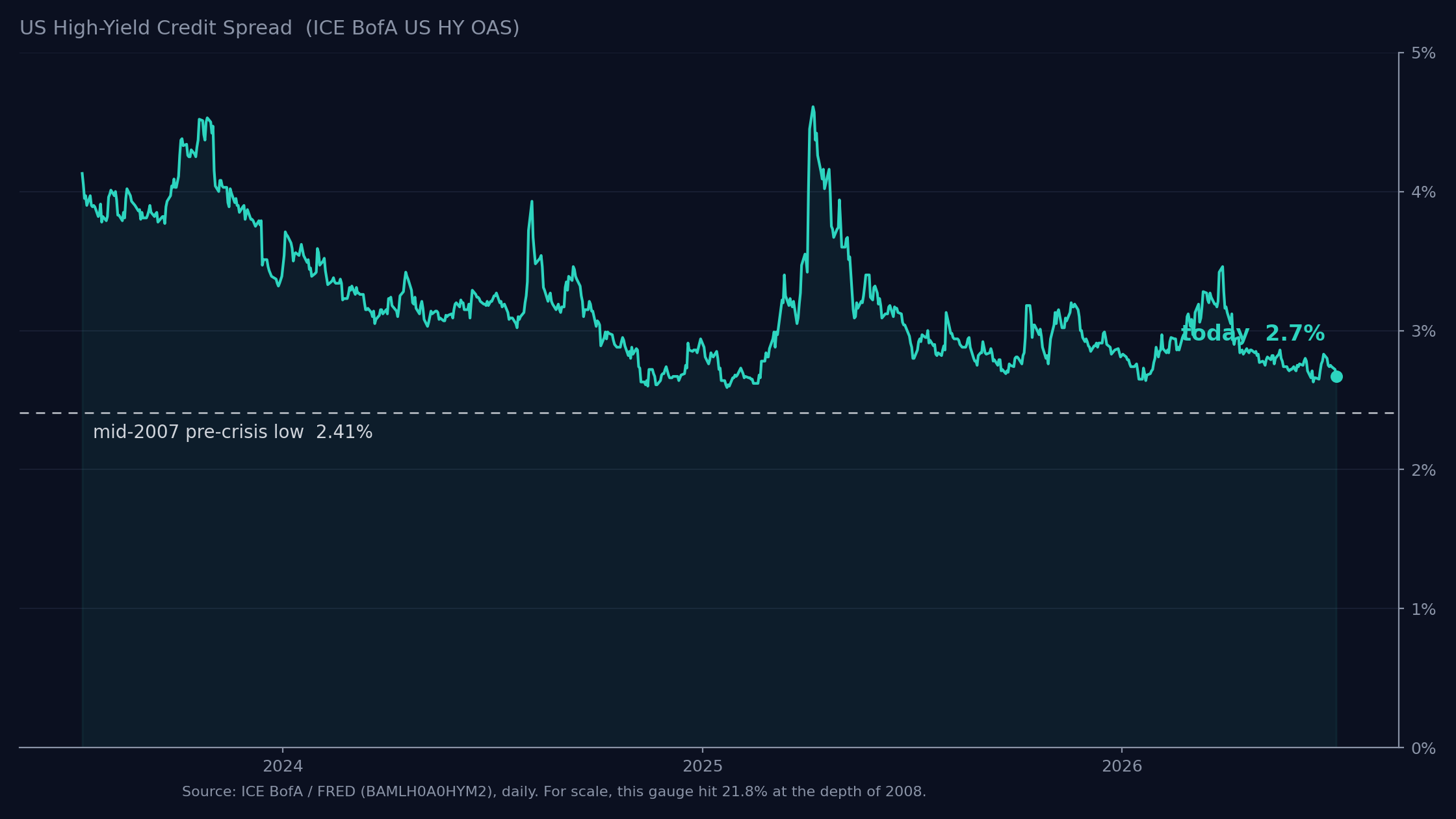
The first concrete trigger is a hyperscaler earnings call where management guides capital spending lower and frames it as newfound efficiency rather than a retreat. Goldman's own read is that the first company to make that move gets rewarded instead of punished, so the moment one respected CEO does it, the rest get the cover to follow. The second is the debt market, specifically any sign that AI and data-center debt issuance is getting harder to place, since this buildout increasingly runs on borrowed money. The third is high-yield credit spreads, which at 2.7% today are near their calmest levels since before 2008 and have room only to widen. None of these has broken yet, and that's exactly the point of watching them now rather than after.
Related Reading: Why I Still Own $ORCL After the AI Cloud Pullback and Why I Own $META After the AI Capex Reset.
Disclosure: I hold long positions in several AI-buildout names touched on here, including $META, $ORCL, $AMZN, $BE and $PLTR, all disclosed in prior articles.
Disclaimer: This is commentary and my personal opinion, not personalized investment advice, and you should do your own research and manage your own risk. See the full disclaimer for details.
Howard is a full-time trader based in New Jersey with 13 years of experience across Forex, crypto, equities, and futures. He started Position Note to document his trades and analysis in public. All positions are disclosed. Nothing here is personalized investment advice.