13F Coverage
Tepper Nearly Tripled UBER in Q1 2026: Why It Matters

Disclosure: I don't hold a position in UBER or any security mentioned in this article at the time of publication. This isn't personalized investment advice.
David Tepper nearly tripled his Uber position in Q1 2026.
Not a small add. A +242% increase that brought Appaloosa's stake to 6.33 million shares worth approximately $455M.
That's the signal. Not a new discovery, not a passive rebalance.
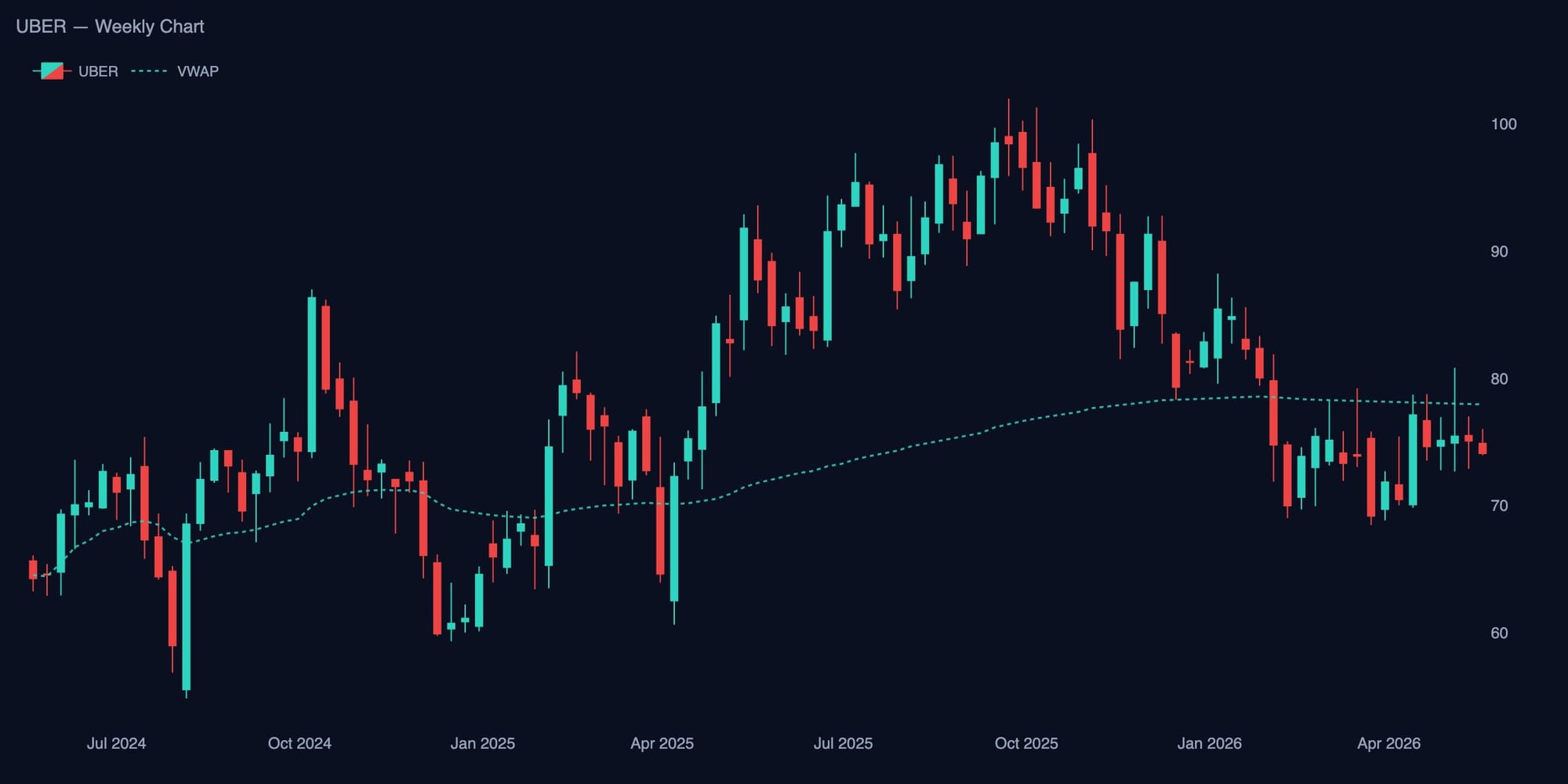
Tepper moved aggressively into Uber while the stock was sitting 26% off its 52-week high of $101.99. Tom Russo at Gardner Russo also added during the same quarter.
Different manager, different framework, same direction.
Here's what the full positioning looks like and what I think it means.
Tier 1: Long-Duration
Tom Russo at Gardner Russo increased his Uber position by 0.6%, adding 28,344 shares to bring the position to 5.17 million shares worth approximately $372M.
I'll be honest about the signal weight here. A 0.6% increase from a long-duration manager is portfolio maintenance, not a conviction add.
Russo has owned Uber for a while and barely moved.
The Tier-1 signal on UBER is directional only. It matters because it confirms a long-duration holder wasn't selling into the weakness.
But it doesn't carry the weight of a major new position or a large add.
The real story is one tier down.
Tier 2: Opportunistic
David Tepper's Appaloosa added 4.48 million shares, a 242% increase that brought the position to 6.33 million shares worth approximately $455M.
Tepper doesn't accidentally nearly triple a position.
He moves fast and with conviction when he thinks the setup is right. A 242% increase in a single quarter is an active call that the price was wrong.
That matters because Tepper has one of the better track records on this list for timing entries in consumer and tech names.
When he moves this aggressively, it's worth understanding what he was buying into.
The setup in Q1 was clear. Uber had sold off from $101.99 to a low of $68.46, a 33% decline driven by broader market fear and robotaxi disruption headlines.
Tepper appears to have looked at that selloff and decided the market was overpricing the risk.
Tier 3: Dynamic
No Tier-3 managers moved meaningfully on Uber in Q1.
The signal here is concentrated: one major Tier-2 add with small Tier-1 directional confirmation.
That's thinner consensus than GOOGL or AMZN. It's worth flagging honestly.
This is a single-manager conviction signal, not a broad cross-tier wave.
What the Positioning Actually Tells You
Tepper's Q1 move on Uber gets interesting when you look at what he was buying into.
Uber's Q1 2026 results were solid. Revenue came in at $13.2B, EPS of $0.72 beat the $0.71 consensus, and gross bookings hit $53.7B, up 25% year-over-year.
The business wasn't broken.
The stock sold off because of broader market fear and the ongoing robotaxi narrative around Waymo and Tesla.
That's the setup Tepper was buying. Not a broken business, but a good business trading at a discount because the market was pricing in a disruption risk that hasn't fully materialized yet.
At 18.7x earnings on a platform growing revenue 18% year-over-year, Uber isn't expensive by historical standards.
That's the valuation case.
The 13F signal doesn't say Uber is risk-free. It says one aggressive, opportunistic manager used the selloff to size up.
That's different from broad consensus, but it still matters.
The Bull Case
The bull case comes down to three things.
First, the platform moat is real. Uber operates in 70+ countries with network effects that are genuinely difficult to replicate.
Waymo and Tesla can disrupt the ride-hailing margin structure, but displacing the demand aggregation layer is a different problem entirely.
Second, Delivery is the underappreciated asset.
Uber Eats continues to grow, and the unit economics keep improving. As the platform matures, Delivery can become a higher-margin business than the market currently prices.
Third, the valuation is reasonable.
At $75 with 18.7x earnings and 18% revenue growth, Uber is cheaper than most consumer tech peers on a growth-adjusted basis.
That's what gives Tepper's Q1 add its context. The price was genuinely attractive relative to earnings power.
The Bear Case
The bear case is real and worth taking seriously.
Robotaxi disruption isn't a fake risk. Waymo is already operating in multiple cities, and Tesla is pushing hard on Full Self-Driving.
If autonomous vehicles start taking meaningful share from Uber drivers, the unit economics of the platform change.
Worker classification is the other risk.
Regulatory rulings in the US and Europe could force Uber to reclassify drivers as employees, which would materially increase operating costs.
The stock is also already up from the March low. At $75, Uber has recovered 10% from $68.46.
The easy money from the panic selloff has already been made.
That's why I'm treating this as a watchlist signal, not a chase signal.
Tepper's move is interesting. The current price still has to make sense.
What I'm Watching
Q2 earnings on August 4 are the next real catalyst.
Gross bookings growth is the number that matters. If bookings stay above 20% year-over-year, the platform thesis holds.
If growth decelerates meaningfully, the multiple compression risk comes back.
I'm also watching the robotaxi narrative. Every Waymo expansion announcement creates headline risk for Uber.
The stock is sensitive to that narrative even when the actual competitive impact is limited.
For the public thesis, the question is simple: can Uber keep compounding bookings and earnings faster than the market discounts robotaxi risk?
If the answer is yes, Tepper's Q1 add makes sense. If the answer is no, the stock probably needs a lower reset before it gets interesting again.
Related reading: Klarman and Elliott Both Opened NCLH in Q1. The Stock Is Now at 52-Week Lows, and Four Managers Quietly Added Amazon in Q1. Nobody Noticed
Howard is a full-time trader based in New Jersey with 13 years of experience across Forex, crypto, equities, and futures. He started Position Note to document his trades and analysis in public. All positions are disclosed. Nothing here is personalized investment advice.