Market Notes
Meta's 2-for-1 Split Is a Funding Move, Not a Reward, 2026

Meta is creating a new class of non-voting Class C stock and handing every shareholder one share of it for each share they already own. That makes the Class A price look like a 2-for-1 split, and most of the coverage I saw called it exactly that. I think the split is the packaging and the capital raise is the product. 5 days after announcing it, Meta priced $37.5 billion of new equity and said it plans a roughly $60 billion at-the-market program in Class C shares once they start trading. Mark Zuckerberg's voting control doesn't move at all.
What the Data Shows
Meta reported Q3 2026 on October 21, 2026, and the revenue line was fine. Revenue was $64.601 billion, up 26% from a year earlier. The cash flow line was the problem, because free cash flow came in at negative $2.120 billion for the quarter on capital expenditures of $34.906 billion including finance lease payments.
The nine-month figures show how fast this turned. Meta spent $83.055 billion on property and equipment through September 30, 2026, against $48.308 billion in the same nine months of 2025. Over that same stretch it repurchased zero dollars of its own Class A stock, down from $26.248 billion a year earlier. Those come straight from the Q3 2026 10-Q.
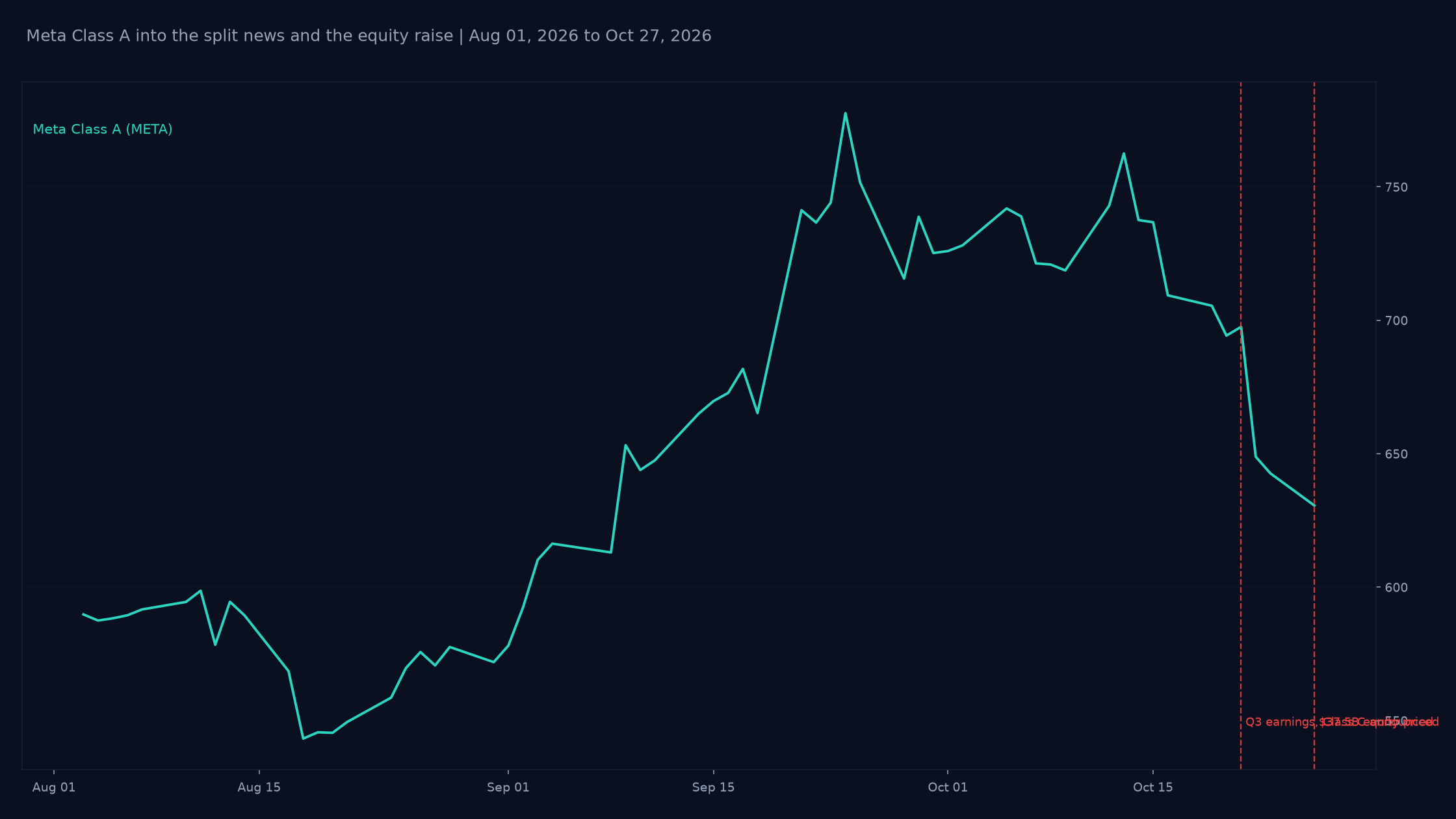
Then it went the other direction. On October 26, 2026, Meta priced $12.5 billion of 6.50% Series A mandatory convertible preferred stock and $25.0 billion of Class A stock through forward sale agreements at $625.00 per share, against a $642.62 close on October 23. The same release flagged the roughly $60 billion Class C at-the-market program, which isn't expected to start before the first quarter of 2027.
The Class C shares are what makes all of that possible. Meta's own earnings release says the stock dividend "will not change the voting power of any shareholder," and the April 2026 proxy says Meta is a controlled company under Nasdaq rules because Zuckerberg controls a majority of the voting power. Google ran this same play on April 2, 2014, when it paid out non-voting Class C shares and kept the founders' votes intact.
Why It Matters for Your Portfolio
If you own Meta, this isn't a reward, it's the bill. Between the $37.5 billion priced on October 26 and the $60 billion program planned for 2027, Meta has lined up close to $97.5 billion of equity issuance to fund a buildout guided at $135 billion to $145 billion of capex in 2026 alone. The shares paying for it carry no vote, so you fund the AI capex and you get no say in whether it was worth it. I own Meta and I'm not selling on this, but I'm now reading it as a company that needs outside money every year rather than one that funds the buildout out of its own operating cash flow.
What I'm Watching
January 19, 2027 is the effective date on the amended certificate of incorporation, with Class C trading expected to begin in late January. After that, the thing I want to see is whether the $60 billion at-the-market program actually launches in Q1 2027 and how fast Meta uses it, because an ATM that runs hard is a very different signal than one that sits there. The other one is 2027 capex. Meta said on October 21 that it's still developing its budget and capacity plans for next year, so if that number lands above the $135 billion to $145 billion range guided for 2026, the equity raises aren't finished.
Related Reading: Why I Own $META After the AI Capex Reset and The AI Bubble's Early Tripwires Are Already Flashing
Disclosure: as of September 2, 2026 I hold a position in $META.
Howard is a full-time trader based in New Jersey with 13 years of experience across Forex, crypto, equities, and futures. He started Position Note to document his trades and analysis in public. All positions are disclosed. Nothing here is personalized investment advice.