Market Notes
OpenAI's Revenue Didn't Fall. The AI Trade Did, 2026

OpenAI's revenue didn't drop on October 8. The way people counted it changed, and the Nasdaq 100 fell 1.39% that session anyway. The Financial Times reported that OpenAI told investors its annualized revenue was about $50 billion at the end of September 2026, roughly $20 billion under the number that had been circulating for a week. The gap is an accounting difference, not lost demand. The part worth knowing is that a definition change in one private company's unaudited number took about $169 billion off Nvidia in a single day.
What the Data Shows
The $20 billion gap comes down to one question: who books the sale when a customer buys through a cloud marketplace. Anthropic counts the full value of sales made through its cloud partners. OpenAI counts only its own share of those sales. Investors grossing OpenAI up so they could compare the two companies side by side are where the $70 billion came from, and when the Financial Times published the real figure on October 8, 2026, it was about $50 billion as of the end of September. Same customers, same demand, two different definitions.
Nothing inside the same investor presentation got worse. Quartz reported on September 29, 2026 that OpenAI told investors its run rate grew 77% during the third quarter, with the enterprise segment up 107%, and the company is still pointing at $70 billion or more by the end of 2026. Getting from $50 billion to $70 billion means another 40% in one quarter, so I'd treat that target as a stretch, but it isn't a company telling investors demand is slowing.
The market ignored all of that. On October 8, 2026 the Nasdaq 100 fell 1.39% while the S&P 500 fell 0.47%, so nearly all of the damage landed inside one trade. Nvidia closed down 2.94% at $230.48, AMD fell 3.90%, and CoreWeave fell 7.77%.
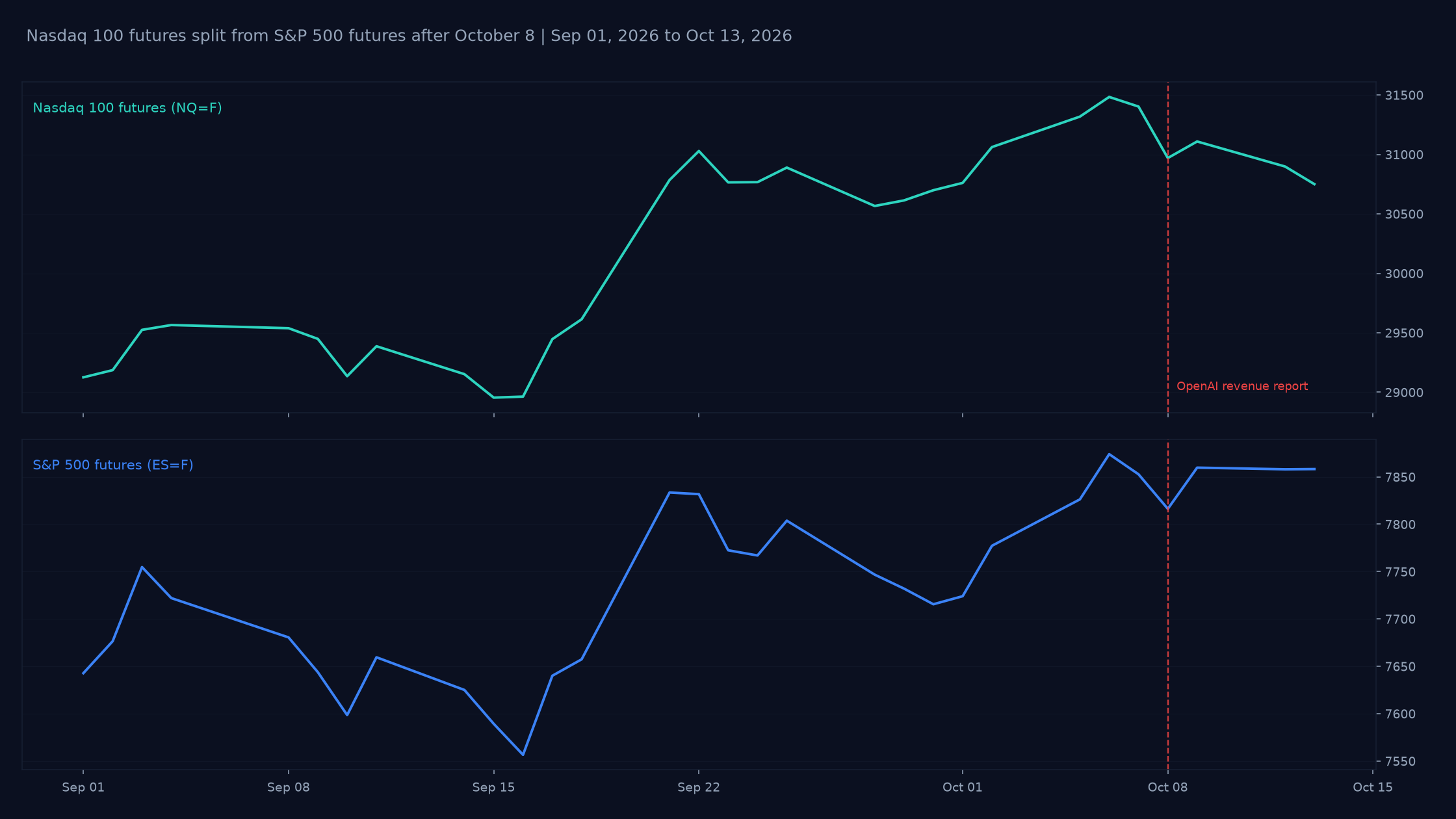
3 sessions later the split is still open. Nasdaq 100 futures went from 30,969.50 on October 8 to 30,764.00 on October 13, down 0.66%, while S&P 500 futures gained 0.55% and gold futures gained 1.34% over the same stretch.
Why It Matters for Your Portfolio
If you own the AI complex, the lesson here isn't that demand broke. It didn't. The lesson is what you're actually paying for. A number nobody audits, that one private company publishes when it feels like it, and that two companies compute differently, moved the Nasdaq 100 1.39% in a session while the rest of the market barely flinched. The names carrying that risk are the ones whose forward estimates lean on one buyer's spending plans staying intact.
What I'm Watching
2 things. The first is the year-end number, because the $70 billion target is checkable in January and I'll take the reported figure over the forecast every time. The second is the gap between the two indexes, with S&P 500 futures at 7,859.00 and Nasdaq 100 futures at 30,764.00 as of October 13, 2026. If the Nasdaq 100 keeps lagging while the S&P 500 grinds higher, the market is repricing the AI premium and not the economy. I could be wrong on how long that takes, but I'd rather watch the spread than argue about the headline.
Related Reading: Anthropic's S-1 Is an Accounting Test for AI in 2026 and The S&P 500's Top 10 Is 37% and Mostly One Trade in 2026
Howard is a full-time trader based in New Jersey with 13 years of experience across Forex, crypto, equities, and futures. He started Position Note to document his trades and analysis in public. All positions are disclosed. Nothing here is personalized investment advice.