Market Notes
The S&P 500's Top 10 Is 37% and Mostly One Trade in 2026

The 10 biggest holdings in the S&P 500 were 37.4% of the index on August 14, 2026, and 8 of those 10 are the AI trade in one form or another. So when someone tells you an index fund is diversified, what they actually own is mostly one bet: the world keeps buying American AI at American prices. I went and pulled the published price lists this week to see what the alternative costs, and the gap is wide enough that I think the pricing side of this story is the soft spot, not the demand side. I'm not calling a top on AI, I'm saying the part of the thesis nobody stress tests is the part that says the margin holds.
What the Data Shows
State Street publishes the SPDR S&P 500 ETF holdings every day, so this one is not somebody's estimate. As of August 14, 2026, Nvidia was 8.14% of the fund and Apple was 6.70%, and the top 10 together came to 37.4%. Strip out Apple and JPMorgan and you're left with 8 names that are chips, cloud, memory, or the companies building the data centers. It's the same trade wearing 8 different names.
Then there's what the compute actually sells for. Google's own pricing page on August 18, 2026 lists Gemini 3.1 Pro at $2.00 per million input tokens and $12.00 per million output tokens for prompts under 200,000 tokens. DeepSeek's pricing page the same day lists its v4-pro model at $0.66 input and $1.98 output during off-peak hours, roughly double that at peak. They're not the same model and I'm not claiming they do identical work, but both of those are published list prices for a flagship tier, and one of them is several times cheaper on the output side.
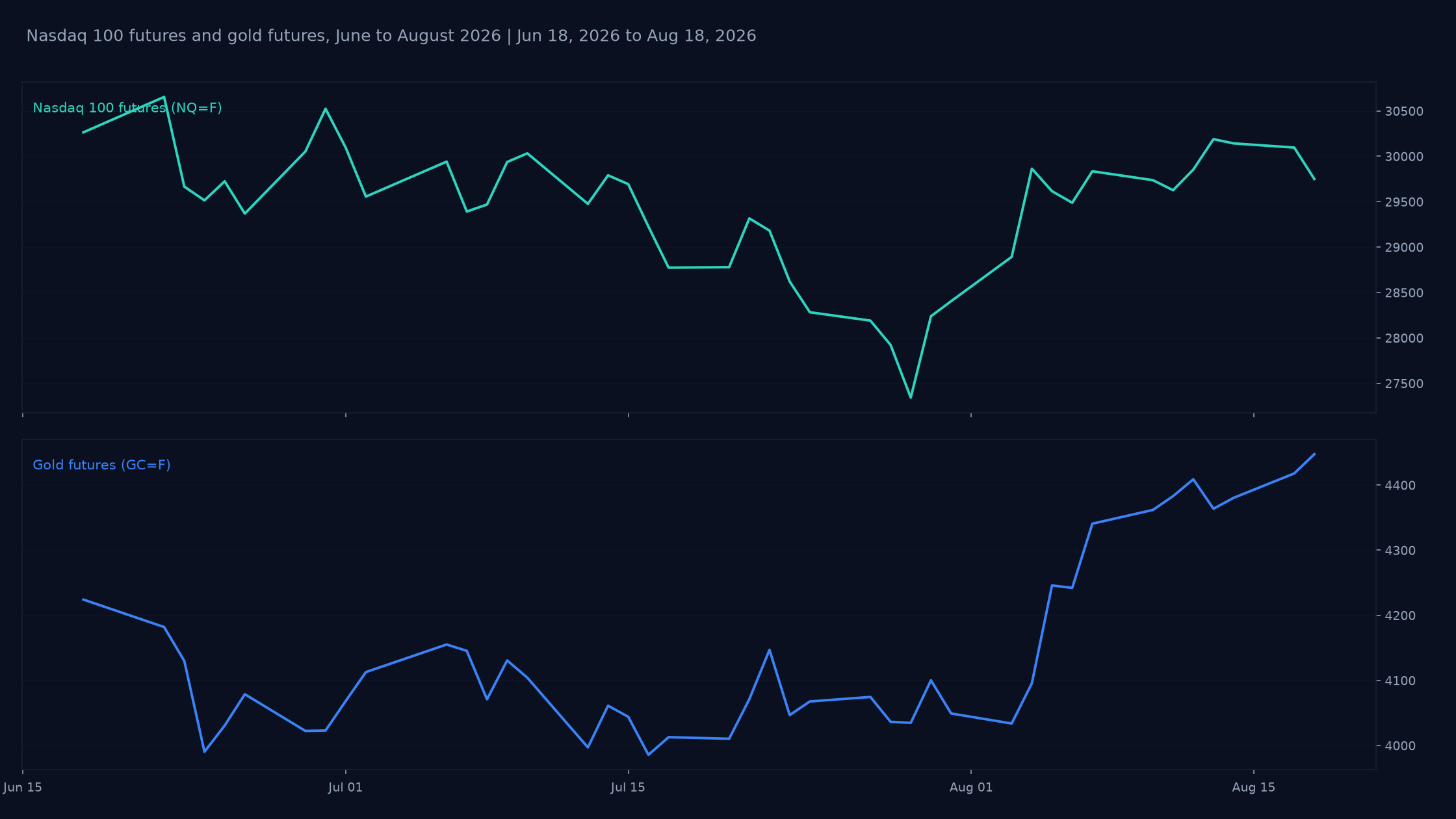
The tape started sorting it this week. Nasdaq 100 futures closed at 29,745.25 on August 18, down 1.47% over 5 sessions, while S&P 500 futures were down 1.23% over the same stretch. Gold futures went the other direction, up 1.95% to 4,448.90. The dollar index was 99.63 and the 10-year Treasury yield was 4.68% on August 14 per FRED, so this wasn't a rate shock, it was the AI-heavy index leaking faster than the broad one.
Why It Matters for Your Portfolio
If you hold an S&P 500 fund or a Nasdaq fund, you own the AI trade whether you picked it or not, and you own it concentrated at the top. The risk everyone argues about is demand, whether all this capacity gets used. The risk I'd rather watch is price, because a customer with a cheaper published option doesn't have to walk away to cost you money, they just have to negotiate at renewal. Margin comes out of a story long before revenue does.
What I'm Watching
Nvidia reports its fiscal second quarter on August 26, 2026, per the company's own July 29 announcement, and it's 8.14% of the index by itself. I care more about the gross margin line and any pricing commentary than the revenue headline, because that's where a price war shows up first. After that the FOMC meets September 15 and 16, 2026, and if the AI names keep sliding while gold holds its bid through both events, that's rotation rather than a rates story. Let's be honest about the limits here: a cheaper list price isn't a signed contract, list prices move, and I can't see enterprise renewal pricing at all, so I'm watching this one, not calling it.
Related Reading: The AI Bubble's Early Tripwires Are Already Flashing and Why I Own $AMZN as the 2026 AI Infrastructure Stock
Howard is a full-time trader based in New Jersey with 13 years of experience across Forex, crypto, equities, and futures. He started Position Note to document his trades and analysis in public. All positions are disclosed. Nothing here is personalized investment advice.