Position Trades
Why I Own $AMZN as the 2026 AI Infrastructure Stock

Amazon isn't just an e-commerce stock for me.
It's an infrastructure bet.
That's the reason I own $AMZN here. The public story still starts with Prime, retail, and consumer spending, but the real upside comes from AWS, AI infrastructure demand, advertising, logistics scale, and the operating leverage that shows up when all of those pieces work together.
I'm not adding right now. I'm holding. My average cost is about $207.40, and I think the stock can work toward a broad $270-$305 valuation range over the next year if AWS keeps accelerating and the retail/advertising profit engine keeps expanding.
This isn't a panic-recovery trade like UNH. It is a strong-stock position trade where I already have the entry I want, the business is still executing, and the main job is not to overtrade it.
The Chart
$AMZN already had the pullback I cared about earlier this year.
The stock traded down near $196 in February, then recovered into the $240s and $250s. That matters because my position was built closer to the pullback, not after the stock had already stretched back toward the highs.
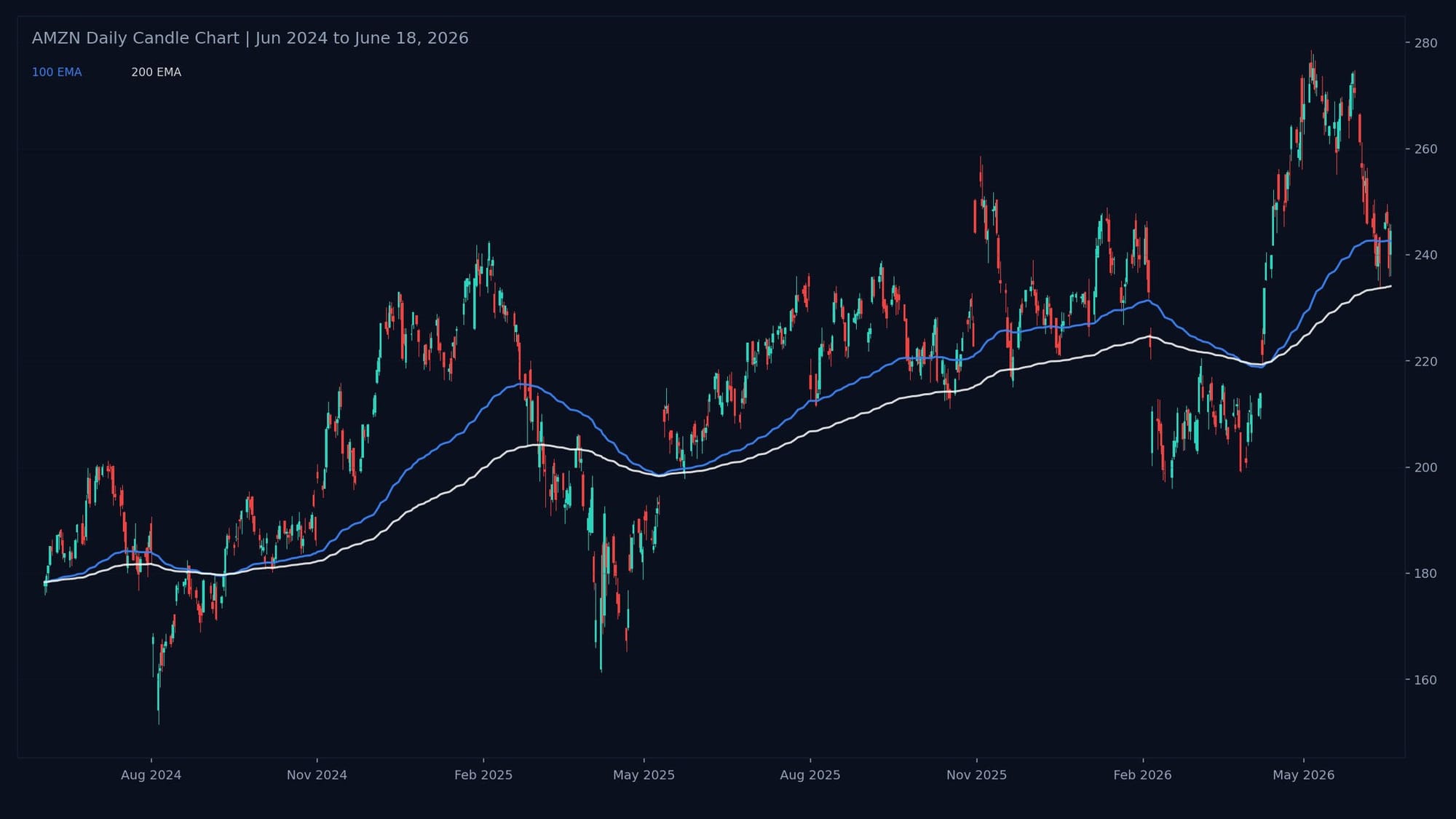
The chart isn't giving me a fresh add signal right now. It is giving me a hold signal.
If $AMZN had a deeper pullback later, I would look at it again. But that would be of a swing-trade decision unless the drop got large enough to make me want to size the position up in a meaningful way.
For now, I already own the stock. I don't need to chase more shares just because the chart still looks constructive.
Why the Business Is Still Intact
Amazon's latest quarter made the thesis pretty simple: the business is still growing, and the profit mix is getting better.
In Q1 2026, Amazon reported $181.5 billion in net sales, up 17% year over year. Operating income increased to $23.9 billion from $18.4 billion a year earlier. Net income was $30.3 billion, or $2.78 per diluted share.
Those are not weak numbers.
The most important piece is AWS. AWS revenue grew 28% year over year to $37.6 billion, and AWS operating income increased to $14.2 billion. That means AWS produced almost 60% of Amazon's total operating income in the quarter.
That's why I don't want to frame Amazon as a normal retailer.
Retail still matters. North America sales grew 12% year over year to $104.1 billion, and North America operating income increased to $8.3 billion from $5.8 billion. International also stayed profitable, with $1.4 billion of operating income.
But the real investment case is that Amazon now has multiple profit engines sitting on top of the same customer and infrastructure base.
AWS is the cloud and AI infrastructure engine. Advertising is the high-margin monetization layer. Prime and retail keep the consumer relationship active. Logistics gives Amazon scale that most competitors cannot easily copy.
That combination is why I own the stock.
Why the Infrastructure Bet Still Works
The market knows Amazon is big. That's not the edge.
The edge is that Amazon's size makes the infrastructure bet stronger, not weaker, if the company keeps executing.
AWS is the obvious part. AI demand is forcing companies to spend more on compute, storage, networking, and cloud infrastructure. Amazon already has the customer base, the data center footprint, the developer relationships, and the balance sheet to keep investing through the cycle.
That investment is expensive. It can pressure free cash flow in the short term. I'm not ignoring that.
But I would rather own the company with the demand problem than the company without one. If AWS is growing 28% on a base this large, the right question is not whether capex is high. The right question is whether that capex turns into durable revenue and operating income over the next several years.
Advertising is the second piece.
Amazon's ad business is already one of the most valuable hidden assets inside the company. It sits close to purchase intent, which makes it different from a normal display-ad platform. People are searching, comparing, and buying inside Amazon's ecosystem. That gives advertisers a reason to spend even when the broader ad market gets more selective.
Retail is the third piece.
The old Amazon story was revenue growth at almost any margin. The newer story is operating leverage. North America is already showing that the retail engine can produce real operating income while the company keeps investing in faster delivery, fulfillment, and Prime.
That's the setup I like: AWS growth, advertising monetization, and retail margin improvement all pushing in the same direction.
This is also why the Q1 13F signal mattered to me. Klarman, Nygren, Ackman, and Tepper all added to Amazon in Q1. I don't buy a stock just because other managers added, but I pay attention when different investor types look at the same pullback and all decide to increase exposure.
For me, that supported the idea that the February weakness wasn't a broken-business signal. It was a chance to own a stronger version of Amazon before the market fully priced the next leg of the infrastructure story.
My Valuation Range
A plain P/E target is too blunt because AWS, advertising, retail, subscriptions, and logistics don't deserve the same multiple. The better way to value $AMZN is to separate the major profit engines, value them independently, then cross-check the result against earnings.
For AWS, I'm using annualized Q1 operating income of about $56.8 billion and a 30x-34x operating income multiple. That values AWS around $1.7-$1.9 trillion.
For advertising, I'm using roughly $70 billion of annualized revenue and a 7x-9x sales range. That puts the ad business around $490-$630 billion.
For the retail, marketplace, subscription, and logistics base, I'm using annualized North America and International operating income of about $38.8 billion and a 20x-24x operating income range. That values the core commerce engine around $775-$930 billion.
Add those pieces together, apply a 10%-15% discount for complexity, capex intensity, and overlap between the segments, and the equity value lands around $2.9-$3.3 trillion. With roughly 10.76 billion shares outstanding, that gives me a broad valuation range of about $270-$305 per share.
That's my public target zone.
At a recent price around the mid-$240s, that range gives the stock reasonable upside without needing a ridiculous multiple. I'm not saying $AMZN is screaming cheap. I'm saying the current price still doesn't look stretched if AWS keeps compounding and advertising keeps becoming a larger part of the profit mix.
As a cross-check, the forward earnings framework gets me to a similar place. If Amazon can earn roughly $9-$10 per share over the next year and the market gives it a high-quality infrastructure/platform multiple in the low 30s, the stock also lands in the high $200s to low $300s.
That's close enough to the sum-of-the-parts range for me to use $270-$305 as the public valuation range.
Where I'm Wrong
I'm wrong if the infrastructure spending doesn't turn into durable profit.
More specifically, I'm wrong if AWS growth slows sharply while capex stays elevated, if AI infrastructure demand proves less profitable than expected, if retail margins roll over, or if advertising growth starts decelerating faster than the market expects.
The risk with Amazon isn't that the company is too small or irrelevant. The risk is that investors keep paying for future operating leverage while capex consumes more of the cash flow than expected.
That's the line for me.
If AWS is still growing fast and operating income is still expanding, I can live with heavy investment. If growth slows and spending stays high, the stock deserves a lower multiple.
What I'm Watching Next
The next few quarters are about AWS growth, capex discipline, and retail margin durability.
I want to see AWS stay above 20% growth. I want to see operating income keep expanding even while Amazon invests heavily in AI infrastructure. I want to see advertising stay one of the fastest-growing revenue streams in the business. I also want North America retail margins to hold up, because that's the proof that Amazon isn't just buying revenue.
If those things keep working, I think $AMZN can move toward my $270-$305 valuation range.
If they don't, I will treat the position differently.
For now, I'm holding. I'm not adding here. If the stock drops a lot later, I will revisit whether it becomes a larger position trade. Until then, my job is simple: let the infrastructure thesis keep playing out.
Related Reading
- Four Managers Quietly Added Amazon in Q1 — Nobody Noticed
- Why I Own UNH After the Trust Reset
Disclosure: I own shares of Amazon.
Disclaimer: This isn't personalized investment advice. I'm sharing my own research process and portfolio thinking. Do your own work before making any investment decision.
Premium: How I'm Managing the Position