Position Trades
Why I Own UNH After the Trust Reset

UnitedHealth Group is not a broken-business bet for me.
It is a trust-reset and margin-normalization bet.
That is the whole reason I own $UNH here. The stock has already been punished for Medicare Advantage pressure, medical cost inflation, Optum execution problems, regulatory headlines, and management credibility issues. Those are real problems. I am not trying to pretend they do not matter.
But I think the market has been pricing UNH like the earnings engine may be permanently impaired. My view is different. I think the business is damaged, but not broken. If the company can stabilize medical costs, keep repricing its book, clean up Optum, and restore investor trust, the upside over the next two to three years is still meaningful.
This is not a forever hold for me. It is a position trade with a defined thesis, a defined valuation range, and a clear reason I would change my mind.
The Chart
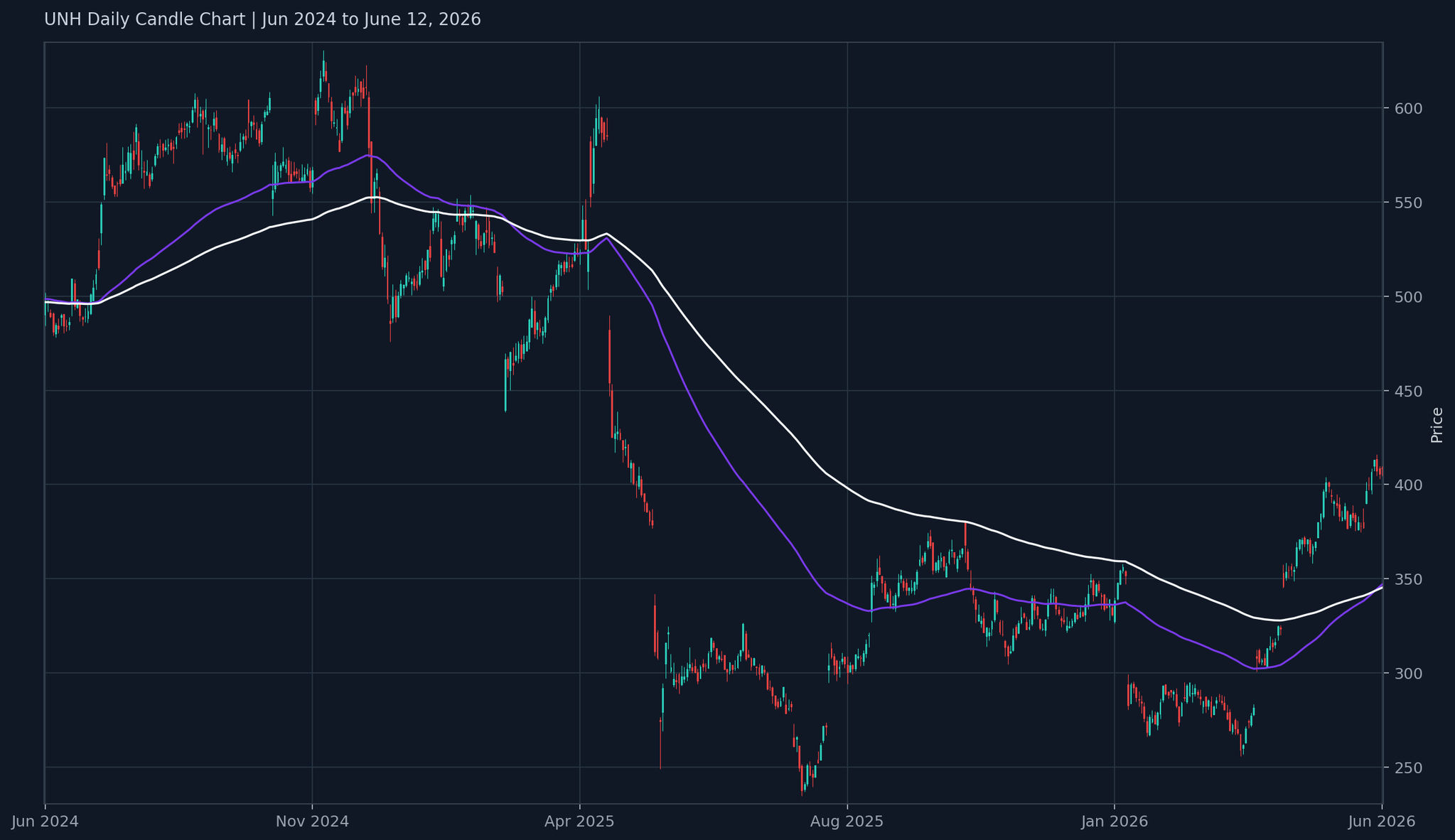
UNH is still well below where it traded before the market lost confidence in the story. That matters because the setup is not based on chasing a strong stock at a premium multiple. It is based on buying a damaged healthcare compounder while investors are still debating whether the old earnings power can come back.
The chart tells the same story as the fundamentals: this is no longer a clean momentum name. It is a recovery trade.
I am not buying this because the chart looks perfect. I am holding it because the panic already happened, the business is still producing huge cash flow, and the stock does not need a heroic multiple to work if earnings normalize.
Why the Business Is Still Intact
The first thing I want to check in a selloff like this is simple: is the business still making serious money?
For UNH, the answer is yes.
In the first quarter of 2026, UnitedHealth reported $111.7 billion in revenue, up 2% year over year. Earnings from operations were $9.0 billion. Adjusted EPS was $7.23. Cash flow from operations was $8.9 billion, or 1.4 times net income.
That is not a broken company.
The medical care ratio was 83.9%, down from 84.8% in the prior-year quarter. That is one of the most important numbers in this thesis because the bear case is built around medical costs running too hot. If the medical care ratio keeps improving, the stock can recover. If it gets worse again, the thesis gets much weaker.
UnitedHealthcare also expanded its first-quarter operating margin to 6.6%, up from 6.2% a year earlier. Optum is still messier. Optum revenue was $63.7 billion, with $3.3 billion of earnings from operations and a 5.2% margin. Optum Health is the piece I would watch most closely because that is where elevated medical costs and value-based care issues have hit confidence.
So the financial check is mixed, but it is not catastrophic.
The company is still massive. It is still profitable. It is still generating cash. The question is whether 2025 was a permanent reset lower in earnings power or a painful transition year that the market is now extrapolating too far.
That distinction matters. A broken business deserves a permanently lower multiple. A good business working through a margin reset usually deserves a discount for a while, but not forever. My bet is not that UNH goes straight back to its old valuation. My bet is that the current discount can narrow if the company proves the earnings base is still repairable.
Why the Selloff Can Be Temporary
The cleanest way to frame UNH is this:
The stock is down because investors stopped trusting the model.
For years, UnitedHealth was treated like one of the highest-quality compounders in healthcare. It had scale, Optum, strong earnings growth, buybacks, dividends, and a long record of execution. Then the story changed. Medical costs ran hotter. Medicare Advantage became more difficult. Optum Health had contract issues. Regulatory scrutiny increased. Management credibility took a hit.
That kind of damage does not get fixed in one quarter.
But that is also why the opportunity exists. I do not need the market to love UNH again immediately. I just need the company to prove that the worst fears are not permanent.
The recovery path is pretty clear:
First, medical costs need to stay manageable. Q1 showed improvement, but one quarter is not enough.
Second, repricing needs to work. UnitedHealthcare said the first-quarter margin improvement was driven mainly by repricing across its lines of business in response to elevated cost trends. That is exactly what I want to see.
Third, Optum has to stop being a drag on the story. It does not need to be perfect, but investors need evidence that the restructuring and contract cleanup are working.
Fourth, the legal and regulatory cloud cannot turn into permanent earnings damage. The DOJ and Medicare Advantage scrutiny are real risks. The stock deserves a lower multiple while that uncertainty exists.
That is why this is a two-to-three-year trade for me. The market is not going to forget these issues overnight. But if the company shows two or three more quarters of stabilization, the conversation can shift from "is the model broken?" to "what is normalized earnings power?"
That is where the upside comes from.
I also like that the setup does not require a perfect macro backdrop. Healthcare spending is not discretionary in the same way many consumer categories are. That does not make UNH risk-free, especially with regulation involved, but it does mean the company has a large recurring revenue base while it works through the reset. For a recovery trade, that matters.
My 2-3 Year Valuation Range
I am treating UNH as a managed-care recovery trade. The closest valuation framework is a normalized earnings multiple, because the core question is not liquidation value or asset value. It is what earnings power looks like after medical costs, Medicare Advantage pricing, and Optum margins stabilize.
Management now expects 2026 adjusted EPS of more than $18.25. I do not want to value UNH off a depressed transition year alone. My base case is that normalized EPS can recover toward the mid-$20s over the next two to three years if repricing works and Optum stops dragging down consolidated margins.
Using $24-$26 of normalized EPS and an 20x-22x recovery multiple gives me a broad valuation range of about $480-$570.
That is my public target zone.
At the June 12 close of $408.52, that range implies roughly 18% to 40% upside before dividends. I do not need UNH to return to a premium market-darling multiple for this to work. I need the market to believe the earnings base is repairable.
If the company earns closer to $22 and the market only gives it 17x, the stock is worth around $375. That is the bear-side math and why this is not risk-free.
But if normalized earnings power is closer to $26 and the multiple repairs to the low 20s, then the current price still leaves room for a real recovery trade.
Where I Am Wrong
I am wrong if the problems are not temporary.
More specifically, I am wrong if medical cost ratios stay elevated even after repricing, Optum margins fail to recover, Medicare Advantage exits do not stabilize profitability, or legal and regulatory outcomes permanently reduce normalized earnings power.
If that happens, UNH is not cheap because people are scared. It is cheap because the profit model changed.
That is the line for me.
This trade is not about pretending the headlines do not matter. It is about deciding whether the headlines have pushed the stock below what the business is likely to earn once the company gets through the reset.
What I Am Watching Next
The next few quarters matter.
I want to see the medical care ratio stay under control. I want to see UnitedHealthcare keep showing margin improvement. I want to see Optum Health margins stabilize. I want to see cash flow stay strong. I want to see management rebuild credibility by underpromising and overdelivering instead of asking investors to trust the old story.
If those things happen, I think the stock can keep working toward my $480-$570 valuation range over the next two to three years.
If they do not, I will treat the position differently.
For now, I am holding. I am not adding. I am waiting for my take-profit levels to hit.
Related Reading
- Your Index Fund Is About to Buy SpaceX Whether You Want It To
- The Dollar Trade Nobody's Talking About in 2026
Disclosure: I own shares/options of UnitedHealth Group.
Disclaimer: This is not personalized investment advice. I am sharing my own research process and portfolio thinking. Do your own work before making any investment decision.
Members Only: How I Am Managing the Position
- My current position size and where I entered
- Whether I'm adding, holding, or trimming here
- Exact price levels where I'd exit the trade