Market Notes
The US Just Bought Yen. Gold Read It First in 2026

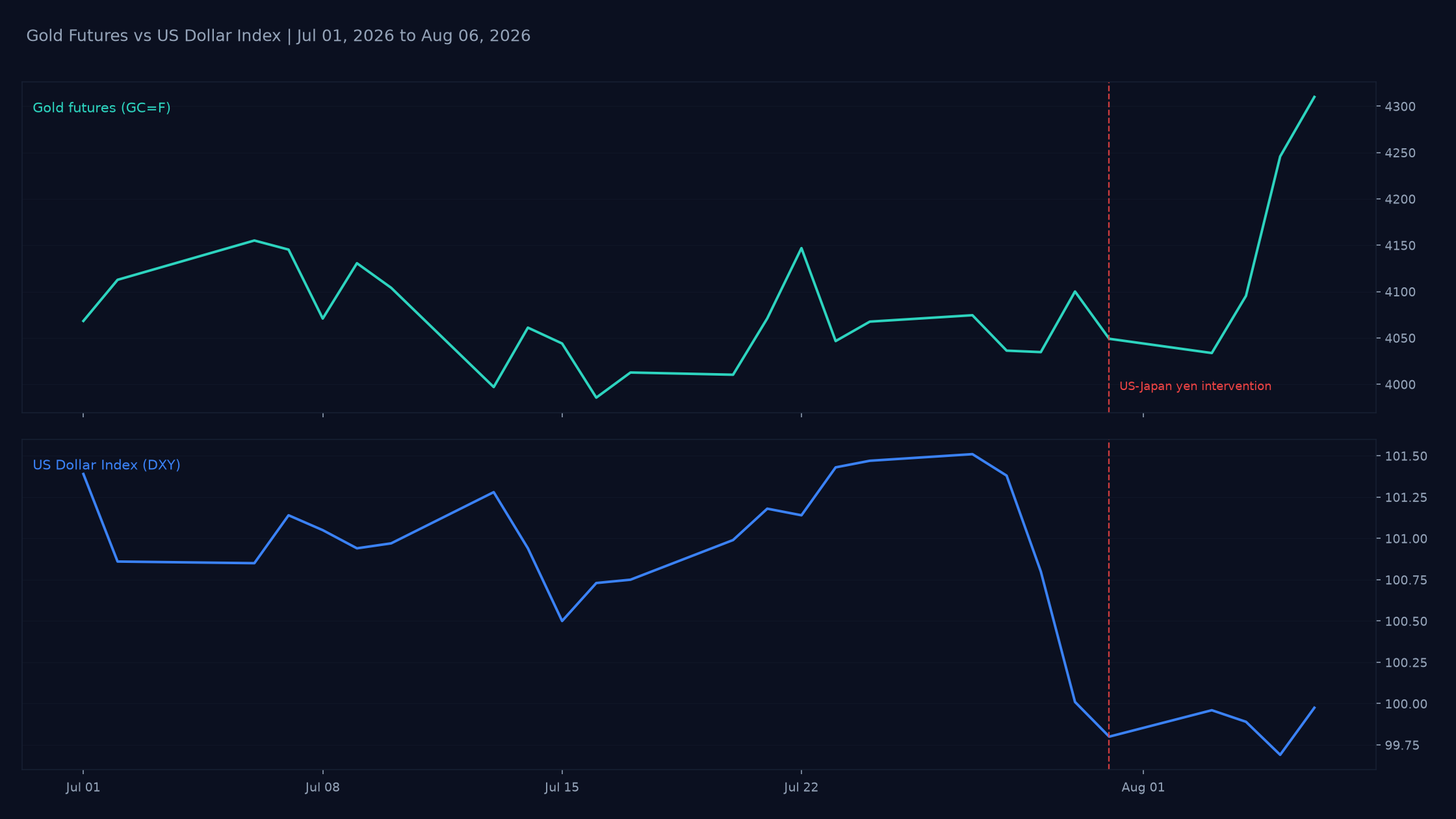
The US Treasury spent its own money strengthening a foreign currency on July 31, and the market that understood it fastest was gold. Washington and Tokyo confirmed the joint yen-buying operation on August 3, the first coordinated action of its kind between the two in about fifteen years. Since that confirmation, gold futures have run 7.41% in four sessions while the dollar index has moved two tenths of a percent and the 10-year yield has drifted lower. My read is that the reserve issuer has started managing the dollar's exchange value in public, and the dollar index is too blunt an instrument to register it.
What the Data Shows
The operation itself is on the record. Treasury Secretary Scott Bessent's August 3, 2026 statement described "Friday's coordinated foreign exchange actions" as a counter to disorderly yen movements, said the US strongly supports Japan's steps to correct what it called the substantial undervaluation of the yen, and added that the US wouldn't hesitate to take part in further joint intervention. Japan's Ministry of Finance framed its own side the same way, as a response to excessive volatility and disorderly moves in the currency. Press reporting on August 1 added the operational detail that matters most, that the New York Fed funded the purchase by selling euros instead of dollars, and I'm flagging that one as reported rather than confirmed because Treasury hasn't published the composition.
Now the market response, taken from my data pull on the morning of August 6. Gold futures closed at 4,033.70 on August 3 and 4,332.40 on August 6, a 7.41% move in four sessions. Over that same window the dollar index went from 99.96 to 99.76, a decline of 0.20%, and the 10-year Treasury yield eased from 4.74% on July 31 to 4.62% on August 5, with FRED putting the 10-year at 4.63% and the 2-year at 4.20% on August 4. Gold didn't rally because the dollar broke or because real yields collapsed, because neither of those things happened.
Behind it sits the arithmetic that makes a cheaper dollar useful to Washington in the first place. Treasury's own Debt to the Penny series puts total public debt outstanding at $39.83 trillion on August 4, 2026, against $35.06 trillion on August 5, 2024. That's roughly $4.8 trillion added in two years with no recession and no rescue package to explain it.
Why It Matters for Your Portfolio
If the preferred fix for that debt load is a slowly cheaper dollar delivered without an announcement, the thing being repriced isn't one asset, it's your cash and the long end of your bond ladder. The dollar index will keep looking calm for a while, because selling euros to buy yen pushes two of its components in opposite directions and the basket nets out to roughly nothing. Anything priced in dollars that nobody can print more of is the cleaner read on this policy than the index is.
What I'm Watching
First, whether gold futures hold above 4,033.70, the August 3 close that preceded the run. Losing that level tells me this was a four-day scramble rather than a regime signal, and I'd drop the thesis. Second, Japan's Ministry of Finance publishes its intervention totals monthly, so the release at the end of August will show what Tokyo actually spent and whether it kept buying after the joint operation. Third, a repeat US operation would settle the question of whether July 31 was a one-time favor to an ally or the opening move in a managed devaluation, and Bessent has already said on the record that he wouldn't hesitate.
Related Reading: Gold's Long Game Is Getting Louder. I'm Still Watching and The Dollar Trade Nobody's Talking About in 2026
Howard is a full-time trader based in New Jersey with 13 years of experience across Forex, crypto, equities, and futures. He started Position Note to document his trades and analysis in public. All positions are disclosed. Nothing here is personalized investment advice.