Position Trades
Why I'm Still Holding $BE After the 2026 AI Power Run

Bloom Energy is not a fresh buy for me here.
It's a hold.
That's the whole point of this position trade. I already own $BE, the stock has turned into one of my biggest winners, and I don't want to confuse a strong business thesis with a good new entry.
I still like the setup because Bloom is sitting directly inside one of the biggest problems in AI infrastructure: power. Data centers need electricity faster than the grid can always deliver it. Bloom's fuel cells give large customers another way to get reliable on-site power without waiting years for traditional grid upgrades.
That is why I'm still holding. But I'm not adding right now.
My public valuation range is $300-$360. At a recent price around $329, the stock is already inside that range. That doesn't mean it has to stop there, but it does mean the easy part of the trade is gone. From here, Bloom has to keep proving that the revenue growth, margin expansion, and AI data-center demand are real enough to support the valuation.
The Chart
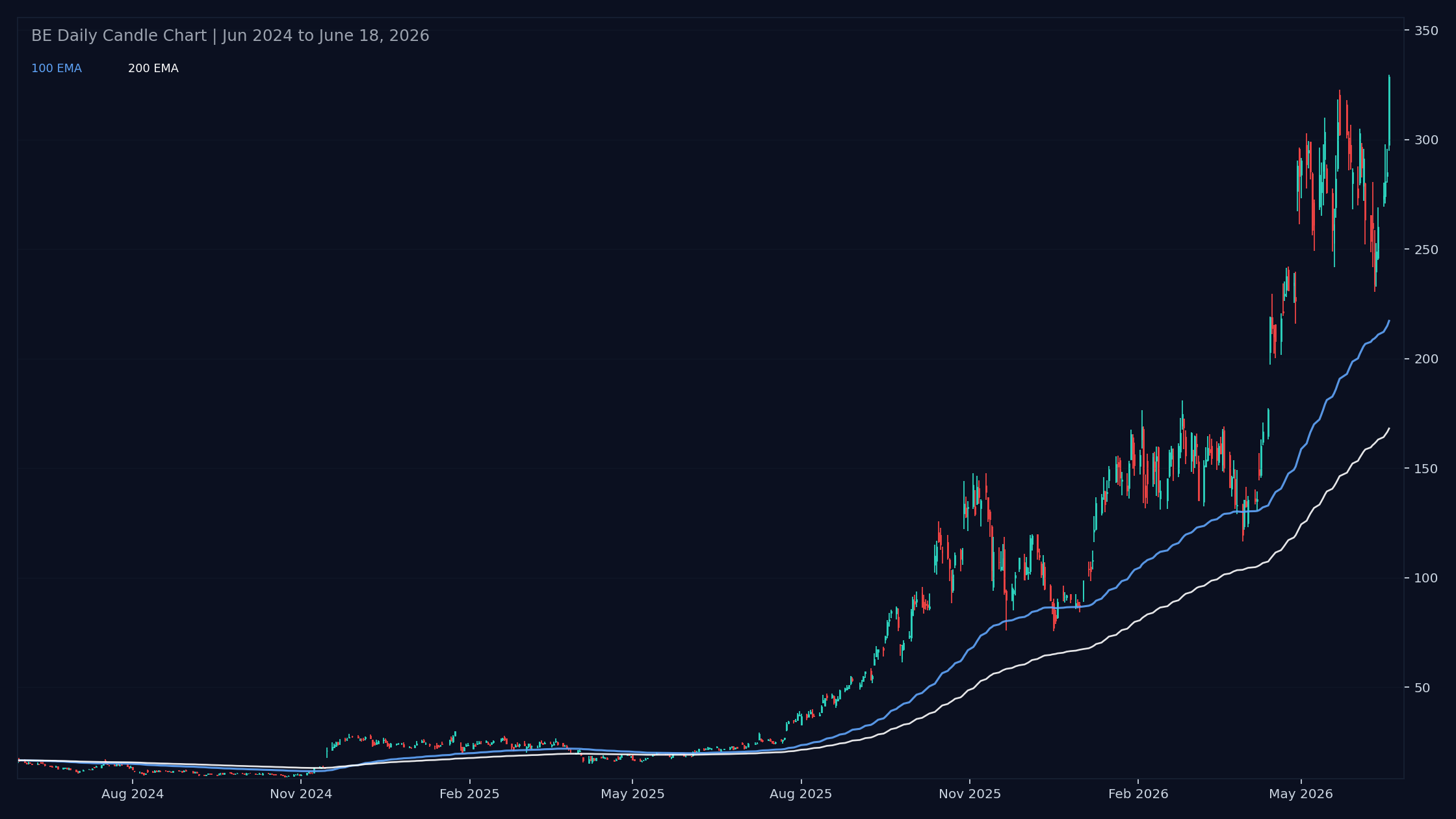
The chart is powerful, but it is not giving me a clean add signal.
$BE has gone from a forgotten fuel-cell stock to a full AI power trade. Over the past two years, the stock moved from the mid-teens to more than $300. The latest close around $329 is near the two-year high, and the stock is far above both the 100-day and 200-day moving averages.
That is a great chart if you already own it.
It is not the kind of chart where I want to chase more shares.
The 100-day moving average is around $217 and the 200-day moving average is around $168. That doesn't mean the stock has to fall back to those levels, but it does show how extended the move has become. When a stock gets this far ahead of its trend, the risk is not just a bad business update. The risk is that even good news is already priced in.
So my chart read is simple: hold the winner, don't add at the highs, and make the company keep earning the valuation.
Why the Business Is Still Intact
Bloom's latest numbers support the business thesis.
In Q1 2026, Bloom reported $751.1 million of revenue, up 130% year over year. Product revenue was $653.3 million, up 208% year over year. Non-GAAP gross margin was 31.5%, and non-GAAP operating income was $129.7 million.
That is a major change from the old Bloom story.
For years, this was a promising clean-energy company with too much proof still missing. The market could believe in the technology and still doubt the economics. Now the company is showing real scale, positive operating income, and customer demand tied to one of the strongest infrastructure themes in the market.
Bloom also raised its full-year 2026 outlook. Management guided to $3.4-$3.8 billion of revenue, about 34% non-GAAP gross margin, $600-$750 million of non-GAAP operating income, and $1.85-$2.25 of non-GAAP EPS.
That guidance is why I'm still taking the position seriously.
The stock has already moved a lot, but the business is not standing still. If Bloom can move from a volatile growth story into a real AI power infrastructure company with operating leverage, the market can keep valuing it differently than it valued the company in past cycles.
Why the AI Power Thesis Still Works
The core thesis is bigger than fuel cells.
The core thesis is power scarcity.
AI data centers need huge amounts of reliable electricity. The grid is not built to handle every new data center request on the timeline customers want. That creates a practical problem for hyperscalers, cloud providers, and infrastructure developers: the servers may be ready, the demand may be there, but the power interconnection can become the bottleneck.
That is where Bloom fits.
Bloom's fuel-cell systems can provide on-site power for large customers. They are not a perfect solution for every location, and they are not free from fuel, policy, permitting, or execution risk. But they solve an urgent problem: customers need dependable power close to where compute is being built.
The market is already starting to connect those dots.
Bloom has been tied to major AI infrastructure projects, including the Oracle-linked data center power buildout in New Mexico and the Brookfield strategic partnership focused on AI infrastructure. I don't need every announced project to become a straight-line success. I need the pattern to continue: large infrastructure buyers looking for faster, reliable power solutions, and Bloom being one of the companies that can actually deliver hardware at scale.
That is why I see $BE as an AI infrastructure stock, not just a clean-energy stock.
The old clean-energy market was often about subsidies, narratives, and future adoption. The AI power market is more direct. The customer either needs electricity or it can't fully deploy the compute. That makes Bloom's product more urgent than it looked in the old fuel-cell cycle.
My Valuation Range
I don't think a simple P/E target works well for $BE right now.
Earnings are just beginning to scale, and the market is valuing the company more like an AI infrastructure supplier than a normal industrial manufacturer. A trailing earnings multiple would miss the point, but a pure story-stock valuation would be too loose.
So I'm using a forward revenue and operating-income framework.
Management's 2026 revenue guidance is $3.4-$3.8 billion. The midpoint is about $3.6 billion. For a company growing this fast, with AI infrastructure demand behind it, I think the market can justify a high forward sales multiple as long as margins keep expanding.
Using roughly 26x-31x 2026 revenue gets to an enterprise value range of about $94-$112 billion. Bloom's cash and debt are close enough that net debt does not change the per-share math much. Using roughly 320 million diluted shares, that gives me a valuation range of about $295-$350 per share.
The operating-income cross-check points to a similar zone. Management guided to $600-$750 million of non-GAAP operating income for 2026. If investors are willing to value that at a premium infrastructure-growth multiple because the AI power cycle is still early, the stock can support something around the low $300s to mid-$300s.
That is why I'm using $300-$360 as my public valuation range.
The important part is that the recent price is already inside the range. This is not a cheap-stock argument. It is a hold-the-winner argument.
If Bloom keeps beating numbers, raises the 2026 outlook again, and proves that AI data-center demand is turning into durable multi-year revenue, the stock can overshoot my range. Momentum stocks often do that.
But I don't want to build the public thesis around an overshoot. I want the base case to be honest: the business is working, the stock has already priced in a lot, and the right move for me is to hold rather than add.
Where I'm Wrong
I'm wrong if the AI power demand doesn't convert into profitable, repeatable revenue.
More specifically, I'm wrong if the announced data-center projects slip, if margins roll over, if customer concentration becomes a bigger issue, if Bloom has to spend too much capital to support growth, or if investors start valuing the stock like a normal industrial again instead of an AI infrastructure supplier.
The biggest risk is valuation.
At this price, $BE does not have much room for a messy quarter. The company can still be fundamentally better than it was two years ago and the stock can still correct if expectations get too high.
That is the line for me.
If revenue growth stays strong, margins keep expanding, and the AI infrastructure pipeline keeps converting into real deployments, I can keep holding. If the growth story turns into project delays, lower margins, or a guidance reset, I have to treat the position differently.
What I'm Watching Next
The next few quarters are about proof.
I want to see Bloom keep converting AI power demand into revenue. I want to see gross margin hold near the mid-30s. I want to see operating income keep scaling instead of disappearing as the company grows. I also want to see backlog and customer announcements turn into deployed systems, not just headlines.
The stock has already rewarded patience.
Now the job is different.
I don't need to chase. I don't need to add. I need to keep watching whether the business can grow into the valuation.
For now, I'm holding $BE. It is one of the clearest examples in my portfolio of why a position trade can work when the entry is right and the thesis keeps improving.
Related Reading
- Why I Own UNH After the Trust Reset
- Why I Own $AMZN as the 2026 AI Infrastructure Stock
Disclosure: I own shares of Bloom Energy.
Disclaimer: This isn't personalized investment advice. I'm sharing my own research process and portfolio thinking. Do your own work before making any investment decision.
Members Only: How I'm Managing the Position
- Why I'm treating the $300-$360 valuation range as a risk-management zone, not an automatic sell target
- How I'm handling the 99-share position after a major unrealized gain
- What would make me protect the win instead of continuing to hold