Position Trades
Why I Own $CNSWF After the Constellation Pullback

$CNSWF is not a hype trade for me.
It's a quality compounder that finally pulled back hard enough to be interesting again.
Constellation Software has one of the best long-term acquisition models in software. The company buys vertical market software businesses, leaves them decentralized, and keeps redeploying cash flow into more acquisitions. That model can look boring when it's working, but over a long enough period, boring can compound into something very hard to replace.
That's why I own $CNSWF here.
I'm not treating this like a quick swing. The stock has already fallen a long way from the highs, the business is still producing cash, and the open sell orders I have set are above the current price. This is a position trade where I want to let the recovery work, but I also want a plan if the market starts paying up for the Constellation model again.
The Chart
$CNSWF has gone from premium compounder to broken-looking chart.
That doesn't mean the business is broken.
It means the stock stopped getting the benefit of the doubt.
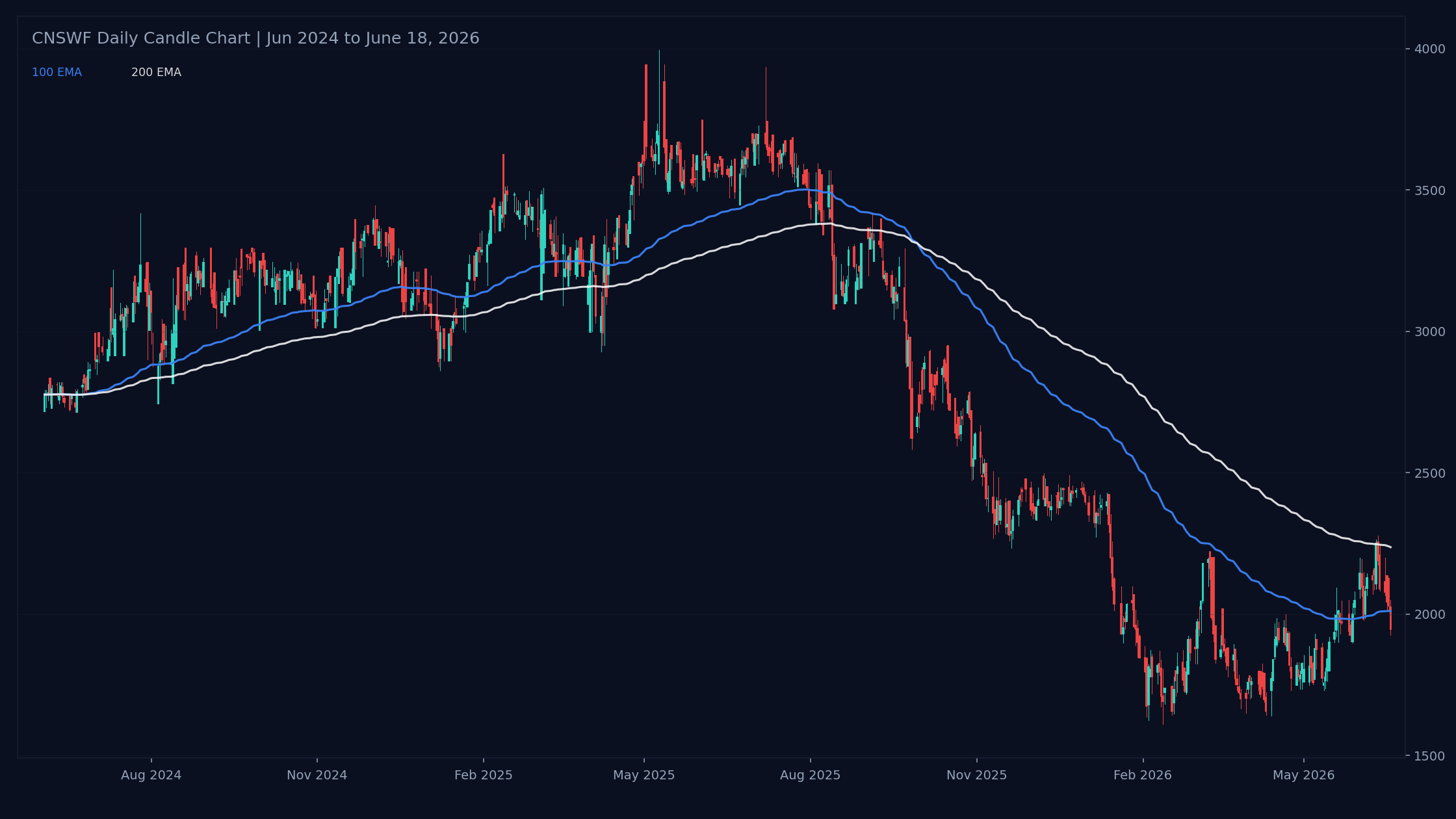
The chart shows the whole setup. $CNSWF traded near the upper $3,000s in 2025, then fell hard into 2026. The stock recently traded around $1,946 on the U.S. OTC line, which puts it well below the 100-day and 200-day moving averages.
That's not a momentum chart.
It's a recovery chart.
I don't need the stock to instantly reclaim the highs for this trade to work. I need the business to keep producing cash, keep deploying capital, and prove that the market overreacted to the drawdown.
For now, the chart tells me two things. The stock is still damaged, but the valuation reset has made the risk/reward more interesting than it was near the highs.
Why the Business Is Still Intact
Constellation is not a normal software company.
The company doesn't depend on one giant product cycle. It owns a large collection of vertical market software businesses across many niche industries. These are the kinds of businesses that often have sticky customers, specialized workflows, and limited direct competition because the markets are too narrow for most large software companies to attack aggressively.
That's the heart of the model.
Constellation acquires small and mid-sized software companies, keeps the operating structure decentralized, and lets each business continue serving its niche. The parent company focuses on capital allocation, operating discipline, and spreading best practices across the system.
The model is not exciting in the same way AI infrastructure or cloud growth is exciting.
It's exciting because it can keep repeating.
The latest numbers support that view. In Q1 2026, Constellation reported $3.181 billion of revenue, up 20% year over year. Organic growth was 6%, or 2% after adjusting for foreign exchange. Net income attributable to common shareholders was $367 million, compared with $136 million in the same quarter last year. Cash flow from operations was $897 million, up 9%, and free cash flow available to shareholders was $733 million, up 44%.
That's not a dead business.
The quality of the revenue matters too. In Q1, maintenance and other recurring revenue was about $2.444 billion, or roughly 77% of total revenue. That's the part of the model I care about most because it shows why these niche software businesses can be durable even when the stock is volatile.
The company also completed acquisitions for total consideration of about $809 million during the quarter, and after quarter-end it had completed or committed to additional acquisitions with total consideration of about $786 million.
That matters because the thesis depends on capital deployment.
Constellation is not supposed to sit on cash and wait for the market to love it again. It's supposed to generate cash, buy more vertical software businesses, and let the acquired earnings power show up over time.
That machine is still running.
Why the Pullback Matters
The reason I care about $CNSWF now is that the stock finally stopped looking untouchable.
For a long time, Constellation had the problem every great compounder eventually gets: everyone knew it was good. When a company has a long record of disciplined acquisitions, high returns, and consistent cash generation, the market often prices it like nothing can go wrong.
That's dangerous.
Even the best compounder can be a bad buy if the valuation assumes every acquisition works, every reinvestment opportunity stays attractive, and every management decision keeps compounding at the same rate.
The pullback changed the setup.
At roughly $1,946 on the U.S. line, the stock is no longer priced like the market has unlimited patience. Based on the latest market data, the market cap is around $41 billion. Using 2025 free cash flow available to shareholders of about $1.683 billion, plus the Q1 2026 improvement over Q1 2025, the trailing cash-flow base is closer to $1.9 billion.
That puts the stock around the low-20s on trailing free cash flow available to shareholders.
For Constellation, that's not expensive if the acquisition engine keeps working.
The market is not giving the company full premium-compounder credit right now. That's the opportunity. I'm not saying the stock is statistically cheap like a distressed value stock. I'm saying the price has moved far enough that the business quality matters again.
My Valuation Range
I don't want to value $CNSWF on reported net income alone.
Reported earnings can move around because of acquisition accounting, amortization, financing costs, and other items that don't always capture the way Constellation creates value. For this business, cash flow available to shareholders matters more.
So I'm using a free-cash-flow framework.
Constellation generated $1.683 billion of free cash flow available to shareholders in 2025. Q1 2026 free cash flow available to shareholders was $733 million, up from $510 million a year earlier. If I use that improvement as a rough trailing-twelve-month adjustment, the current cash-flow base is about $1.9 billion.
From here, the question is what the market should pay for that cash flow.
If the market treats Constellation like a normal software acquirer with slower organic growth and acquisition risk, the multiple can stay in the low 20s. That would not give the stock much help.
But if the market starts trusting the model again, I think a high-quality vertical software compounder can support something closer to the high 20s to low 30s on free cash flow available to shareholders.
Using roughly $2.0-$2.2 billion of forward free cash flow available to shareholders and a 28x-32x range gets to an equity value of about $56-$70 billion. With roughly 21.2 million shares outstanding, that gives me a public valuation range of about $2,650-$3,300 per share.
That's the zone I care about publicly.
It doesn't require the stock to immediately reclaim the old highs. It requires the market to move from fear back toward respect. If Constellation keeps converting acquisitions into cash flow, I think that's possible.
Where I'm Wrong
I'm wrong if the acquisition machine slows down or starts producing lower-quality results.
The biggest risk with Constellation is not that the company suddenly becomes irrelevant. The bigger risk is that the model gets harder as the company gets larger. It needs to keep finding enough attractive acquisition targets, pay disciplined prices, keep acquired businesses healthy, and avoid letting complexity dilute returns.
I'm also wrong if organic growth stays weak after adjusting for currency.
The Q1 headline organic growth number was 6%, but the currency-adjusted figure was only 2%. For a company like this, acquisitions can carry a lot of the growth. But I don't want the underlying businesses to become too dependent on M&A alone.
I'm also watching the culture risk. Mark Leonard is no longer standing for re-election to the board, even though he is expected to remain involved as an advisor. Constellation is bigger than one person at this point, but the culture and capital allocation discipline are part of the thesis. If those weaken, the multiple should weaken too.
The other risk is valuation.
Even after the pullback, $CNSWF is not a low-quality bargain trading at a single-digit multiple. This is still a quality-business trade. If the market decides that lower organic growth, higher financing costs, or weaker acquisition returns deserve a permanently lower multiple, the stock could stay under pressure.
That's the line for me.
If cash flow keeps growing and capital deployment stays disciplined, I can keep holding. If the acquisition model starts looking less repeatable, I have to treat the position differently.
What I'm Watching Next
The next few quarters are about cash flow and capital deployment.
I want to see free cash flow available to shareholders keep growing. I want to see acquisitions continue without Constellation chasing deals just to maintain growth. I want to see organic growth stabilize, especially after currency adjustments. I also want to see the stock start acting like the market believes the model still works.
The chart is still ugly.
The business is not.
That's why I own $CNSWF. The stock has already been punished, the cash-flow engine is still alive, and the valuation no longer looks priced for perfection.
For now, I'm holding the position and letting the recovery setup work.
Related Reading
- Why I Own $AMZN as the 2026 AI Infrastructure Stock
- Why I'm Still Holding $BE After the 2026 AI Power Run
Disclosure: I own shares of Constellation Software.
Disclaimer: This isn't personalized investment advice. I'm sharing my own research process and portfolio thinking. Do your own work before making any investment decision.
Members Only: How I'm Managing the Position
- The exact sell orders I already have set for $CNSWF
- Why I'm treating the first order as a recovery trim and the second as a stretch target
- What would make me cancel, adjust, or keep the orders in place