Position Trades
Why I Am Trimming $HOOD Into Strength

$HOOD is no longer just a turnaround stock for me.
It has become a position-management trade.
I already sold 30 shares at $100, and I still own the remaining position. That matters because the setup has changed. The first part of the trade worked. Now the question is how much more upside Robinhood can earn before the valuation starts doing the work against me.
I still like the business.
Robinhood is building something bigger than a trading app. The company now has brokerage, crypto, retirement, banking, credit card, advisory, prediction markets, futures, and private-market access moving through one consumer finance platform. The market is starting to value it less like a pandemic trading app and more like a high-growth financial platform.
That is why I am still holding some $HOOD.
But I am not treating it like a fresh entry here. After the move from my average cost in the mid-$70s to above $100, the trade is about discipline. The stock has rewarded the thesis, and I want to keep participating without pretending the risk/reward is the same as it was before the breakout.
My public valuation range is $115-$150. That range is not a guarantee and it is not a reason to chase. It is the zone where I think the stock can trade if Robinhood keeps showing customer asset growth, strong net deposits, product velocity, and enough earnings power to justify a premium multiple.
The Chart
$HOOD has already made the hard move.
The stock spent 2024 and 2025 proving that the business was not just a retail-trading fad. It then pulled back, reset, and started pushing higher again in 2026. The latest close around $108 puts the stock back above both the 100-day and 200-day moving averages, which is exactly the kind of chart action I want to see after a position has already started working.
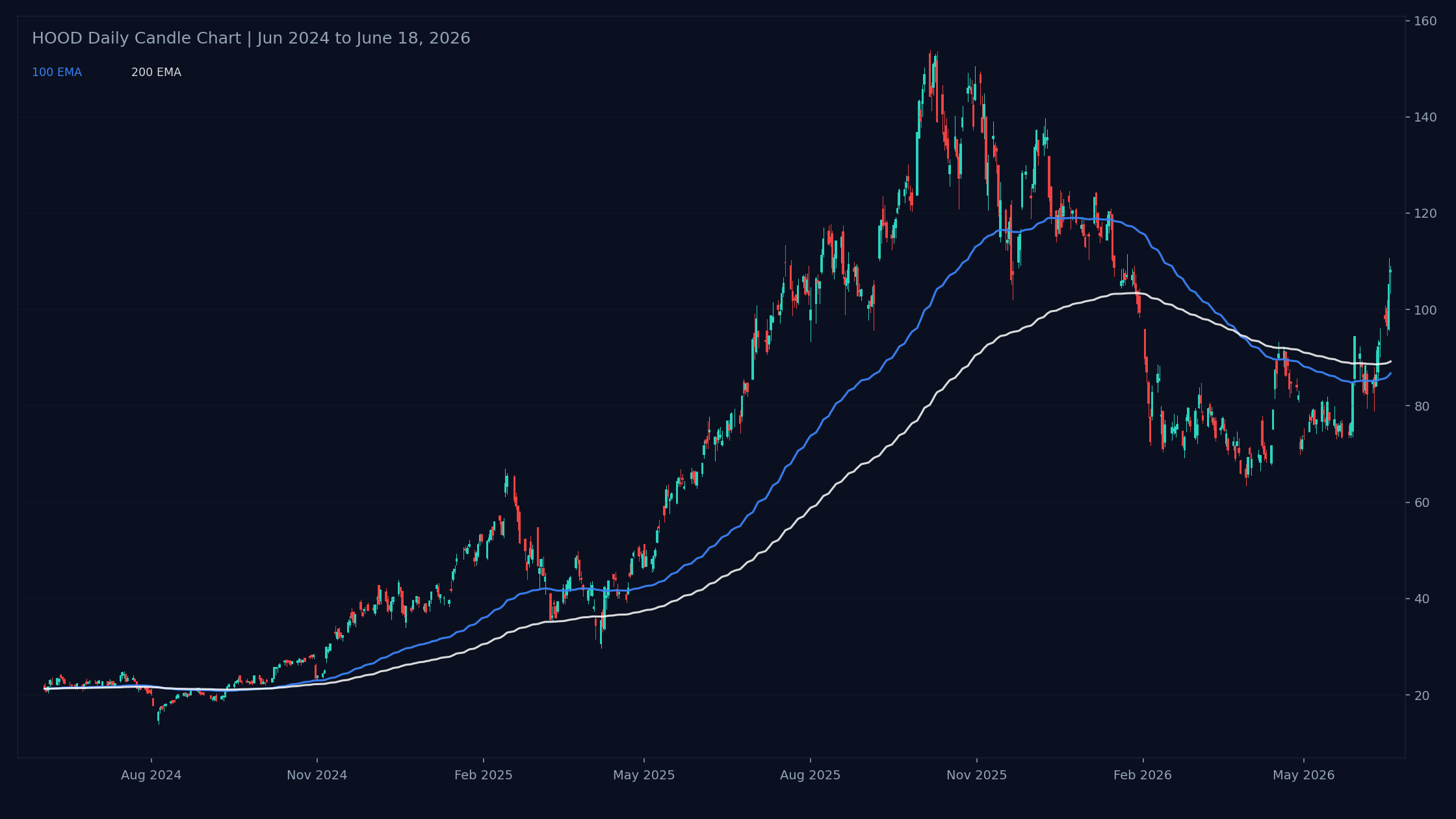
This is not a broken chart. It is a strong chart that has already moved a lot.
The 100-day moving average is around $87 and the 200-day moving average is around $89. With the stock closing near $108, $HOOD is no longer sitting at an obvious discount to trend. It has reclaimed the moving averages and is trying to build momentum again after the prior drawdown.
That is the reason I already trimmed at $100.
When a stock moves quickly from my average cost to a clean profit zone, I do not want to act like nothing changed. Taking the first trim reduces risk while keeping enough exposure if the business keeps compounding.
The chart tells me to stay involved, but not get careless.
Why the Business Is Still Working
The $HOOD thesis is built on customer assets, engagement, and product expansion.
Robinhood's Q1 2026 results were not perfect, but they still showed a platform that is much stronger than the old bear case suggested.
Total net revenues increased 15% year over year to $1.07 billion. Net income was $346 million. Diluted EPS was $0.38. Adjusted EBITDA was $534 million, with a 50% adjusted EBITDA margin.
Those numbers matter because Robinhood is now profitable at scale.
The customer metrics are the part I care about most. Funded customers increased 6% year over year to 27.4 million. Investment accounts increased 8% to 29.1 million. Total platform assets increased 39% year over year to $307 billion. Net deposits were $17.7 billion in the quarter, a 22% annualized growth rate relative to the prior quarter's platform assets.
That is the real setup.
If Robinhood can keep growing assets while adding more products around the same customer relationship, the business can become more durable than a pure trading-volume story.
Robinhood Gold is a good example. Gold subscribers grew 36% year over year to 4.3 million, and Gold subscription revenue was $50 million in Q1, up 32%. Customers are paying for more than free stock trades.
The product list keeps expanding too.
In Q1, Robinhood highlighted strong engagement across equities, options, futures, index options, prediction markets, margin, retirement, banking, credit card, advisory, private markets, and international expansion. Event contracts traded reached a record 8.8 billion, and margin book increased 93% year over year to $17.0 billion.
That kind of product velocity is why the market is willing to pay a premium.
The risk is that investors start treating every new product as guaranteed success. I do not want to do that. But I also do not want to ignore the platform shift.
The Financial Check
The strongest part of the current story is that revenue is no longer one-dimensional.
In Q1, transaction-based revenues were $623 million, up 7% year over year. Options revenue was $260 million, up 8%, equities revenue was $82 million, up 46%, and other transaction revenue was $147 million, up 320%, driven largely by event contracts.
Crypto was the weak spot. Crypto revenue fell 47% year over year to $134 million. That is the reminder that Robinhood still has cyclical exposure.
But the rest of the business helped offset it. Net interest revenue increased 24% year over year to $359 million. Other revenue increased 57% to $85 million, helped by Gold subscription revenue. Cash and cash equivalents were $5.0 billion. The company also repurchased $250 million of stock in Q1 at an average price around $81 and refreshed its buyback authorization to $1.5 billion.
That does not make the stock cheap. It does make the business more real.
Robinhood is generating profits, producing large adjusted EBITDA, adding assets, and returning capital through repurchases while still investing in new products. That is the combination I want to see in a position trade.
My Valuation Range
I do not want to value $HOOD like a normal discount broker.
That would miss the reason the stock is working.
Robinhood is being valued like a high-growth consumer finance platform with trading activity, net interest income, subscription revenue, crypto optionality, prediction markets, retirement, credit, and international expansion. The right framework is a premium earnings and platform-growth model.
Using recent diluted share count around 915 million, every $1 of EPS is worth about $915 million of net income. The company earned $0.38 of diluted EPS in Q1, or about $1.52 annualized. That is not enough to make the stock cheap at $100-plus.
But Q1 also had weaker crypto, while the platform still produced $534 million of adjusted EBITDA. If the stronger parts of the platform keep growing, and if trading activity, net deposits, Gold, margin, and new products carry through the year, I think a reasonable forward earnings base can move toward roughly $2.50-$3.00 per share over the next one to two years.
For a company growing platform assets near 40% year over year, adding products quickly, and operating with high adjusted EBITDA margins, I think the market can justify a premium multiple as long as growth stays intact. Using roughly 45x-50x that forward earnings power gets to about $115-$150 per share.
That is my public valuation range.
I am not using that range as a reason to buy more here. I am using it as a framework for managing what I still own. The first trim already happened at $100. If the stock keeps moving toward the public range, the decision becomes how much risk I want to keep while the valuation catches up to the story.
Where I Am Wrong
I am wrong if $HOOD turns back into a trading-volume story instead of a broader financial platform.
The easiest way this thesis breaks is if transaction revenue slows, crypto stays weak, options activity cools, event contracts hit regulatory problems, or product expansion fails to turn into durable customer assets and revenue.
Regulation is a real risk. Robinhood operates in brokerage, crypto, prediction markets, lending, banking-adjacent products, retirement, and now more international markets. That gives the company a lot of optionality, but it also creates more ways for regulators to push back.
I am also wrong if expenses rise faster than the revenue base can support. Q1 total operating expenses increased 18% year over year to $656 million, and management raised its 2026 adjusted operating expense and SBC outlook to $2.7-$2.825 billion because of additional work tied to Trump Accounts. If the growth investments stop producing growth, the multiple should compress.
The other risk is valuation.
At $100-plus, $HOOD is not priced like a hated turnaround anymore. It is priced like the market believes the platform story. That can keep working, but it leaves less room for disappointment.
That is why I am scaling instead of simply holding everything.
What I Am Watching Next
The next few quarters are about proving that Robinhood can keep growing outside of one hot trading cycle.
I want to see platform assets keep rising. I want net deposits to stay strong. I want Gold subscribers to keep growing. I want margin, options, event contracts, and new products to add revenue without turning the company into a regulatory headline.
The first trim is done.
Now the rest of the trade is about letting the winner work while keeping the exit plan in place.
For now, I still own $HOOD. I have already taken some profit, and I am managing the remaining shares as a momentum-plus-platform trade with a public valuation range of $115-$150.
Related Reading
- Why I'm Still Holding $BE After the 2026 AI Power Run
- Why I Own $CNSWF After the Constellation Pullback
Disclosure: I own shares of Robinhood Markets.
Disclaimer: This isn't personalized investment advice. I'm sharing my own research process and portfolio thinking. Do your own work before making any investment decision.
Members Only: How I Am Managing the Position
- The first $HOOD trim I already made after the breakout
- The exact open sell orders I have set on the remaining shares
- Why I am scaling out instead of trying to call the perfect top
- What would make me cancel, adjust, or keep the orders in place