Position Trades
Why I Own $META After the AI Capex Reset

$META is still one of the cleaner big-tech cash-flow trades I own.
The market is worried about the AI spending cycle, and I get why. Meta is pushing capital expenditures higher again in 2026. But the core advertising business is still throwing off enough operating income that I do not want to treat the stock like a broken story.
This is not a blind AI bet for me.
It is a position trade built around a simple idea: the Family of Apps business is still producing huge profits, AI is already helping the ad engine, and the stock has reset enough that the upside case is still alive if management can prove the spending is turning into stronger revenue and engagement.
My public valuation range is $700-$800. That is not a guarantee, and it is not a reason to chase every green candle. It is the zone where I think $META can trade if the market gets comfortable with the AI investment cycle and keeps valuing the company on the earnings power of the core business.
The Chart
$META has stopped looking like a straight-line momentum winner.
That is the point of the setup.
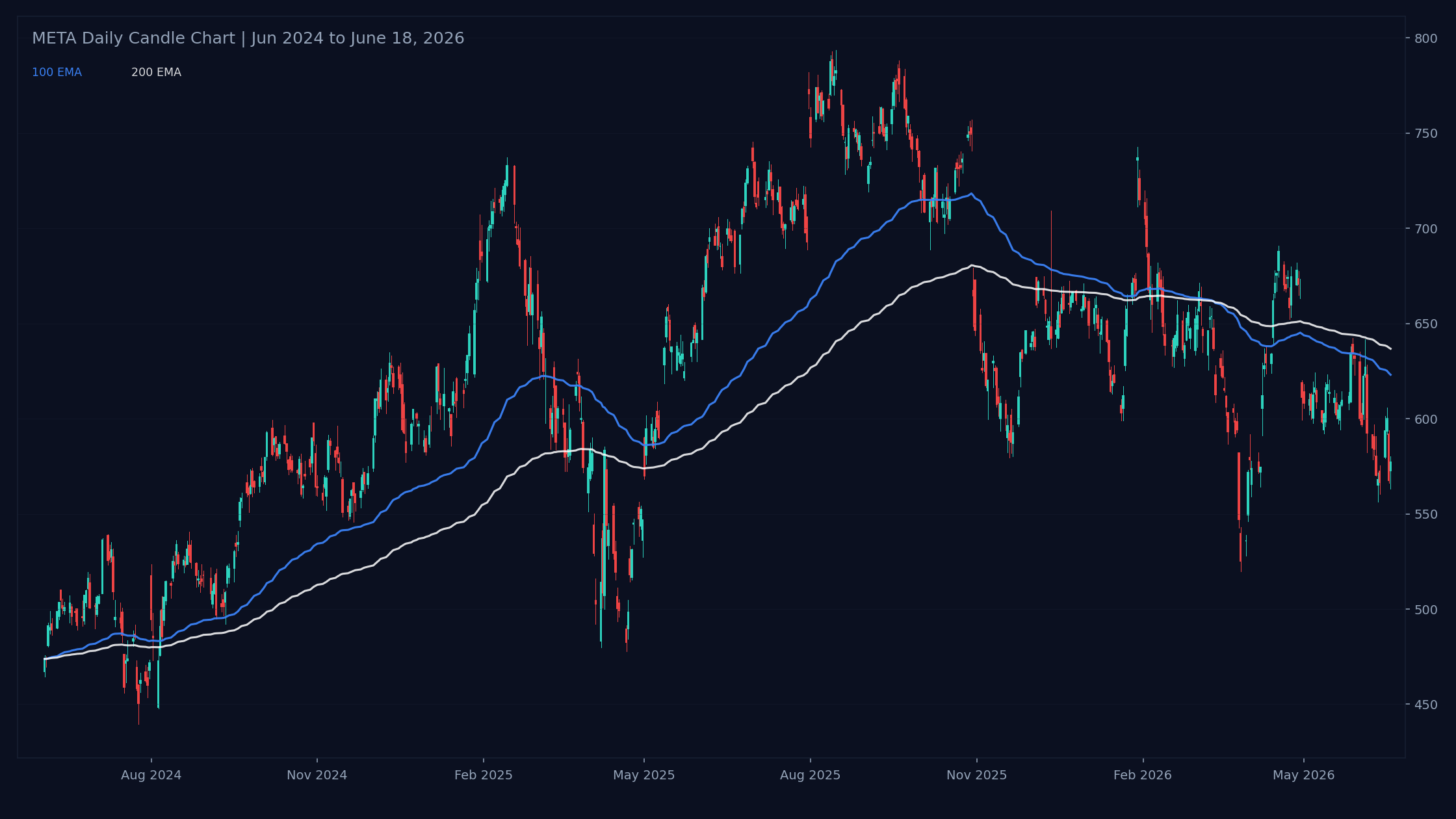
The stock recently closed around $577. That puts it below both the 100-day and 200-day moving averages, with the 100-day near $623 and the 200-day near $637.
I do not love that from a momentum perspective.
But I also do not hate it for a position trade. The chart has already absorbed a real reset from the highs, and the stock is now sitting in the area where the market is deciding whether the AI capex concern is a temporary pressure point or the start of a bigger multiple reset.
For me, that makes $META a hold-and-manage position, not a fresh chase.
If the stock starts reclaiming the moving averages, the market is telling me investors are getting more comfortable with the spending story. If it keeps failing below them, then the trade needs more patience and more discipline.
Why the Business Is Still Working
The $META thesis starts with the ad machine.
Meta reported Q1 2026 revenue of $56.31 billion, up 33% year over year. Operating income was $22.87 billion, up 30%, and operating margin stayed at 41%.
That is the number I care about.
Even with heavier spending, Meta is still producing one of the best operating-income profiles in the market. Family daily active people reached 3.56 billion, up 4% year over year. Ad impressions across the Family of Apps increased 19%, and average price per ad increased 12%.
That combination matters because it means growth is not only coming from one lever.
Meta is getting more impressions, better pricing, and still keeping margins high. That is exactly what I want to see if I am going to hold through a large AI investment cycle.
The segment detail makes the setup even clearer. Family of Apps revenue was $55.91 billion in Q1, while Family of Apps operating income was $26.90 billion. Reality Labs lost $4.03 billion, which is still a major drag, but the core business is large enough to fund it.
That does not make the spending harmless.
It means the company has room to invest aggressively without immediately breaking the earnings story.
The AI Spending Problem
The risk is obvious: Meta is spending a lot of money.
Management now expects 2026 capital expenditures, including finance lease principal payments, of $125-$145 billion. That is up from the prior $115-$135 billion range.
That is the pressure point in the stock.
Investors are willing to fund AI infrastructure when they can see the return. They get more nervous when capex keeps moving higher before the payoff is fully visible. That is why I do not want to pretend $META is a low-risk compounder at any price.
The bull case is that Meta's AI spend keeps improving ranking, recommendations, ad targeting, creative tools, engagement, and eventually new products. If that happens, the spending is not just defensive. It becomes the infrastructure layer behind a stronger ad business.
The bear case is that capex becomes the story by itself.
If investors start valuing Meta like an infrastructure-heavy company with lower free cash flow conversion, the multiple can stay capped even if revenue grows. That is the main reason the stock has to prove itself again.
The Financial Check
The current numbers still support the position.
Q1 net income was $26.77 billion, although that included an $8.03 billion tax benefit. Diluted EPS was $10.44, and excluding that tax benefit, EPS would have been $3.13 lower.
So I do not want to overstate the headline EPS.
The cleaner read is operating income and cash flow. Meta generated $32.23 billion of operating cash flow and $12.39 billion of free cash flow in Q1, even after $19.84 billion of capital expenditures and finance lease principal payments.
That tells me the business is still financially strong.
Meta also ended the quarter with $81.18 billion of cash, cash equivalents, and marketable securities. The balance sheet gives management room to keep investing, pay the dividend, and absorb volatility in the spending cycle.
The market cap is around $1.47 trillion at a recent price near $577. That is not cheap in absolute dollars, but the valuation is not extreme if the forward earnings base continues moving higher.
That is the balance I am weighing.
$META is not a distressed value stock. It is a high-quality earnings machine going through an expensive AI buildout. I want exposure to the earnings machine, but I want a plan because the buildout risk is real.
My Valuation Range
I am valuing $META with a forward earnings framework.
The company is still fundamentally an advertising and engagement platform. AI matters because it can make that platform more useful, more personalized, and more efficient, but the valuation still has to come back to earnings power.
Using recent market data, $META trades around the high teens on forward earnings. That is not demanding for a company with Q1 revenue growth above 30%, operating margin above 40%, and a core app business that still reaches more than 3.5 billion daily active people.
The question is what multiple the market should pay if AI capex remains high.
I do not want to use an aggressive multiple because the spending cycle deserves a discount. But I also do not want to value Meta like a no-growth company when the ad business is still compounding.
If Meta can earn roughly $36-$40 per share over the next year or two, and the market applies an 18x-20x earnings multiple, that gets me to about $650-$800 per share. I am using $700-$800 as my public valuation range because I want to see some evidence that investors are willing to look through the capex step-up.
That range lines up with how I want to manage the position.
I am not saying $META has to go straight there. I am saying the upside case still exists if revenue growth, ad pricing, AI product improvements, and operating income keep offsetting the spending concern.
Where I Am Wrong
I am wrong if AI spending starts consuming the thesis instead of supporting it.
The biggest risk is that capex keeps rising faster than investors can underwrite the return. If free cash flow gets pressured for longer than expected, or if management keeps raising the spending range without showing clear product and revenue benefits, the market can keep compressing the multiple.
Reality Labs is another risk.
The segment lost more than $4 billion in Q1, and Meta has already told investors that Reality Labs losses are expected to remain significant. I can accept that while the core business is producing huge operating income. I would think differently if those losses expand while the Family of Apps business slows.
Regulation is also always part of the $META story.
The company continues to face scrutiny around privacy, youth safety, competition, Europe, and U.S. legal matters. Any one of those can create headline risk, costs, or product changes that pressure the business.
The final risk is the chart.
If the stock cannot reclaim the 100-day and 200-day moving averages, I have to respect that the market is still rejecting the story. I can hold through volatility, but I do not want to ignore a long trend deterioration if the fundamentals stop backing me up.
What I Am Watching Next
The next few quarters are about proving that the AI spend is earning its keep.
I want to see ad impressions and pricing stay healthy. I want Family of Apps operating income to remain strong. I want free cash flow to hold up despite the capex cycle. And I want management to show that AI is improving the core business, not just creating a bigger infrastructure bill.
For now, I still own $META.
The stock has pulled back enough to make the setup interesting again, the business is still producing serious operating income, and the public upside range remains $700-$800 if the market gets comfortable with the AI capex reset.
Related Reading
- Why I Am Trimming $HOOD Into Strength
- Why I Own $CNSWF After the Constellation Pullback
Disclosure: I own shares of Meta Platforms.
Disclaimer: This isn't personalized investment advice. I'm sharing my own research process and portfolio thinking. Do your own work before making any investment decision.
Members Only: How I Am Managing the Position
- The exact $META sell order I already have set
- The pullback area where I would look to add
- Why I am using a staged exit instead of trying to call the perfect top
- What would make me keep the order, adjust it, or cancel it
- How I am balancing the AI capex risk against the core ad cash flow