Market Notes
Bessent Blames Oil for 5% Yields. The Data Doesn't, 2026

The Take
Treasury Secretary Scott Bessent told CNBC on October 28 that the Fed should keep "an open mind in terms of the transitory nature of the supply shock," and that there's been "a very high correlation between oil prices and the 10-year." I think he's right on the first part and wrong on the second, and the bond market's own numbers are what say so. Inflation expectations barely moved while oil ran from $96 to $110 in October. If the oil shock is transitory, oil can't also be the thing holding the 10-year near 5%.
What the Data Shows
The 10-year breakeven is basically what the bond market expects inflation to average over the next 10 years, the gap between a regular Treasury and a TIPS. Per FRED, it closed between 2.32% and 2.38% every trading day in October. WTI spot went from $96.34 on October 14 to $110.01 on October 19 per EIA, and the breakeven was 2.35% on both of those days. A 14% oil move that leaves inflation expectations flat is the market agreeing with Bessent on transitory.
So what moved the 10-year? Split it into its 2 pieces. On October 5 the 10-year hit 5.31%, which was 2.36% of inflation expectations plus a 2.95% real yield per FRED. By October 30 it was 4.94%, with the breakeven at 2.34% and the real yield at 2.60%, so 35 of the 37 basis points of decline came out of the real yield, the part that isn't inflation at all.
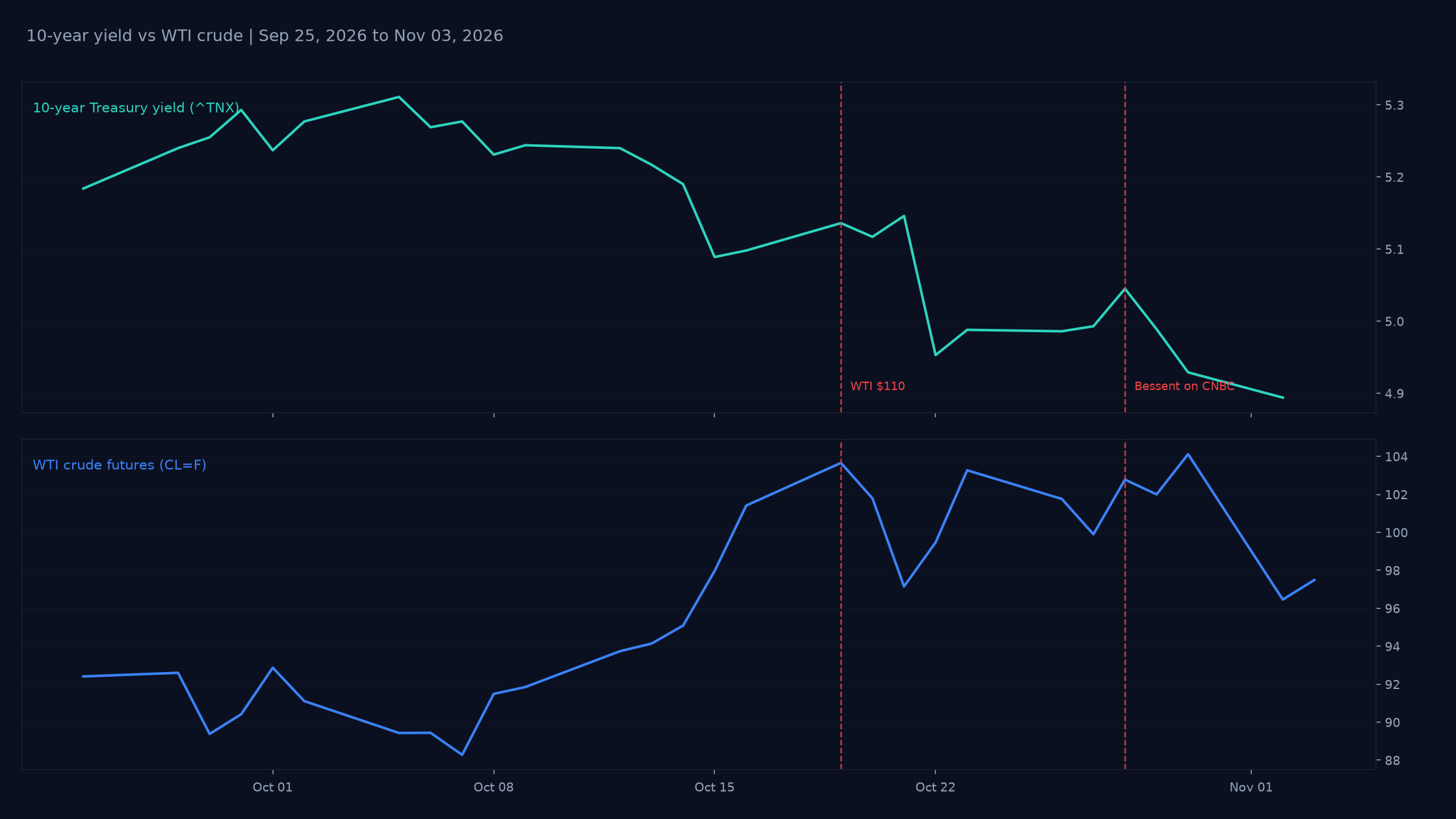
The day Bessent spoke was a rough day for his story. On October 28 the Fed held at 3.75% to 4.00% in a 10 to 2 vote, and both dissenters, Lisa Cook and Beth Hammack, wanted a quarter-point hike. The 10-year closed at 5.05% that day per FRED, and the breakeven hit its October high of 2.38%. By November 2 the 10-year was down to 4.89% per CBOE and the breakeven was down to 2.29%.
Why It Matters for Your Portfolio
If the 10-year near 5% is mostly a 2.6% real yield, an Iran deal that sends oil lower doesn't automatically bring rates down. Long-dated assets feel this the most: growth stocks priced on cash flows years out, homebuilders that live on mortgage rates, and long bonds themselves. Bessent also said on CNBC that "the bond market has done a lot of tightening for us," and I think that's the more honest line. It's a real-yield story, not an oil story.
What I'm Watching
The midterms are today, November 3, and the New York Times reported in late October that the US and Israel have drawn up plans for renewed strikes on Iran after the vote. If that happens and oil spikes again, the breakeven is the tell. A close above 2.40% would mean the bond market stopped buying transitory, and I'd take the oil and yields link a lot more seriously.
The other number is the 10-year real yield. With breakevens around 2.3%, a real yield back above 2.75% puts the 10-year over 5% again, with or without oil. October CPI comes out November 10 and the Fed meets December 8 and 9, so we get 2 real tests before year end. I'm watching, not calling it.
Related Reading: Oil Hit $110 as Stocks Priced an Iran Deal, October 2026 and CPI Hit 3.7% and the 10-Year Fell Anyway, October 2026
Howard is a full-time trader based in New Jersey with 13 years of experience across Forex, crypto, equities, and futures. He started Position Note to document his trades and analysis in public. All positions are disclosed. Nothing here is personalized investment advice.