Market Notes
AI Data Center Debt Is Sitting in Insurance Money, 2026

The Take
On July 29, 2026 the SEC's Division of Corporation Finance answered a law firm's question and said the bonds funding AI data centers are not asset-backed securities. That answer pulls those deals out of the disclosure and risk-retention rules Washington wrote after 2008. It matters because of who buys this kind of paper. US life insurers held $807 billion of private illiquid credit at the end of 2025, and 93 of those insurers are now privately owned. I'm not calling a blowup here; I'm saying we just gave up the ability to see one coming.
What the Data Shows
The letter is public and it is specific. SEC staff agreed that a data center is not a self-liquidating financial asset the way a car loan or a mortgage is, so bonds backed by one fall outside the definition of an asset-backed security in Section 3(a)(79) of the Exchange Act. Latham and Watkins, the firm that asked, lists what stops applying: the 5% credit risk retention requirement, Rule 192 on conflicts of interest, and Rules 15Ga-1 and 15Ga-2 on repurchase and diligence disclosure. Those are the rules built so whoever packages the loans keeps some of the risk and tells you what is inside.
Now look at who owns the other end. ALIRT Insurance Research counted 93 privately-owned US life insurers at the end of 2025, up from 16 in 2011, with their invested assets going from $85 billion to nearly $1.2 trillion, or 19.8% of the whole industry. Moody's put private illiquid bond holdings across US life insurers at $807 billion at year-end 2025, up $122 billion in a single year and 20% of the industry's $4 trillion fixed income book. S&P Global Market Intelligence has privately placed bonds at 48.4% of all life industry bonds at year-end 2025, up from 37.4% five years earlier.
The liabilities went somewhere too. ALIRT found US life insurers had ceded $2.7 trillion of life and annuity liabilities at year-end 2025, and $1.1 trillion of that sits in Bermuda, 40.7% of everything ceded and up from 30.9% in 2021.
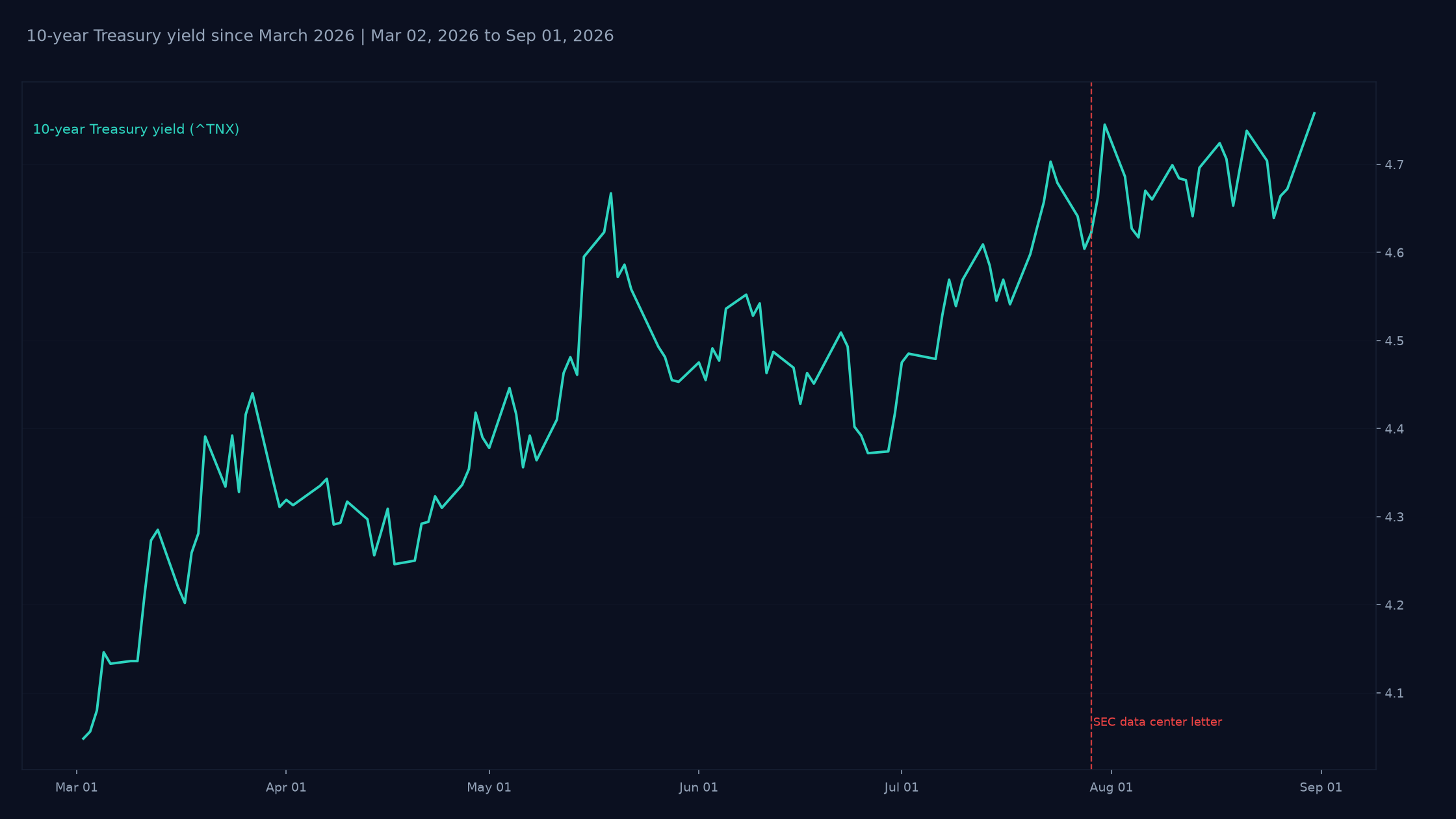
The structure is not theoretical; in October 2025 Meta put its Hyperion campus in Louisiana into a joint venture where Blue Owl funds hold 80% and Meta 20%, about $27 billion of development cost, funded with debt sold privately to PIMCO and other bond investors. All of it works as long as borrowing stays cheap, and borrowing is getting less cheap. The 10-year Treasury was 4.73% on August 28, 2026 per FRED, and the CBOE 10-year yield index closed at 4.76 on August 31, up 2.57% in five sessions.
Why It Matters for Your Portfolio
None of this changes what I own tomorrow. What it changes is how I read credit spreads and insurance company earnings from here. The AI trade has quietly turned into a credit trade, and the marginal lender is not a bank with capital requirements, it's an insurance balance sheet carrying a large share of its book at a model price instead of a market price. The Financial Stability Board made the same point in plainer language on May 6, 2026, warning that valuation opacity and reliance on private credit ratings can amplify strains in stress.
What I'm Watching
Two things, both with dates on them. The first is the 10-year Treasury into the September 15-16 FOMC meeting: at 4.73% this structure funds itself, and every 25 basis points higher makes the long-dated paper already sold worth less than its model price.
The second is disclosure. The NAIC adopted new reporting requirements for private placement securities and the private letter ratings behind them, effective for year-end 2026 statutory filings, so the annual statements filed in early 2027 are the first real look anyone outside these companies gets at that bucket. If that data shows up and it's boring, I was early and wrong. If it arrives vague, then the SEC letter and the Bermuda cessions did exactly what they look like they were built to do.
Related Reading: The AI Bubble's Early Tripwires Are Already Flashing and The S&P 500's Top 10 Is 37% and Mostly One Trade in 2026
Disclosure: as of August 28, 2026 I hold a position in $META, named above only as an example of how these deals are structured. This note takes no view on the stock.
Howard is a full-time trader based in New Jersey with 13 years of experience across Forex, crypto, equities, and futures. He started Position Note to document his trades and analysis in public. All positions are disclosed. Nothing here is personalized investment advice.