Position Trades
My July 2026 Portfolio Update: Rotating Into $AMZN

July was my most active month of the year, and almost all of it was one idea: selling strength to buy weakness. I trimmed $BE twice, cut back $HOOD and $UNH, and exited $PLTR and $SOFI completely. The proceeds went into more $AMZN the day before earnings, more $ORCL near $116, and a brand new $PYPL position around $44. The book now sits 14.46% above cost with roughly 11.5% in cash, and $AMZN just became my largest holding at almost 19% of the account after jumping 15.32% on its Q2 report. Here's every move, the reasoning behind it, and where I might be wrong.
What I Sold in July
$BE comes first, because it's the position that defines how I think about trimming. I bought it at $87.75 in December 2025, watched it touch an all-time high of $351.28 in late June, and sold a slice at $305 on July 6 purely because the move was overextended; that sale locked in nearly 250% on the shares I let go. Three weeks later the stock had collapsed to a July 29 close near $164, about 53% below the high. Then the Q2 beat-and-raise hit (adjusted EPS of $0.78 against the $0.41 estimate, revenue of $1.07 billion against $827 million expected), the stock ripped back above $200 on July 30, and I sold again near $212 and $199.
Those two July sales did something important: they returned more than my entire original investment. What remains, about half the original position and still up 134.55% on my cost, is house money riding the AI power thesis I laid out in Why I'm Still Holding $BE After the 2026 AI Power Run. I'm done trimming it for now.
$HOOD and $UNH were smaller versions of the same discipline. I sold roughly a third of my $HOOD at $113 on July 2, exactly the plan from Why I Am Trimming $HOOD Into Strength, and the stock trades at $86.56 today, 23% below where I sold. I also trimmed $UNH by about 29% at $455 on July 16, locking in a 72% gain on those shares against my $264.62 average; it has since drifted back to $414.
Then the two full exits, and this is the part I owe readers a straight answer on. On July 1 I published Why I Own $PLTR After the 2026 AI Software Pullback and Why I Still Own $SOFI After the 2026 Fintech Pullback; on July 13 I sold all of my $PLTR at $128.68, and on July 29 all of my $SOFI at $15.56. Neither thesis broke. I simply believe in $AMZN more, and in an account this size, concentration means something has to be sold to fund conviction. The scoreboard so far is mixed: $PLTR closed today at $123.06, about 4% below my exit, while $SOFI closed at $16.31, about 5% above it.
Where the Money Went
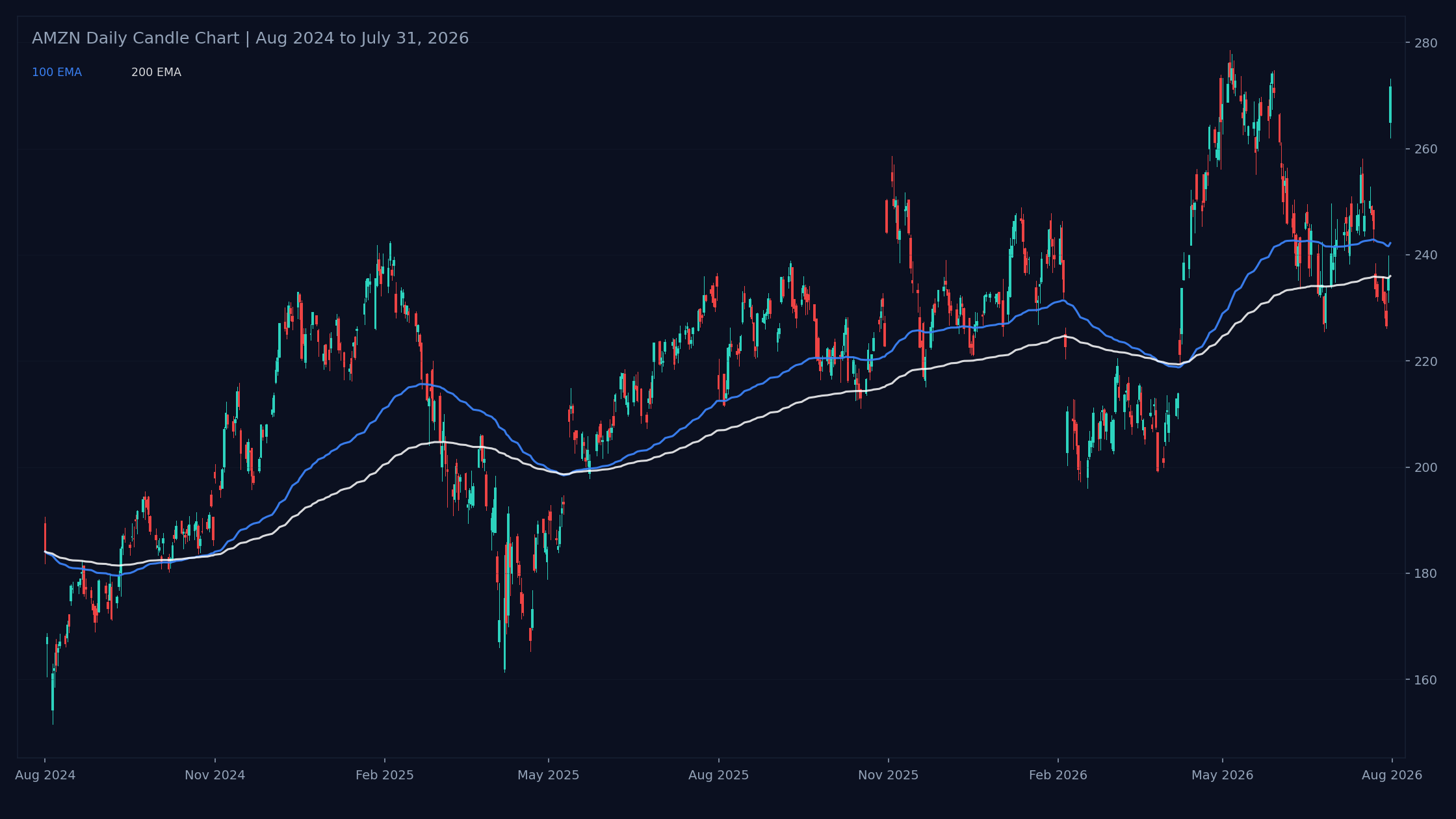
$AMZN got the biggest share. I grew the position by about half on July 29 at $230.32, one day before earnings, funded directly by the $SOFI exit. My plan was actually to buy even more on further weakness; the stock never gave me the dip, and the Q2 report took the opportunity away for good.
The quarter was the best AWS has printed in years:
- Net sales of $200.6 billion, up 20% year over year and Amazon's first $200 billion quarter
- AWS revenue of $42.2 billion, up 37% year over year, its fastest growth in 18 quarters against expectations near 31%
- CEO Andy Jassy said the AI and chips businesses each passed a $25 billion annualized run rate
The stock jumped 15.32% today on the news, which makes $AMZN my largest position at almost 19% of the account, up 26.15% on my cost. The infrastructure thesis from Why I Own $AMZN as the 2026 AI Infrastructure Stock is playing out faster than I expected, and my only regret is size.
$ORCL was the quieter add. I added nearly 60% more shares at $115.57 on July 24, which brought my average cost down from about $150 to about $137; with the stock at $129.87 the position still shows a 5.37% loss overall, even though the July add is already up 12%. Nothing has changed in the case I made in Why I Still Own $ORCL After the AI Cloud Pullback; I just finally got a real chance to fix a bad average.
$PYPL is the new name, and I'll be honest about where the idea came from. Michael Burry disclosed on his Substack in April that PayPal was about 3.5% of his portfolio at prices around $49, then added again in June near $41, writing that the stock "has to look attractive to both PE firms and strategic acquirers at this level, 7-8x earnings and buying back stock hand over fist." I did my own work, agreed with the setup, and bought on July 8 at $44.05. The position is up 29.88% since and sits right around 10% of the book.
One thing belongs on the record here: $PYPL is a trade for me, not a marriage. My target zone is $60 to $70 and I'll be selling into it, and with the stock closing at $57.21 today, that could start soon. If you're reading this after a $PYPL pop, assume I'm already reducing.
The Book After the Rotation
Here's the full portfolio by weight as of today's close, with each position's gain or loss on my cost:
- $AMZN: 18.8% of the account, up 26.15%
- Cash: 11.5%
- $ORCL: 11.4%, down 5.37%
- $PYPL: 9.6%, up 29.88%
- $MSFT: 9.3%, up 25.58%
- $UNH: 9.0%, up 56.60%
- $META: 8.3%, down 9.93%
- $BE: 7.7%, up 134.55%
- $MSTR: 5.3%, down 44.09%
- $CNSWF: 4.8%, up 21.04%
- $HOOD: 4.0%, up 13.86%
- Two residual positions, $MP and a $BABA dividend reinvestment remnant, under half a percent combined
Across everything, open positions sit 14.46% above cost, and the book gained 3.12% today, driven almost entirely by the $AMZN move.
The Losers, Honestly
$MSTR is the ugliest line in the book at 44.09% below my cost, and I'm not going to dress it up. I'm treating it as a straight value hold at around 5% of the account: not adding, not selling, and not pretending I have a cleverer plan than patience. It earns its spot over quarters, not weeks.
The $META position bothers me far less at 9.93% down. The capex reset case from Why I Own $META After the AI Capex Reset hasn't moved, and I did nothing with the position in July. $ORCL's smaller loss I covered above, and the rest of the red is residual dust.
Where I'm Wrong
There are two ways this rotation blows up on me. First, concentration: $AMZN, $ORCL, and $PYPL together are about 40% of the account, and the first two are the same AI infrastructure bet wearing different tickers. I flagged the credit-side warning signs for exactly this trade in The AI Bubble's Early Tripwires Are Already Flashing, and if AI capex cracks, an 11.5% cash buffer is my only real cushion.
Second, the rotation itself could just be early selling dressed up as discipline. Trimming has looked right on $HOOD and $BE so far, but $SOFI already trades above my exit, and if $PLTR and $SOFI re-rate higher while $PYPL stalls below my targets, this whole month cost me performance. I'd rather say that now than explain it away in a recap later.
What I'm Watching Next
Three things into August. Whether $AMZN holds its post-earnings gap, because I'm still holding cash and I still want more. Whether $PYPL presses into my $60 to $70 target zone, where the scaling out begins. And whether $BE can defend the $200 level it reclaimed on earnings, because the house-money half I still own decides how this year's best trade finishes.
Related Reading:
- Why I Own $AMZN as the 2026 AI Infrastructure Stock
- The AI Bubble's Early Tripwires Are Already Flashing
Disclosure: I currently hold positions in $AMZN, $BABA, $BE, $CNSWF, $HOOD, $META, $MP, $MSFT, $MSTR, $ORCL, $PYPL, and $UNH. I exited $PLTR and $SOFI in July as described above.
Disclaimer: Nothing on Position Note is personalized investment advice. All content represents my personal opinions and analysis based on publicly available information. I may hold positions in securities discussed, and all positions are disclosed. Trading and investing involves substantial risk of loss; do your own research before making investment decisions.
Howard is a full-time trader based in New Jersey with 13 years of experience across Forex, crypto, equities, and futures. He started Position Note to document his trades and analysis in public. All positions are disclosed. Nothing here is personalized investment advice.
Members Only: How I Am Managing the Portfolio
- The exact $PYPL exit plan, level by level, and what happens if it stalls under $60
- Where the 11.5% cash goes first if $AMZN or $ORCL pull back
- The $BE house-money math and the one thing that would make me sell the rest
- How I'm handling $MSTR at 44% down without averaging down